![Is White Dust Ruining Your Bricks? 4 Efflorescence Fixes [2026]](https://masonryrescue.com/wp-content/uploads/2026/04/Is-White-Dust-Ruining-Your-Bricks-4-Efflorescence-Fixes-2026.jpeg)
Is White Dust Ruining Your Bricks? 4 Efflorescence Fixes [2026]
The Ghost in the Wall: Understanding the White Bloom
I remember the first time I saw a high-end client lose their mind over a ‘ghost.’ It was a sprawling estate, barely three years old, but the deep red clay bricks looked like they had been spray-painted by a phantom with a taste for chalk. My mentor, a man who had more lime in his lungs than blood in his veins, didn’t even look up from his hawk. He told me to lick it. I thought he was joking. I didn’t lick it, but he did. ‘Sodium sulfate,’ he spat. ‘The builder used a concrete pump masonry mix with too much water and didn’t cover the soldier course during a rainstorm.’ He knew by the taste what I had to learn through twenty years of forensic masonry: that white dust, efflorescence, is the masonry’s way of screaming that it’s drowning from the inside out.
Efflorescence is not just an aesthetic blemish; it is a symptom of a systemic moisture failure. In my three decades of historic masonry preservation, I’ve seen homeowners waste thousands on power washing, only to have the white salt return thicker a week later. They are treating the sneeze while the building has pneumonia. To fix the dust, you have to understand the chemistry of the hydration and the physics of the ‘wick.’
The Chemistry of the ‘Bloom’: Why it Happens
At its core, efflorescence is a three-part tragedy. You need water-soluble salts, moisture to dissolve them, and a path to the surface where the water can evaporate. When water moves through a brick or a mortar joint, it picks up salts—calcium, potassium, or sodium. As that water reaches the face of the brick, it hits the air and evaporates, leaving the solid salt behind.
“Efflorescence is the migration of a salt to the surface of a porous material, where it forms a coating. The essential elements for efflorescence are soluble salts, moisture to dissolve the salts, and a force to move the solution to the surface.” – Brick Industry Association (BIA) Technical Note 23
But there is a darker cousin to this white powder: subflorescence. If you use a modern, non-breathable sealer on an old wall, the salts can’t reach the surface. Instead, they crystallize *inside* the brick pores. The pressure of these growing crystals—often exceeding 2,000 PSI—is enough to shatter the face of a 100-year-old clay unit. This is why I lose sleep when I see ‘lick-and-stick’ contractors slapping heavy sealants on historic tuckpointing projects. You aren’t protecting the wall; you’re building a pressure cooker.
Fix 1: The Surgical Clean (Not the Power Wash)
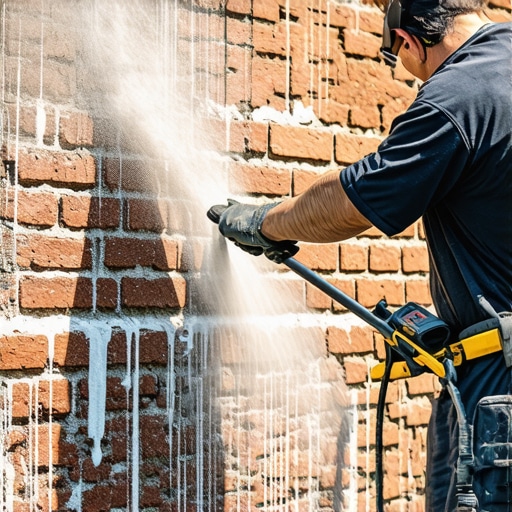
Stop reaching for the 4,000 PSI pressure washer. High pressure forces water deeper into the substrate, dissolving more salts and ensuring the ‘bloom’ returns with a vengeance. For 2026, the standard for historic masonry preservation is dry-brushing followed by a mild acetic solution or a proprietary buffered acid. You want to ‘butter’ the surface with the cleaner, let it dwell without drying, and rinse with low pressure. The goal is to lift the salt without saturating the ‘mud’ behind the brick. If the wall is truly historic, we often use deionized water to ensure we aren’t introducing new minerals into the brick’s capillary system.
Fix 2: Addressing the Entry Point (Coping and Caps)
If you have efflorescence near the top of a wall or a chimney, your problem isn’t the brick; it’s the cap. A failed chimney crown or a poorly executed stone coping installation is like leaving the lid off a jar in the rain. Water enters from the top, travels down the internal cavity, and exits through the face. We see this constantly in outdoor fireplace rebuild scenarios where the mason didn’t install a proper drip edge on the hearth or mantel. A proper chimney cap replacement with a cast-in-place concrete wash or a high-quality stainless steel shroud is often the only way to stop the salt cycle. You have to break the ‘wicking’ action at the source.
Fix 3: Repointing with Sacrificial Mortar
In the world of mortar repointing services, we have a saying: the mortar is the sacrificial lamb. In historic tuckpointing, we use high-lime mortars (Type O or Type K) because they are more permeable than the brick itself.
“Mortar should be weaker than the masonry units so that any stress-induced cracking occurs in the mortar rather than the brick, and it must be more permeable to allow moisture to escape.” – ASTM C270 Standards
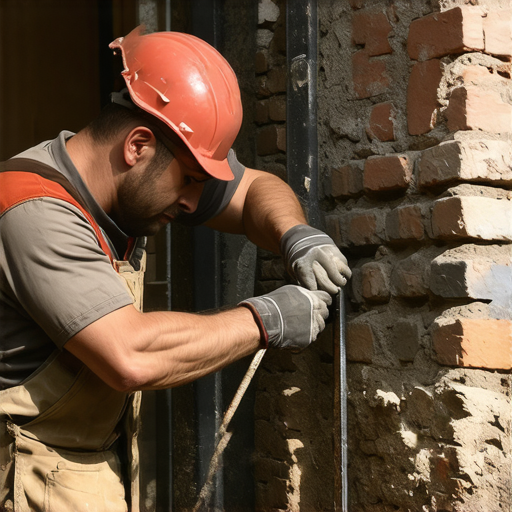
By using a softer, more porous ‘mud,’ the salts migrate to the mortar joints instead of the brick faces. It is much easier to scrape a little salt off a joint than it is to replace a spalled brick. If you’ve been told to use Type S cement on a pre-war home, fire that contractor. They are’t building a wall; they’re building a tombstone for your masonry.
Fix 4: Structural Moisture Control & Drainage
Sometimes the white dust is coming from the ground up. This is ‘wicking’ or capillary rise. If your retaining wall batter correction didn’t include a proper drainage plane, or if your foundation is sitting in a swamp, the wall will suck up moisture like a sponge. This often leads to foundation crack repair needs as the salt cycle weakens the structural integrity of the base courses. We’ve seen mortarless masonry systems fail here too, as they lack the internal moisture barriers needed to prevent hydrostatic pressure from pushing salt through the gaps. In these forensic scenes, the fix involves excavating behind the wall, installing a proper French drain, and ensuring the backfill is clean, non-expansive gravel, not native ‘gumbo’ clay.
Conclusion: The Mason’s Verdict
Efflorescence is a warning. Whether it’s a salt-stained chimney or a ‘wavy’ retaining wall, the white dust is telling you that water is winning. Don’t just wash it. Check your stone coping installation, ensure your mortar repointing services are using lime-rich mixes, and never, ever trust a ‘slicker’ who says a coat of waterproof paint will fix a damp basement. Masonry needs to breathe. If you choke it, it will crumble. Do it once, do it right, and let the stone speak for itself.