Is Your Stone Wall Sagging? 3 Structural Repair Fixes for 2026
The Deceptive Silence of a Sagging Wall
When you walk past a stone retaining wall or a brick facade that has developed a slight belly or a gentle lean, your brain might tell you it is just ‘character.’ In my forty years of dragging a trowel through wet mud, I have learned that ‘character’ is often just a slow-motion disaster waiting for a rainy Tuesday to introduce itself to the sidewalk. A sagging wall is not just an aesthetic hiccup; it is a mathematical failure of gravity, friction, and moisture management. By the time you notice a visible bow, the internal physics of the structure have already surrendered. If you are looking at a cracked brick wall repair or a bulging foundation in 2026, the solutions are no longer about just slapping some mortar into the gaps and hoping for the best. We have moved into an era where forensic masonry meets advanced geophysics.
The Forensic Scene: More Than a Hairline
I remember a call last November. The homeowner thought it was just a hairline crack running through the mortar joints of a hundred-year-old brownstone. They wanted a quick tuckpointing job to satisfy a home inspector. But when I put my borescope inside that crack, I did not see solid masonry. I saw a void where the structural steel lintel had rusted to a red, flaky dust. The rust had expanded, exerting thousands of pounds of pressure, literally blowing the faces off the surrounding stones. What looked like a twenty-minute fix was actually a total structural compromise. This is why we do not just ‘fix’ cracks; we interrogate them. We look for the ‘why’ behind the ‘what.’
1. The Physics of Soil and the Helical Pier Revolution
The primary reason stone walls begin to sag is rarely the stone itself; it is the ground it sits on. In the North, we deal with the brutal reality of the freeze-thaw cycle. When water gets into the soil behind a wall, it expands by approximately 9% upon freezing. This exerts lateral earth pressure that can exceed the tensile strength of even the thickest masonry. Over decades, this ‘pump’ pushes the wall out, millimeter by millimeter. By 2026, the gold standard for emergency masonry repair involves helical piers. Instead of digging a massive, destructive trench, we use high-torque hydraulic motors to screw galvanized steel piles deep into the load-bearing strata of the earth. We then tie these piers to the wall’s footing using heavy-duty brackets. This is not a ‘Band-Aid’; it is an engineered transfer of weight that bypasses the failing soil altogether. We are essentially giving the wall a new pair of legs that reach down to solid ground.
“Water penetration is the single greatest threat to masonry durability. Proper drainage and moisture control are the foundations of any successful repair strategy.” – BIA Technical Note 7
2. Structural Re-pointing with Sustainable Masonry Materials
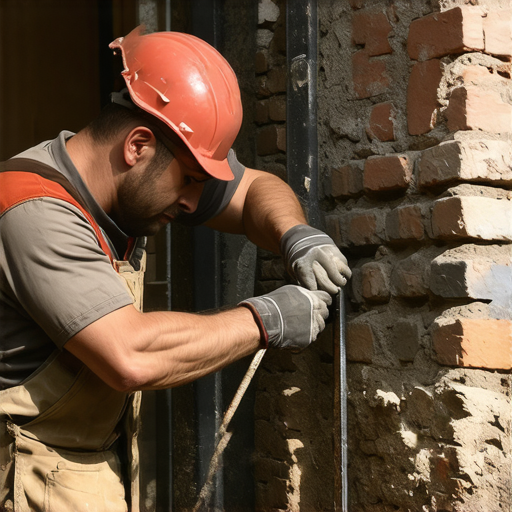
If the sagging is caused by the degradation of the mortar joints rather than the foundation, we look at re-pointing services. But here is the rub: if you use a modern Type S Portland cement on a historic wall, you are signing its death warrant. Old bricks and stones are often ‘softer’ than modern materials. They need to breathe. In the 2026 landscape, we are seeing a massive shift back to historic brick salvage and natural hydraulic lime (NHL) mortars. These sustainable masonry materials are ‘sacrificial.’ They allow moisture to migrate through the mortar rather than trapping it inside the brick. When you ‘butter’ a joint with NHL, you are ensuring that if something is going to crack or erode over the next fifty years, it will be the easily replaceable mortar, not the irreplaceable historic stone. Using a hawk and a slicker to hand-pack these joints is a slow, tactile process, but it ensures the ‘tooth’ of the new mud grips the old masonry perfectly. DIY enthusiasts often buy cheap tuckpointing tools for DIY projects, but without understanding the hydration curve of lime, they often end up with joints that ‘flash set’ and crumble within a year.
3. The Hydrostatic Relief: Weeping and Flashing
Sometimes the fix is not about adding more stone; it is about letting the wall breathe. A sagging wall is often a ‘drowned’ wall. Hydrostatic pressure—the weight of standing water—is a silent killer. In 2026, we are integrating advanced drainage composites behind the masonry. This involves installing weep holes at the base of the wall and ensuring that chimney flashing repair is handled with the same level of scrutiny. If water is entering from the top of a chimney or a parapet, it travels down the interior of the wall, dissolving the lime and causing the ‘honeycombing’ effect that leads to structural collapse. We use high-grade lead or copper flashing to divert water away from the masonry core.
“The durability of a masonry wall is inversely proportional to the amount of water it retains.” – ASTM C270 Standards
Whether you are looking for chimney repair services or a full-scale wall stabilization, the goal is always the same: keep the water moving out, and keep the gravity moving down. If your wall is sagging, do not wait for it to talk to you. Because when a stone wall finally speaks, it does so with a roar, not a whisper.
![Emergency Masonry Repair: 3 Signs Your Wall Might Collapse [2026]](https://masonryrescue.com/wp-content/uploads/2026/03/Emergency-Masonry-Repair-3-Signs-Your-Wall-Might-Collapse-2026.jpeg)

![Stop Retaining Wall Leans with 3 Pro Reinforcement Fixes [2026]](https://masonryrescue.com/wp-content/uploads/2026/03/Stop-Retaining-Wall-Leans-with-3-Pro-Reinforcement-Fixes-2026.jpeg)