
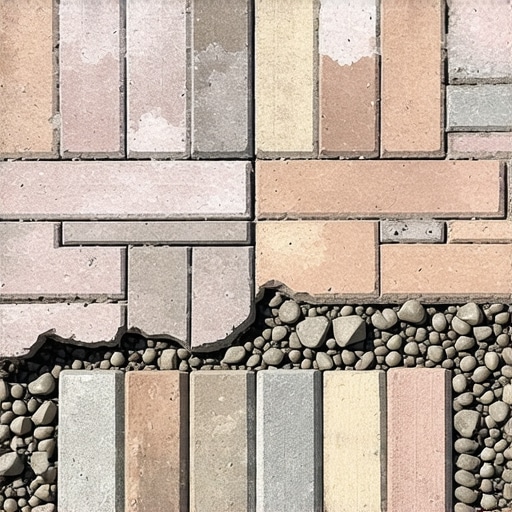
The Anatomy of a Rolling Driveway
I stood looking at a $50,000 retaining wall that lay in a pile of rubble because the contractor forgot one thing: drainage. But it wasn’t just the wall; the entire driveway behind it had buckled and shifted like a tectonic plate during a bad afternoon in San Francisco. The homeowner looked at me, desperate, asking why their expensive pavers were now a series of miniature mountain ranges. I didn’t need a level to see the problem. I could smell the anaerobic rot of trapped water and the sour scent of oversaturated limestone screenings. This wasn’t a product failure; it was a physics failure.
When you see your driveway pavers shifting, sinking, or ‘weaving,’ you aren’t looking at a material problem. You are looking at a fundamental breakdown of the sub-grade. As a third-generation mason, I’ve seen men try to fix this by throwing more ‘mud’ at it or trying to butter the edges with concrete. It never works. If the base isn’t right, the pavers are just expensive decorations sitting on a liquid foundation.
The Physics of the Base: Beyond the Surface
Most ‘lick-and-stick’ contractors will tell you a few inches of sand is enough. That’s a lie that leads to failing retaining wall repair and driveway heaving. In the forensic world, we look at the modulus of subgrade reaction. In regions with heavy freeze-thaw cycles, water is the ultimate predator. When water penetrates the joints of your pavers, it doesn’t just sit there. It migrates into the bedding sand and the aggregate base below. If that base isn’t properly compacted to a 98% Proctor density, you’ve essentially created a subterranean swimming pool.
“Water penetration is the single greatest threat to masonry durability, whether it is a vertical wall or a horizontal pavement system.” – BIA Technical Note 7
The Micro-Zoom: Let’s talk about the 9% expansion. When water freezes, it expands by nearly a tenth of its volume. In a tightly packed, non-draining base, this expansion exerts thousands of pounds of upward pressure. This is ‘frost heave.’ If your base is made of ‘dirty’ stone (stone with too many fines), those fines hold the water like a sponge. When it freezes, the ice lenses push the pavers upward. When it thaws, the soil loses its bearing capacity, and the pavers sink into the resulting muck. This is why commercial masonry maintenance programs emphasize joint integrity before the first frost hits.
Tuckpointing the Horizontal: Joint Stability
We often talk about tuckpointing brick walls or structural repointing when we discuss vertical masonry, but pavers require a similar logic. The sand between your pavers is the ‘mortar joint’ of your driveway. It provides the frictional interlock that prevents lateral movement. If you lose that sand—through power washing, wind, or poor installation—the pavers lose their ‘tooth.’ Once the interlock is gone, every time you turn your tires, you are applying shear force that shoves the pavers out of alignment.
Modern digital twin masonry projects have shown that without proper edge restraint, the entire system ‘creeps.’ A soldier course at the edge of your driveway isn’t just for looks; it’s a structural dam. If that dam isn’t set in a deep concrete haunch or pinned with heavy-duty spikes, the pressure of a 5,000-pound SUV will push the pavers sideways into the lawn. This is where masonry repair services usually start—re-establishing the perimeter before we even touch the middle.
The Geotechnical Reality of Soil and Drainage
If you live in an area with heavy clay, your driveway is sitting on a giant, slow-moving sponge. Clay expands when wet and shrinks when dry. This cyclic movement causes foundation wall bowing repair issues in basements, and it does the same to your driveway. To fight this, we use a ‘sacrificial’ base layer of open-graded aggregate. We want the water to move through the base, not sit in it. This is the same principle behind sustainable block cutting and permeable pavement systems.
“The stability of any masonry assembly is contingent upon the management of moisture and the distribution of loads to a stable substrate.” – ASTM C936 Standards
When I see honeycombing in a concrete base or a cold joint where a contractor stopped and started their pour, I know a crack is coming. The same applies to pavers. If the contractor didn’t use a vibratory plate compactor to ‘knit’ the pavers into the bedding sand, the system is unfinished. You’ll see the pavers ‘rocking’ under foot—this is the sound of a failing system.
The Fix: Do It Once, or Do It Twice
Repairing a shifting driveway isn’t about pulling up one or two bricks. It’s about forensic excavation. We often have to go down 12 to 18 inches to remove the ‘plastic’ soils and replace them with engineered fill. We look at brickwork pointing styles to match the aesthetic, but the real work is underground. If you’re seeing tuckpointing failures on your steps or failing retaining wall repair needs nearby, it’s a sign that the entire site’s drainage is compromised.
Avoid the ‘asphalt gypsies’ who offer a cheap fix with leftover material. They won’t mention the soil mechanics or the digital twin masonry projects that prove their methods fail within two winters. They’ll slap some mud in the cracks and disappear. A real master mason knows that masonry is a dance between rigid materials and a moving earth. We build to accommodate that movement, not to ignore it. Whether it’s tuckpointing brick walls to keep water out or rebuilding a driveway base to let water through, the goal is the same: permanence. Don’t settle for a driveway that moves. Demand a base that stands still.