
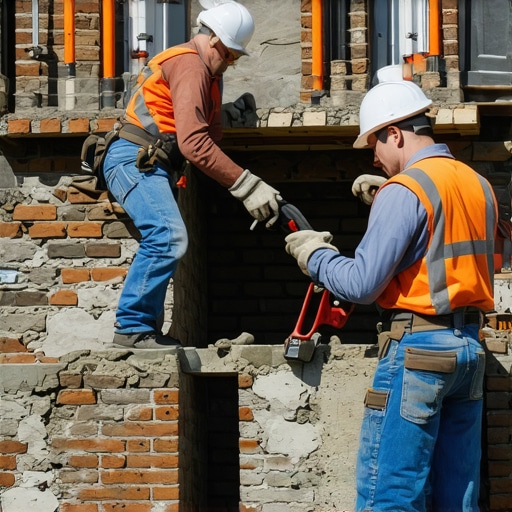
The Forensic Scene: When Iron Turns to Dust
The homeowner in Boston thought it was just a hairline crack, a minor blemish on a stately Georgian facade. But when I put my scope inside the cavity through a weep hole, I didn’t see the expected glimmer of galvanized steel. I saw the structural steel was rusted to dust. The ties—those critical umbilical cords that bind a brick veneer to the structural frame—had surrendered to the relentless ingress of salt-laden moisture. This wasn’t just a cosmetic issue; this was a looming collapse. Brick veneer detachment repair isn’t about slapping on more mud; it is about understanding the chemical betrayal happening behind the red clay.
When you spend forty years looking at failing walls, you realize that the most dangerous problems are the ones you can’t see without a boreoscope. In the Northern freeze-thaw belts, water is a predator. It sneaks behind the brick, sits against a cheap, non-galvanized tie, and begins the process of ‘rust jacking.’ As that iron oxidizes, it expands up to seven times its original volume. It doesn’t just disappear; it grows, pushing the bricks outward, creating a bulge that a layperson might miss until the wall is lying on the sidewalk. This is the reality of commercial masonry facade maintenance in an era of aging infrastructure.
“Water penetration is the single greatest threat to masonry durability. Without proper moisture control, structural metal components are subject to rapid oxidation.” – BIA Technical Note 7
The Physics of the Cavity: Why Ties Fail
In commercial masonry maintenance, we talk about the ‘cavity’ as a living thing. It needs to breathe. But when a wall was built fifty years ago with substandard ties, that breath becomes a death rattle. In cold climates, the 9% expansion of freezing water is compounded by the chemical reaction of the mortar. If a previous ‘handyman’ used a high-Portland cement mix on an old wall, he trapped the moisture. The hard mortar won’t let the wall weep, forcing the water back toward the steel ties. We see this often in concrete masonry unit restoration where the CMU backup wall and the brick veneer have different thermal expansion coefficients. Without flexible, resilient ties, something has to give.
Tactic 1: The Helical Stabilizer (The Surgical Strike)
The first tactic for brick veneer detachment repair is the installation of stainless steel helical ties. This is a dry-fix or resin-fix method that doesn’t require tearing down the entire wall. We drill a pilot hole through the veneer and into the backup material—whether that’s block, concrete, or timber. The helical tie is then driven in. The ‘tooth’ of the helix bites into the masonry, creating a mechanical connection that resists both tension and compression. This is the go-to for masonry repair services looking to save a historic facade without a total rebuild. You aren’t just ‘buttering’ a joint; you are re-engineering the structural integrity of the building. The beauty of the helical tie is its slim profile; once the hole is patched with a matching high-performance mortar mix, the repair is invisible to the naked eye.
Tactic 2: Mechanical Expansion Anchors and CMU Integration
When dealing with concrete masonry unit restoration, especially in commercial settings where the backup wall is heavy-duty CMU, we often turn to mechanical expansion anchors. These are utilized when the backup wall is too porous or degraded for a simple helical bite. We cut out a soldier course or a few stretchers to gain access, install a heavy-duty stainless steel anchor into the block, and then tie it back to the veneer. This is where sustainable block cutting comes into play—precision is key. You don’t want to create a cold joint or cause honeycombing in the backup grout. The anchor must be set to a specific torque to ensure it doesn’t crush the internal webbing of the CMU while still providing enough pull-out resistance to withstand 100-mph wind loads.
“The selection of anchors for masonry must account for the physical properties of both the veneer and the substrate to ensure compatible movement.” – ASTM C1242 Standard
Tactic 3: The Reconstruction of the Brick Arch and Tie Replacement
Sometimes the corrosion is so localized that it causes a specific structural failure, like a sagging lintel or a failing arch. Brick arch restoration is an art form. You can’t just shove some mud in the cracks. You have to shore up the opening, remove the failing units, and replace the ties in that specific zone. This often involves brickwork pointing styles that match the original weathered joints. If it’s an old building, we use self-healing concrete foundations logic by ensuring the mortar is ‘sacrificial’—softer than the brick. A Type O or Type K mortar is often used in these delicate surgeries to allow for moisture migration without popping the faces off the brick.
The Grit of the Trade: Mortar, Mud, and Maintenance
I’ve seen too many ‘pros’ try to fix a detached veneer by just squirt-gunning some epoxy into a crack. That is a ‘handyman special’ that leads to lawsuits. Real commercial masonry maintenance requires a forensic mind. You have to understand that the wall is moving. It’s expanding in the summer heat and shrinking in the winter chill. If your ties are rusted, they are no longer sliding in their tracks; they are locked, and that’s when the bricks start to crack. When we do a brickwork pointing styles overhaul, we aren’t just making it look pretty with a slicker or a hawk. We are checking the ‘suction’ of the brick. If the brick is too dry, it sucks the water out of the mortar too fast—we call that ‘burning’ the mud. It leaves the mortar brittle, and the new ties won’t have the lateral support they need. We wet the bricks, we mix the high-performance mortar mixes to a creamy consistency, and we ‘butter’ the units with the respect a 100-year-old wall deserves. This is how you preserve a legacy instead of just piling up rubble.