
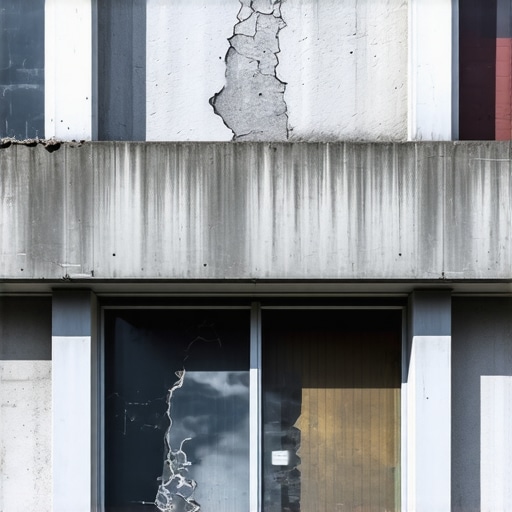
The Forensic Scene: Beyond the Hairline Crack
The building owner told me it was just a few flakes of red clay on the sidewalk. He called it ‘cosmetic weathering.’ But when I stood on that swing stage ten stories up and shoved my fiber-optic scope into a weeping head joint, the reality was a nightmare of iron and ice. I didn’t just see a crack; I saw a structural steel lintel that had rusted to a jagged, swollen husk. It was a classic case of oxide jacking. When steel oxidizes, it can expand to ten times its original thickness, exerting upward of 5,000 PSI of pressure against the masonry. That brick didn’t just fall; it was launched by the slow-motion explosion of its own internal skeleton.
As a third-generation mason, I’ve seen this play out in every major city where the freeze-thaw cycle rules the calendar. We are currently facing a crisis of commercial facade failure, driven by decades of deferred maintenance and the misunderstanding of how old-world materials interact with new-world chemistry. If you see your brick faces popping off—a process we call spalling—you aren’t looking at a surface issue. You are looking at the death gasps of an exterior wall system that has lost its fight against hydrostatic pressure and thermal movement.
The Physics of the Pop: Why Bricks Shed Their Skin
Masonry is not a solid, static object; it is a breathing, porous lung. Every brick has a specific rate of absorption, and every joint has a specific ‘tooth’ that holds the assembly together. In northern climates, the enemy is the 9% expansion of water as it transitions from liquid to solid. When moisture penetrates the brick through hairline fractures or failed tuckpointing, it settles into the pore structure. As the temperature drops, that water crystalizes, creating internal stresses that exceed the tensile strength of the clay. The result? The face of the brick—the hardest, most fire-hardened part—simply pops off, leaving the soft, ‘shuff’ interior exposed to the elements.
“Water penetration is the single greatest threat to masonry durability. Moisture can enter through a variety of sources, including rain, snow, and internal condensation, leading to serious structural issues if not managed.” – BIA Technical Note 7
On commercial structures, this is exacerbated by ‘lick-and-stick’ repairs where a previous handyman might have buttered over a crack with a hard, Type S Portland cement. This is a death sentence for historic brick. In historic mortar analysis, we often find that the original builders used soft lime-based mortars. If you put a modern, high-strength mortar into an old wall, the mortar becomes harder than the brick. The wall can no longer flex. Instead of the mortar being the ‘sacrificial’ element that cracks to save the brick, the brick itself is crushed by the thermal expansion of the cement. This is why historic brick salvage is so difficult; once you’ve used the wrong mud, you’ve essentially turned the entire facade into a ticking time bomb of brittle failure.
The Restoration Reality: Fixing the Skeleton
When we approach a brick infill panel repair, we aren’t just slapping on new clay. We are reconstructing a moisture management system. This often requires cracked brick wall repair that goes deep into the substrate. On high-rise commercial buildings, we are now utilizing robotic masonry repair systems for precision cutting and depth control that a human with a handheld grinder simply cannot match. These robots allow us to reach areas where traditional scaffolding might be cost-prohibitive, ensuring that tuckpointing weatherproofing is applied with sub-millimeter accuracy.
A critical component often overlooked is the brick arch restoration. In older commercial buildings, the arches over windows and doors are structural, not decorative. They rely on the ‘ring’ of the brick—if you tap a brick with your trowel and it gives a dull thud instead of a metallic ring, that unit is dead. It has lost its structural integrity. We have to meticulously replace these units, often shoring up thousands of pounds of masonry while we reset the keystone. This isn’t a job for a guy with a bucket of premix from a big-box store; this is forensic engineering with a slicker and a hawk.
Thermal Dynamics and Internal Failures
Commercial facades also fail from the inside out. We frequently see issues related to heating systems in older industrial conversions. Without a proper chimney heat shield installation, the intense thermal cycles from modern high-efficiency boilers can desiccate the mortar in old flues, leading to a collapse of the inner withe. This heat transfers to the exterior facade, creating a localized thermal bridge that causes the brick to expand at a different rate than the rest of the wall, leading to vertical ‘shearing’ cracks.
“The masonry units and mortar should be selected to ensure that the mortar is weaker than the masonry units, thereby ensuring that any cracks will occur in the mortar joints rather than in the units themselves.” – ASTM C270 Standard Specification for Mortar for Unit Masonry
The same logic applies to the grounds of the property. I’ve seen modular retaining walls and retaining wall block replacement projects fail because the contractor didn’t account for the surcharge load of the commercial parking lot above it. You can’t just stack blocks; you have to manage the ‘toe’ of the wall and the drainage behind it. If the weep holes are clogged, the wall is essentially a dam holding back tons of liquified soil. Eventually, the physics of gravity wins, and the wall ‘blows out’ at the base.
The Process: How We Save a Failing Facade
Saving a spalling facade requires a disciplined, multi-stage process. First, we conduct a historic mortar analysis to determine the exact calcium-to-sand ratio used in the original construction. We then match the aggregate size—the ‘grit’—to ensure the new tuckpointing weatherproofing blends seamlessly and breathes correctly. We use a hawk and a slicker to push the ‘mud’ deep into the joint, ensuring there are no air pockets where water can hide. If the damage is structural, we may implement robotic masonry repair to install stainless steel helical ties that pin the facade back to the structural frame of the building.
For the horizontal surfaces, we look at retaining wall block replacement or stabilization. If the wall is leaning, we don’t just push it back; we excavate, improve the drainage with 57-stone, and ensure the hydrostatic pressure has an escape route. It’s about managing the environment as much as it is about the material. In the South, we’d be worried about the sun ‘burning’ the mortar before it cures; here in the North, we are racing against the first frost, ensuring our lime putty has enough time to carbonize and gain its strength before the moisture inside it turns to ice.
Conclusion: The Cost of Waiting
A spalling brick is a warning shot. It’s the building’s way of telling you that the internal systems are failing. If you ignore the flakes on the sidewalk today, you’ll be dealing with a cracked brick wall repair that involves structural steel replacement and potential liability issues tomorrow. Whether it’s brick arch restoration or a simple chimney heat shield installation, the goal is the same: longevity through material compatibility. Don’t let a ‘handyman’ with a bag of Portland cement destroy a century of craftsmanship. Respect the stone, respect the suction, and for heaven’s sake, respect the physics of water.