
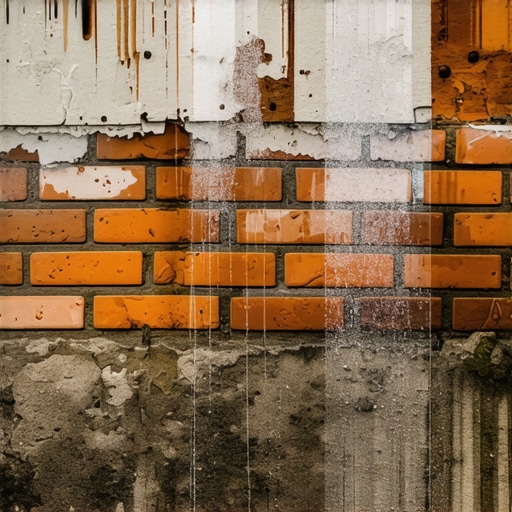
The Forensic Scene: When a Hairline Crack Becomes a Structural Grave
The homeowner stood on their porch, pointing at a thin, vertical fissure running through the fifth soldier course above the garage. They thought it was a ‘settlement crack,’ a phrase people use when they want to sleep better at night. But when I pulled my borescope out and fed the fiber-optic lens into a weep hole, the reality was grim. Behind that ‘hairline’ crack, the structural steel lintel was gone. Not just rusted—it had oxidized to the point of expansion, blowing out the surrounding masonry like a slow-motion explosion. The steel was rusted to dust because the wall had been ‘drinking’ rain for twenty years with no way to sweat it out. This isn’t just a cosmetic issue; it is a chemistry problem. Masonry is a breathing, porous skin, and when you choke it with the wrong materials or ignore the signs of saturation, the building starts to eat itself from the inside out.
“Water penetration is the single greatest threat to masonry durability.” – BIA Technical Note 7
The Physics of the ‘Thirsty’ Brick: Capillary Suction and Pore Pressure
Every brick is a sponge. If you take a dry, extruded clay brick and place it in a shallow tray of water, you can watch the moisture climb. This is capillary suction, driven by the microscopic pore structure created during the firing process. In a freeze-thaw environment, this becomes a ticking bomb. When rain hits a wall, it doesn’t just run off; it enters the brick. If the temperature drops, that water undergoes a phase change, expanding by roughly 9%. In a dense, modern brick, that pressure has nowhere to go. It builds until the face of the brick literally pops off—a process we call spalling. To prevent this, structural repointing must be done with a mortar that is vapor-permeable. You want the mortar to be the ‘wick’ that draws the water out, allowing it to evaporate on the surface rather than freezing inside the unit. If a previous ‘handyman’ used high-strength Portland cement on an old wall, they’ve essentially plugged the exhaust pipe of the building.
Chimney Leak Detection: The Entry Point of Destruction
Water doesn’t always come through the face of the wall; often, it’s invited in from the top. Chimney leak detection is where we find the most egregious failures of masonry logic. The chimney is the most exposed part of any structure, taking a beating from 360 degrees. Most ‘leaks’ aren’t actually the bricks leaking; it’s a failed chimney crown repair job. The crown is the concrete slab that sits on top of the chimney. If it’s cast with a ‘cold joint’ or without a proper overhang, water runs down the face of the masonry, saturating it. When the crown cracks, water enters the internal flue space, rusting the damper and rotting the mortar joints from the inside. We use a slicker to finish joints, but no amount of slicking can save a chimney where the crown has turned into a funnel.
The Science of Structural Repointing and Stone Facade Restoration
When we talk about stone facade restoration, we are dealing with varying densities. Natural stone and mortar must exist in a sacrificial relationship. The mortar must be softer than the stone. If I’m working on a historic limestone building, I’m mixing ‘mud’ with lime putty and sand, avoiding Portland cement entirely. The goal of structural repointing is to restore the integrity of the masonry bond while ensuring the wall can still ‘breathe.’ We grind out the old, failing joints to a depth of at least twice the width of the joint to ensure a proper ‘tooth’ for the new mortar. If you just ‘butter’ the surface, the new material will peel off within two seasons, leaving the wall even more vulnerable to water ingress.
“The water vapor transmission of a masonry assembly is critical to prevent interstitial condensation and subsequent material degradation.” – ASTM C90 Standard Commentary
Foundation Wall Bowing Repair and Hydrostatic Pressure
If your basement walls look like they are holding their breath, you’re looking at foundation wall bowing repair in your near future. This is caused by hydrostatic pressure—the weight of water-saturated soil pushing against the masonry. When the soil around your home doesn’t drain, it becomes a heavy, liquid mass. This pressure can exceed the shear strength of the mortar, causing horizontal cracks and the ‘bow’ effect. The fix isn’t just slapping some advanced masonry adhesives on the crack. You have to address the water. Often, this requires retaining wall block replacement in the yard to redirect surface runoff or excavating to install a proper drainage plane. Without a way for that water to move away, the wall will eventually collapse, no matter how many ‘helical piers’ you try to throw at it.
Precision Cuts and Modern Aesthetics: Birdsmouth and Metallic Finishes
Even in modern construction, we see failures in the details. Masonry birdsmouth cuts—those intricate notches used to fit bricks around structural members—are often done poorly, creating pockets where water can pool. A true master uses a wet saw to ensure the cut is clean, leaving no room for water to sit and fester. On the aesthetic side, metallic brick colors application has become popular. These bricks often have a glazed or metallic coating that acts as a vapor barrier. While they look sharp, they require a very different approach to moisture management. You cannot rely on the brick to breathe, so the concrete flatwork services around the base and the flashing systems behind the wall must be perfect. If you trap moisture behind a metallic-glazed brick, the ‘vapor drive’ will push that moisture inward toward your drywall, leading to mold and rot that you won’t see until it’s too late.
The Hard Truth About Longevity
The masonry industry is currently flooded with ‘quick fixes.’ People think advanced masonry adhesives can replace a properly struck joint, or that a coat of ‘sealer’ will stop a chimney from leaking. In reality, sealers often trap moisture inside, accelerating the decay. Whether it is concrete flatwork services for a new patio or a complex stone facade restoration, the physics remains the same: Water is the enemy, and your only defense is a combination of gravity, drainage, and material compatibility. You can do it right the first time, or you can pay me to come out with a borescope in five years to tell you why your ‘lick-and-stick’ stone is falling off the side of your house. There are no shortcuts in the world of mud and stone. You either respect the suction, or the suction destroys you.