
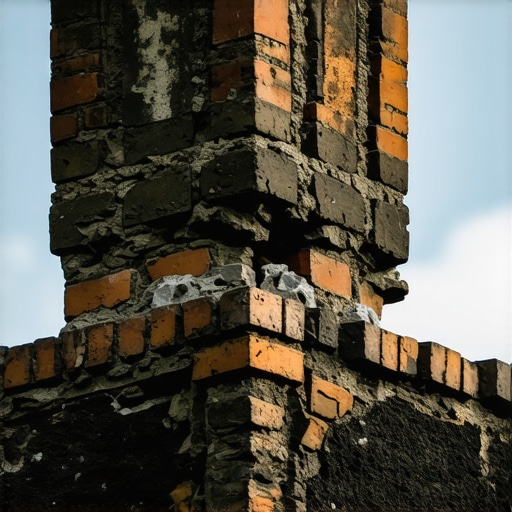
The Forensic Scene: When a Hairline Crack Becomes a Structural Disaster
The homeowner stood in the driveway, looking up at the stack, and told me it was just a little bit of sand in the gutters. They thought it was a minor annoyance, perhaps a quick afternoon fix with a tube of caulk. But as I hauled my ladder to the roof and deployed the fiber-optic scope into the voids, the reality was far more grim. I saw the structural steel of the internal supports rusted to a fine, orange dust. The interior wythe of the chimney was no longer a cohesive unit; it was a stack of loose blocks held together by gravity and a prayer. This wasn’t just ‘losing mortar.’ This was a slow-motion collapse of a historic structure. This is where emergency masonry repair transitions from a maintenance task to a forensic rescue operation.
The Chemistry of the ‘Sacrificial Joint’
To understand why your chimney is shedding its ‘mud,’ we have to look at the molecular lattice of the mortar itself. In professional historic tuckpointing, we respect the principle of the sacrificial joint. For over a century, masonry was built to breathe. The mortar was designed to be softer and more permeable than the brick. Why? Because water is an inevitable invader. When moisture enters a wall, it needs an exit strategy. A lime-based mortar joint acts as a wick, drawing the water out through its pores. If that mortar is functioning correctly, the salts and minerals (efflorescence) deposit on the mortar face, not inside the brick. When you lose that mortar, the chimney is literally shedding its skin to save its bones. However, modern ‘handyman’ interventions often involve applying a hard, Portland-cement-based mix over these soft joints. This is a death sentence. The hard mortar traps the water, and during the next freeze-thaw cycle, the pressure has nowhere to go but through the face of the brick, causing catastrophic spalling.
“Water penetration is the single greatest threat to masonry durability. The selection of mortar must be based on its compatibility with the masonry unit, ensuring that the mortar remains the most vapor-permeable element of the assembly.” – BIA Technical Note 7
The Physics of Thermal Expansion and Flue Dynamics
Your chimney is a thermal engine. Every time you light a fire, the internal temperature spikes, causing the chimney flue liner to expand. If that expansion isn’t managed by proper chimney flue liner installation, the internal pressure pushes outward against the masonry casing. Over decades, this constant ‘pulse’ of heat and cold creates micro-fractures in the mortar. If the mortar has lost its elasticity—its ‘tooth’—it simply crumbles. We see this often in chimney structural repair cases where the original lime has fully carbonated and become brittle. The chemistry is fascinating: lime mortar (calcium hydroxide) absorbs carbon dioxide from the air over a hundred years to become calcium carbonate (limestone). If this process happens too fast, or if the mix was ‘lean’ on lime, the bond fails. The mortar turns back into the sand it came from, leaving the bricks sitting ‘dry.’
[IMAGE_PLACEHOLDER]
The Seduction of ‘Lick-and-Stick’ and Modern Failures
I have a particular disdain for the modern trend of applying stone veneer over brick as a quick cosmetic fix for a failing chimney. It’s like putting a bandage over a gangrenous wound. When you slap a non-breathable synthetic stone over a chimney that is already losing its mortar, you create a moisture trap. The original brick continues to decay behind the veneer, and because you can’t see the historic pointing styles failing, the first sign of trouble is when the entire facade peels off in one piece. We often get called for masonry rescue after disaster specifically because a veneer failed to account for the hydrostatic pressure building up behind it. Proper professional masonry restoration requires stripping back the failures, not hiding them.
Identifying the Culprit: Erosion vs. Mechanical Failure
Is your mortar falling out because of the weather, or because the house is moving? This is the core of forensic masonry. If the mortar loss is uniform across the stack, it’s likely environmental erosion. We use flush pointing services to restore the profile and protect the edges of the brick. But if the loss is concentrated in ‘stair-step’ patterns, you aren’t looking at a mortar problem; you’re looking at a foundation underpinning problem. The chimney is heavy—tens of thousands of pounds concentrated on a small footprint. If the soil heaves or settles, the mortar, being the weakest point, breaks first. This is the ‘failing fuse’ of the building. We don’t just ‘butter’ these cracks and walk away; we have to stabilize the earth beneath before we can restore the historic tuckpointing above.
“The mortar should never be stronger than the bricks it joins; for if the wall should settle, it is better that the joints should crack than the stones.” – Vitruvius, De Architectura
The Restoration Process: Mixing the ‘Mud’ with Precision
When we perform historic pointing styles, the mix is everything. We don’t use ‘bagged’ mortar from the big-box store. We analyze the original aggregate. Was it river sand? Was it crushed limestone? We match the ‘tooth’ of the aggregate to ensure the new mortar bonds mechanically to the old. We ‘hawk’ the mud onto the slicker and pack it tight. This isn’t just about appearance; it’s about compaction. We have to eliminate ‘honeycombing’—those tiny air pockets inside the joint that allow water to pool. If a joint is ‘slicked’ too early, the water is trapped inside; if too late, it won’t bond. It’s a game of hours and humidity. This is the difference between a ‘handyman special’ and a master’s touch.
Conclusion: The Cost of Neglect
A chimney losing its mortar is a warning light on the dashboard of your home. You can ignore it until the soldier course at the top begins to tilt, or you can intervene with professional masonry restoration now. When the mortar is gone, the brick is exposed on five sides instead of one. The decay accelerates exponentially. Whether it’s a simple repointing job or a full-scale masonry rescue after disaster, the physics remains the same: you must respect the materials, or the materials will fail you. Do not settle for a ‘cold joint’ fix. Demand a forensic approach that understands the chemistry of the lime, the physics of the heat, and the history of the craft.