
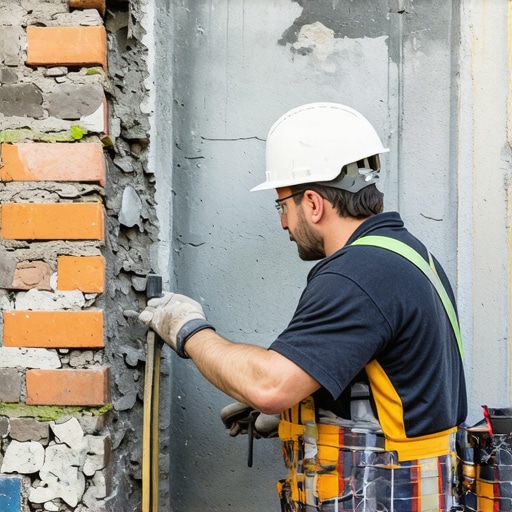
The Anatomy of a Fractured Wall
Most folks see a stair-step crack in a modular block wall and think they can solve it with a $10 tube of caulk from the big-box store. That is the kind of thinking that keeps my phone ringing and keeps the wrecking balls swinging. I have spent thirty-five years crawling through damp crawlspaces and standing on scaffolding, and if there is one thing I have learned, it is that a crack is never just a crack; it is a confession. The wall is telling you exactly how it is being tortured. When we talk about modular masonry units—those standardized blocks and bricks that make up the backbone of modern construction—we are talking about a system that relies on precision and chemistry. When that system fails, it is usually because someone forgot that physics does not take a day off. I remember a forensic call-out to a newly built industrial warehouse. The owner was frantic because a vertical fracture had zipped through fifteen courses of modular block in under a month. He called it ‘settling.’ I put my bore-scope into the core of that wall and saw the truth: a cold joint in the grout pour and rebar that was already blossoming with expansive rust because the drainage was non-existent. The wall was not settling; it was being pushed to its death by hydrostatic pressure.
The Physics of Suction and Hydration
To understand how to repair these units, you have to understand why they fail. Modular units, especially those high-density concrete blocks, have a specific ‘suction’ rate. When you butter a block with mud, the unit starts drinking the water out of the mortar immediately. If the unit is too thirsty, it steals the water needed for the chemical hydration of the Portland cement. You end up with a ‘flash set’ where the mortar looks hard but has the structural integrity of a dried mud pie. This is where high-performance mortar mixes come into play. We are not just mixing sand and cement; we are balancing the water-retention additives to ensure the bond reaches deep into the ‘tooth’ of the masonry.
“The selection of mortar should be based on the properties of the masonry units to be used, ensuring the bond strength exceeds the tensile stresses applied to the wall.” – ASTM C270 Standard Specification for Mortar for Unit Masonry
In the North, we fight the freeze-thaw cycle every single day. Water is a relentless enemy. It finds its way into the microscopic pores of a modular unit, and when the temperature drops, that water expands by 9%. If you have used a repair mortar that is too hard—something high in Portland and low in lime—there is no room for that expansion. The pressure has nowhere to go but out, popping the face shell off the block in a process we call spalling. This is why masonry repair services must prioritize the ‘sacrificial’ nature of the mortar; the joint should always be slightly weaker and more vapor-permeable than the unit itself.
Repairing the Modular Breach: The Technical Process
When I approach a cracked modular unit, I do not just slap on some flush pointing services and call it a day. We start by grinding out the failed joints using a diamond-blade tuckpointing saw, going at least 3/4 of an inch deep. You have to get back to sound material. If the crack has mirrored through the block itself, we are looking at a structural injection or a unit replacement. For stone facade restoration or modular stone veneers, the process is even more delicate. You have to match the compressive strength of the original material. I often see ‘handymen’ use Type S mortar for everything. Type S is strong, sure, but on an older modular unit, it is like trying to weld a steel plate to a piece of cardboard. The cardboard is going to tear right at the edge of the weld. We use high-performance mortar mixes that incorporate lime putty for flexibility. This allows the wall to breathe. If you trap moisture behind a brickwork sealants application that is not vapor-permeable, you are essentially gift-wrapping a disaster. The water gets trapped, freezes, and turns your expensive masonry into rubble.
The Chimney and Flashing Connection
Vertical modular units, like those found in chimneys, are the most exposed to environmental stress. A chimney flashing repair is often the real solution to a ‘cracked block’ problem. If the lead or copper flashing at the roofline has perished, water travels down the interior cores of the modular units. You might see the crack at the base of the chimney, but the murder happened thirty feet up at the crown.
“Flashing is the first line of defense against water penetration into the masonry system, and its failure is the primary cause of internal structural decay.” – BIA Technical Note 18A
When we perform stone balustrade restoration or repair modular chimney stacks, we are looking for honeycombing in the grout. If the original installer didn’t vibrate the grout or used a mix that was too stiff, you get air pockets. Those pockets collect condensation, and in a fire-rated masonry installation, those voids can lead to catastrophic thermal shock. We use specialized pressure-grouting techniques to fill those voids before we even think about the aesthetic flush pointing services.
Patios, Balustrades, and the Horizontal Struggle
Modular masonry is not just for walls. A brick patio restoration often reveals the same sins of physics. Most ‘wavy’ patios are the result of poor compaction and a failure to understand capillary break. If your modular pavers are cracking, it is usually because the base layer is holding water. We use a graduated stone base—no ‘leftover material’—to ensure that water moves away from the units. For stone balustrade restoration, the focus shifts to the pins. Old steel pins rust and expand, cracking the modular stone base. We replace these with stainless steel or fiberglass armatures, bedded in high-performance mortar mixes that can handle the sheer loads. Even when applying metallic masonry finishes for a modern look, the substrate must be perfectly neutralized. If there is leftover efflorescence—that white salty crust—the finish will peel off faster than a cheap sunburn.
The Final Strike: Do It Once
Whether you are dealing with a simple brickwork sealants application or a complex fire-rated masonry installation, the mantra is the same: respect the material. You cannot bully masonry into submission; you have to work with its natural porosity and thermal movement. Using a slicker to tool a joint is not just about making it look pretty; it is about compacting the face of the mortar to shed water. It is about creating a seal that the weather cannot breach. If you are looking at a crack today, do not just look at the gap. Look for the water. Look for the movement. And for heaven’s sake, put down the caulk gun and pick up a hawk and trowel. High-quality masonry repair services are an investment in the next hundred years, not just a fix for the next season. Build it like your grandfather is watching, and repair it like you never want to see it again.