
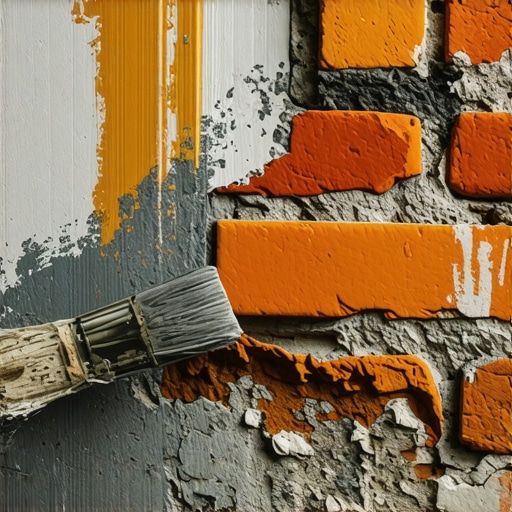
The Autopsy of a Painted Facade: A Forensic Masonry Perspective
I was called to a site last November to inspect what the homeowner described as ‘minor peeling.’ When I arrived, I didn’t see a paint job; I saw a forensic crime scene. This was a 1910 structural masonry home where some ‘innovative’ contractor had convinced the owner that an elastomeric coating would ‘modernize’ the look while sealing the cracks. I took my masonry hammer and gave one of the bricks a light tap. The entire face of the unit, about three-quarters of an inch of hard-fired clay, fell off in a single slab, revealing a mushy, damp interior that had the consistency of wet sand. The homeowner thought it was just a hairline crack. But when I put my scope inside, I saw the structural steel was rusted to dust and the load-bearing integrity of the wall was effectively gone. This is the reality of ‘masonry rescue after disaster’ when the disaster was human-made. Painting over damaged masonry isn’t maintenance; it is a slow-motion demolition of your property’s structural core.
The Physics of Vapor Permeability and the ‘Paint Trap’
To understand why paint is the enemy, you have to understand the ‘breathing’ nature of a brick wall. Old-world masonry is not a static, solid mass; it is a dynamic system of moisture management. Bricks are porous. They act like a sponge, absorbing moisture during rain events and releasing it through evaporation when the sun comes out. This is known as capillary action. When you apply a non-breathable film like standard exterior latex or acrylic paint, you are essentially wrapping your house in a plastic bag. The liquid water still finds its way in—through the tiny fissures in the paint, through the roofline, or rising from the soil via capillary rise—but it can never get out as a vapor. This creates a phenomenon known as hydrostatic pressure at the interface between the brick face and the paint film.
“Water penetration is the single greatest threat to masonry durability.” – BIA Technical Note 7
In colder climates, this trapped moisture is a death sentence due to the freeze-thaw cycle. We know that water expands by approximately 9% when it turns to ice. When that moisture is trapped within the pore structure of the brick because it cannot evaporate through the paint, the expansion forces are greater than the internal tensile strength of the clay. This causes ‘spalling,’ where the brick face literally explodes off. If you are dealing with crumbling mortar joint repair, applying paint only hides the fact that the ‘mud’—the mortar—is disintegrating. The mortar is supposed to be the sacrificial element of the wall. In ‘historic pointing styles,’ we use lime-based mortars specifically because they are more permeable and softer than the brick. This ensures that any moisture movement or structural settling affects the easily replaceable mortar joints rather than the irreplaceable brick units themselves.
The Chemistry of Mortar Decay: Beyond the Surface
Micro-zooming into the chemistry of a mortar joint, we see the ‘carbonation’ process. Traditional lime mortar gains strength over decades by absorbing CO2 from the atmosphere and turning back into calcium carbonate—essentially limestone. This process requires the movement of air. When you seal a wall with paint, you halt this carbonation. Furthermore, if the original mortar was a high-lime mix (Type O or K), and you attempt a quick ‘butter’ job with modern Portland cement before painting, you create a ‘cold joint.’ The hard cement won’t bond to the soft lime. It creates a dam that traps moisture at the bond line, leading to rapid ‘honeycombing’ of the inner wall. For any ‘commercial tuckpointing’ project, the old, decayed mortar must be ground out to a depth of at least 1 inch, or until sound mortar is reached, before new ‘mud’ is struck into the joint with a slicker tool.
Brick Arch Restoration and Structural Integrity
Nowhere is the danger of paint more evident than in ‘brick arch restoration.’ An arch is a masterpiece of compression physics. Every brick, from the ‘skewback’ to the ‘keystone,’ must maintain full contact to distribute the load. When mortar joints in an arch begin to crumble and are simply painted over, the moisture rot softens the load-bearing surfaces. You might not see the ‘stair-step’ cracks forming under the paint, but the arch is losing its ‘tooth.’ Eventually, the compression fails, and the arch collapses. This is why ‘chimney leak detection’ is so critical. A chimney is exposed to the elements on all four sides and experiences the most extreme temperature fluctuations. If you paint a chimney, you are trapping combustion gases and acidic condensation inside the masonry. The sulfuric acid in the soot reacts with the moisture and the lime in the mortar, creating gypsum, which expands and shreds the joints from the inside out.
“Mortar should always be weaker than the masonry units it binds, ensuring that stresses are relieved through the joints.” – ASTM C270 Standard Specification
The Critical Role of Drainage: Weep Holes and Foundations
We must also discuss the ‘geotechnical’ reality of masonry. A ‘retaining wall weep hole cleaning’ is often overlooked, but it is vital. Retaining walls hold back tons of saturated soil. If the weep holes are clogged or—heaven forbid—painted over, the hydrostatic pressure builds up until the wall bows or ‘blows out.’ The same logic applies to ‘brick infill panel repair’ in steel-frame buildings. These panels need to move independently. If they are painted and the joints are stiffened with the wrong materials, the differential thermal expansion will cause the panels to buckle. For ‘outdoor masonry fountain restoration,’ the stakes are even higher as the masonry is in constant contact with water. Here, we don’t use paint; we use mineral silicates that bond chemically with the stone, allowing vapor to pass while shedding liquid water.
The Professional Approach: Real Masonry Rescue
If you have crumbling mortar, the solution isn’t a paintbrush; it’s a ‘hawk’ and a ‘trowel.’ ‘Commercial tuckpointing’ involves matching the aggregate size and color of the original mortar to ensure a visual and structural match. This isn’t ‘lick-and-stick’ work. It’s a technical process of ‘striking’ the joint to the correct profile—whether it’s a weathered joint, a V-joint, or a grapevine joint—to shed water away from the brick. If the damage is extensive, a true ‘masonry rescue after disaster’ might involve ‘soldier course’ replacement or even structural shoring. Don’t be fooled by the ‘handyman special’ who says paint will seal your leaks. It will only bury the evidence of a failing structure until the day the repair bill doubles because you’re no longer just repointing; you’re rebuilding the whole wall. Real masonry is built to last centuries, but only if you respect the physics of the materials. Keep the paint for the drywall and let your brick breathe.