
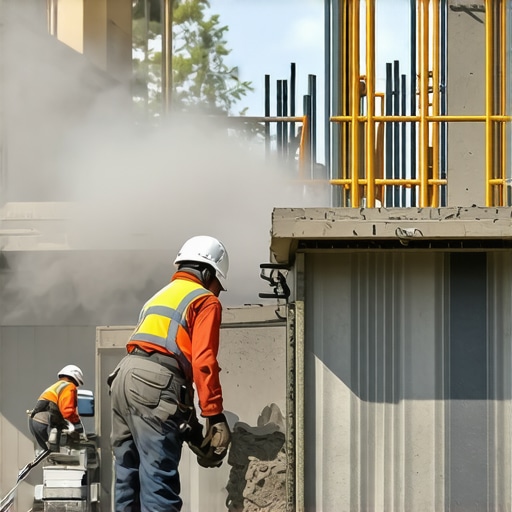
The Forensic Scene: When the Facade Fails
I walked onto a job site at a sprawling commercial complex last October where the property owner swore the building was haunted. Every morning, he’d find shards of brick on the sidewalk, a slow-motion rain of masonry. He called it ‘minor wear.’ I put my digital scope into a hairline fracture on the south-facing wall and saw a graveyard. The structural steel lintels were rusted to flakes, expanding with such force that they were literally jacking the building apart from the inside. The culprit wasn’t ghosts or even age; it was a generic, off-the-shelf mortar used during a previous emergency masonry repair that had no business being on a high-load commercial structure. When you deal with high-performance mortar mixes, you aren’t just buying mud; you’re buying a chemical bond designed to survive the brutal physics of a commercial environment.
The Physics of the Commercial Load
Commercial buildings aren’t just bigger versions of houses; they are machines that breathe, shift, and sweat under immense structural loads. A residential chimney might handle a few hundred pounds of pressure, but a commercial facade deals with wind loads, thermal expansion on a massive scale, and the relentless vibration of HVAC systems. This is why emergency masonry repair in a commercial setting is a different beast entirely. You can’t just slap on a patch and call it a day. You have to understand the ‘tooth’ of the substrate. If the mortar is too hard, it creates a cold joint where the new material never truly marries the old. This leads to honeycombing, where air pockets form within the joint, inviting water to sit, wait, and eventually freeze.
“Water penetration is the single greatest threat to masonry durability, accounting for nearly 90% of all masonry failures in multi-story structures.” – BIA Technical Note 7
In the North, where the freeze-thaw cycle is a seasonal predator, water expands by 9% when it turns to ice. In a tight, non-breathable joint, that 9% is a hydraulic jack. I’ve seen spalled concrete steps repair jobs fail in six months because the contractor used a high-Portland mix that trapped moisture instead of an air-entrained formula that allows microscopic expansion. When we talk about concrete block foundation repair, we are talking about managing hydrostatic pressure. The soil outside a commercial foundation is often heavily compacted, and when it saturates, it pushes. If your mortar joints don’t have the flexural strength to handle that lateral load, the wall bows. A concrete patch is a cosmetic fix for a structural hemorrhage.
The Chemistry of High-Performance Mud
Let’s micro-zoom into the hydration process. When we mix ‘mud’ for a commercial project, we are managing the formation of calcium silicate hydrate (C-S-H) crystals. On a high-performance job, we often use additives like polymers or microsilica. Why? Because we need the mortar to have a higher ‘suction’—the ability to pull into the pores of the brick or block to create a mechanical lock. In an outdoor fireplace rebuild or a commercial incinerator stack, the thermal shock alone would shatter a standard Type N mortar. We need a formula that accounts for the ‘modulus of elasticity.’ If the mortar is stiffer than the masonry units, the units will crack first. This is the ‘Sacrificial Principle’ of masonry: the mortar must be the weakest link so it can be replaced, preserving the more expensive stone or brick.
Chimneys, Drones, and the Invisible Failure
One of the most neglected areas of commercial property maintenance is the chimney stack. It’s out of sight, so it stays out of mind until a piece of the crown falls and hits a parked car. We now utilize drone chimney inspections to catch these issues before they become liabilities. Often, the chimney flashing repair is the first point of failure. If the lead or copper flashing isn’t properly regleted into the mortar joint with a specialized sealant, water will bypass the brick entirely and rot the roof decking. Similarly, masonry joint sand repair on commercial plazas isn’t just about sweeping in some grit. It requires polymeric sands that can withstand power washing and heavy foot traffic without eroding, which leads to failing retaining wall repair needs when the runoff eventually undermines the base.
“Mortar should be designed to be compatible with the masonry units in terms of strength, absorption, and thermal expansion properties.” – ASTM C270 Standard Specification for Mortar for Unit Masonry
The Reality of Restoration
There is a massive difference between tuckpointing (a cosmetic enhancement) and repointing (a structural necessity). When I’m buttering a brick for a soldier course over a commercial window opening, I’m thinking about the shear stress. Using a slicker or a jointer tool isn’t just for looks; it’s to compress the face of the mortar to create a ‘skin’ that sheds water. If you leave the joint ‘open’ or grainy, you’re just building a sponge. I’ve seen failing retaining wall repair projects where the original builder didn’t understand weep holes. Without a way for water to escape, the weight of the saturated soil behind the wall exceeds the tensile strength of the mortar, and the whole thing ‘blows out’ at the base. It’s not a mystery; it’s physics. You do it once with the right chemistry, or you do it twice with a ‘handyman special.’ In the commercial world, doing it twice usually includes a lawsuit. Don’t gamble on the mud. Use specialized formulas that match the life of the building, not just the length of the warranty.