
The Crack That Whispers: A Forensic Scene
The homeowner stood in the driveway, pointing at what looked like a harmless hairline fracture running through the soldier course of his 1980s ranch. He thought it was a cosmetic eyesore, maybe something a tube of hardware-store caulk could fix. But when I put my borescope into that gap and looked past the face of the brick, the reality was much grimmer. The structural steel behind the masonry was rusted to dust, its volume expanding as it oxidized, pushing the wall outward in a slow-motion explosion. This wasn’t a job for a trowel and some wet mud; this was a fundamental failure of the earth beneath us. When the soil decides to move, your house is just a passenger.
The Physics of Settlement and the ‘Grip’ of the Soil
To understand why we turn to helical piers, you have to understand the treachery of the ground. Most foundations fail because of hydrostatic pressure or the fluctuating ‘suction’ of expansive clays. When clay gets wet, it swells like a sponge; when it dries, it shrinks, leaving a void. This cycle creates a ‘cold joint’ between the footing and the earth. Eventually, the weight of the structure—thousands of pounds of concrete, timber, and masonry—exceeds the bearing capacity of the upper soil strata. You start seeing the classic stair-step cracks in the mortar joints. If you’re lucky, it’s just settlement. If you’re unlucky, it’s a total shear failure of the footer. This is where concrete block foundation repair shifts from simple patching to heavy engineering.
“Water penetration is the single greatest threat to masonry durability, but the stability of the substrate is what dictates the lifespan of the assembly.” – BIA Technical Note 7
In regions where the freeze-thaw cycle is a constant enemy, water trapped in the soil expands by 9% when it turns to ice. This creates a lateral shove that can bow a basement wall faster than you can mix a bag of Type S. Strengthening these failing structures requires more than just foundation slab jacking or retaining wall reinforcement. It requires reaching down past the ‘active zone’ of the soil—the top 10 to 20 feet where moisture and frost do their dirty work—and anchoring into the deep, competent strata that hasn’t seen the sun in ten thousand years.
The Anatomy of the Helical Pier: Metallurgy vs. Mud
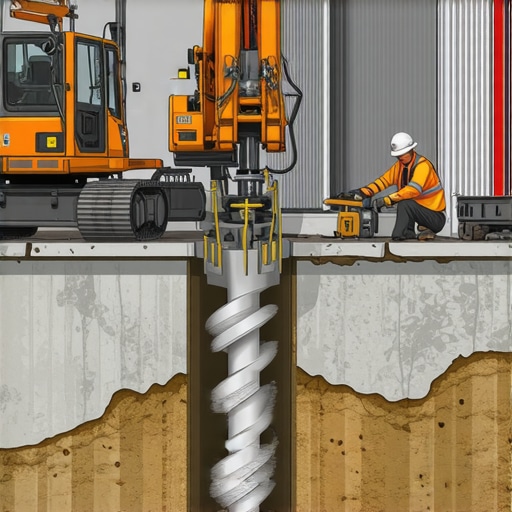
A helical pier isn’t just a giant screw; it’s a marvel of metallurgical engineering. We’re talking about high-strength, galvanized steel shafts with helical plates (flights) welded at specific intervals. The installation is a surgical procedure. We use a hydraulic torque motor to ‘butter’ that pier into the ground. As it spins, we monitor the torque. There is a direct mathematical correlation between the resistance the pier meets (torque) and its ultimate load-bearing capacity. It’s not guesswork. We don’t stop until we hit the ‘refusal’ point, where the torque matches the weight we need to support. This is the ‘cure’—not the ‘band-aid’ of self-healing concrete foundations which, while impressive in the lab, can’t stop a house from sinking into a swamp.
Micro-zooming into the chemistry, consider the hydration of the concrete we use to cap these piers. When we pour the new bracket encasements, we’re looking for the formation of calcium silicate hydrate (CSH). This crystalline structure grows like interlocking needles, binding the aggregate together. If the ‘mud’ dries too fast—what we call ‘flash setting’ in hot climates—the CSH needles don’t have time to interlock, leaving you with a brittle, crumbly mess. We want a slow, cool cure to ensure the bond to the steel pier is absolute.
Restoration and the Art of the Invisible Fix
Once the piers are set and the house is stabilized—or even lifted back to its original elevation—the real masonry work begins. You can’t just slap any old grout into the cracks. For older homes, historic brickwork repointing is a delicate science. You have to match the compressive strength of the original mortar. If you use a modern, high-Portland cement mortar on soft, 100-year-old bricks, the mortar will stay rigid while the bricks try to expand. The result? The faces of the bricks will pop off—a process called spalling. This is why mortar matching services are vital. We look for the right blend of lime and sand to ensure the joint remains ‘sacrificial,’ meaning the mortar fails before the brick does.
“The strength of a wall is not in the hardness of the stone, but in the integrity of its bed and the stability of its footing.” – ASTM C270 Standards
In modern applications, we might use tuckpointing tools for DIY for minor cosmetic touch-ups on the chimney or the upper facade, but structural cracks require a professional ‘slicker’ and a deep understanding of joint geometry. Even tile grouts on masonry or masonry joint sand repair for patios play a role in the overall moisture management of the property. If water can’t shed away from the foundation because of a poorly graded patio, your new piers are going to be working overtime.
When to Call the Forensic Mason
How do you know if you’re looking at a cosmetic flaw or a structural catastrophe? Look for the ‘tell-tales.’ A horizontal crack in a basement wall is almost always a sign of hydrostatic pressure—the earth is trying to move into your living room. A vertical crack that is wider at the top than the bottom suggests one corner of the house is diving. We now use drone chimney inspections to look for separation at the roofline that the naked eye can’t see from the ground. If you see ‘honeycombing’ in your concrete—areas where the aggregate is exposed and the paste is missing—that’s a sign of a poor pour (a ‘cold joint’) from the day the house was built. Don’t wait for the door to stop latching. By the time that happens, the ‘tooth’ of your masonry is already broken, and the cost of the fix just doubled. Do it once, do it right, and anchor into something that doesn’t move.