
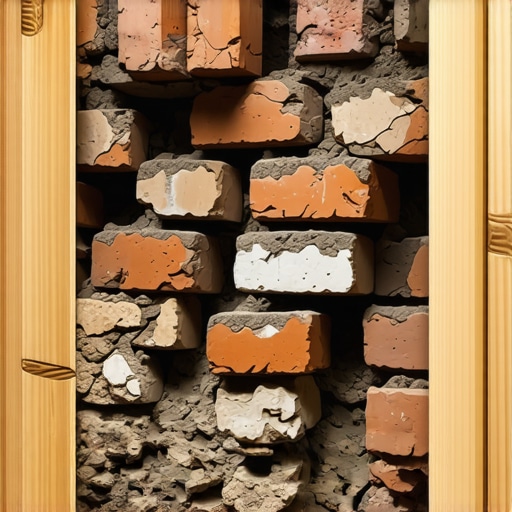
The Forensic Scene: When the Brick Leans Back
The homeowner thought it was just a hairline crack near the window header. But when I put my borescope inside the air cavity of that 1930s facade, I saw a structural graveyard. The steel wall ties, those critical umbilical cords connecting the brick skin to the wooden skeleton, were rusted to orange dust. There was no ‘bite’ left. The wall wasn’t just cracked; it was breathing, detached from the house by a quarter-inch of dead air and decades of moisture. This is the reality of forensic masonry. You don’t look at the brick; you look at what’s happening behind it. Whether you are dealing with a brick quoin repair on a stately manor or a simple outdoor fireplace rebuild, the physics of moisture and movement never lie. I’ve spent forty years smelling damp lime and feeling the grit of failing mortar repointing services between my fingers, and I can tell you: most ‘repairs’ are just putting lipstick on a corpse.
The Physics of the Air Cavity and Why it Fails
In a proper brick veneer system, the masonry is a rainscreen, not a waterproof barrier. Water will get through the brick. It wicks through the pores by capillary action—a process where the suction of the dry clay pulls moisture deep into the unit. Once that water hits the back of the brick, it’s supposed to run down the house wrap and exit through weep holes. But when a ‘handyman’ comes along and performs tuckpointing by slathering hard Portland cement over old lime joints, he seals the tomb. This is where historic mortar analysis becomes a matter of structural life and death. If the wall cannot breathe, the moisture stays trapped, and the wall ties begin to oxidize.
“Water penetration is the single greatest threat to masonry durability, leading to efflorescence, spalling, and the corrosion of embedded metals.” – BIA Technical Note 7
When iron turns to rust, it expands up to six times its original volume. This ‘rust jacking’ exerts incredible pressure, pushing the brick away from the studs until the whole soldier course is ready to tumble onto the lawn.
The Sacrificial Principle: Why Your New Mortar is Killing Your Old Brick
Old bricks, fired in kilns that had hot and cold spots, are soft. They are like sponges. Modern mortar, specifically Type S or Type M, is incredibly hard and dense. If you use a high-strength Portland mix on a pre-1940s home, you have created a structural mismatch. In the winter, during the freeze-thaw damage restoration cycle, the moisture trapped in the wall expands by 9%. If the mortar is harder than the brick, the brick face will pop off—this is called spalling. The mortar must be the sacrificial lamb. It should be softer than the masonry unit so that the stresses of thermal expansion and contraction are absorbed by the joint, not the brick. We use historic mortar analysis to match the original lime-to-sand ratios, ensuring the wall remains flexible. When we perform mortar repointing services, we aren’t just filling gaps; we are restoring the chimney’s ability to sweat out its internal humidity. This is especially critical on tuckpointing curved walls where the geometry creates complex tension points that rigid modern ‘mud’ simply cannot handle.
Hydrostatic Pressure and the Retaining Wall Collapse
It’s not just walls attached to houses that fail. I’ve seen concrete masonry unit restoration projects where 20-foot sections of a backyard were held back by nothing but hope and a few blocks. The hidden enemy here is hydrostatic pressure. Without a proper retaining wall drainage upgrade, water builds up behind the wall. Soil saturated with water weighs twice as much as dry soil. If you don’t have a perforated pipe and a foot of clean gravel behind that wall, that water is going to find a way out, usually by blowing the wall off its footing. When I see foundation crack repair needs on a slope, the first thing I check is the drainage. You can butter the joints with the best mud in the world, but if the water has nowhere to go, the wall is coming down. It’s about managing the ‘tooth’ of the soil and the flow of the earth’s tears.
The Anatomy of a Professional Fix
When we approach a brick quoin repair or a failing veneer, we don’t just patch the surface. We start by grinding out the old, failing joints to a depth of at least twice the width of the joint. We use a hawk and a slicker to pack the new mud in layers. We don’t ‘butter’ the edges; we drive the mortar home to ensure there are no voids or honeycombing. For tuckpointing curved walls, the skill lies in the strike—using the jointer to create a profile that sheds water away from the core of the wall.
“Mortar should be designed to be weaker than the masonry units so that any cracks occur in the mortar joints where they can be easily repaired.” – ASTM C270 Standard Specification for Mortar
This is the ‘Master’s Code.’ We respect the materials. Whether it’s a concrete masonry unit restoration or an outdoor fireplace rebuild, the goal is longevity. Modern contractors want to be in and out in a day. I want my work to be inspected by my grandson in fifty years and have him say, ‘The old man knew his suction and his salts.’