
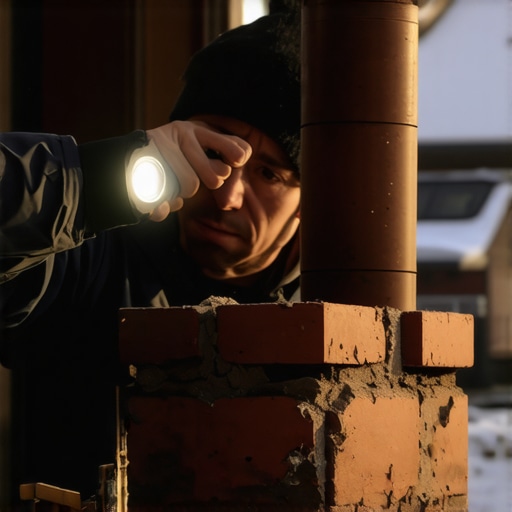
The Forensic Scene: A Ticking Time Bomb in the Attic
The homeowner thought it was just a few loose bits of mortar on the hearth, a minor inconvenience after a heavy autumn rain. But when I sent the high-definition scope up the flue, the reality was a horror show: the interior clay liners had shifted three inches, and the structural wythe was held together by nothing but habit and gravity. It was a forensic disaster waiting for the first sub-zero night to trigger a total collapse. This isn’t just about a cozy fire; it’s about the physics of masonry and the brutal reality of the freeze-thaw cycle. If your chimney hasn’t been vetted by someone who knows the ‘tooth’ of the stone and the chemistry of the mud, you’re playing a dangerous game with your roofline.
The Physics of the Freeze: Why 9% Matters
In the masonry world, we live and die by the freeze-thaw cycle. Water is a relentless invader, finding its way into the interstitial spaces of a brick through capillary action. When the temperature drops, that trapped water undergoes a phase change, expanding by approximately 9% in volume. In a confined space like a mortar joint or a microscopic pore in a soft brick, that expansion generates thousands of pounds of pressure per square inch.
“Water penetration is the single greatest threat to masonry durability, leading to spalling, efflorescence, and structural failure if not managed through proper detailing.” – BIA Technical Note 7
This is why masonry water damage repair is not just about slapping some sealant on a crack. It’s about understanding the pore structure. If you use a modern, hard Portland-based mortar on historic brick salvage, you’ve just signed the chimney’s death warrant. The hard mortar won’t give, so the expansion forces the face of the brick to pop off—a phenomenon we call spalling. I’ve seen 100-year-old chimneys ruined in five years because a ‘handyman’ used the wrong mud.
The Crown: Your Chimney’s Only Umbrella
Most chimneys I inspect are failing from the top down. The chimney crown—that slab of masonry at the very top—is supposed to be a monolithic shield that sheds water away from the flue and the brick faces. Instead, I usually find a thin ‘wash’ of mortar that has cracked into a spiderweb. This is where robotic masonry repair and modern BIM masonry projects are changing the game, allowing us to model the exact thermal stresses a crown undergoes. A proper crown needs an overhang and a drip edge. Without it, water runs down the side of the chimney, soaking into the stone facade restoration work and rotting the chimney flashing repair zones from the inside out. When you’re buttering the joints on a new crown, you have to ensure the suction of the brick doesn’t pull the moisture out of your mix too fast, or you’ll end up with honeycombing before the first frost even hits.
Flashing and the Intersection of Materials
The point where the chimney meets the roof is a war zone. I’ve seen outdoor kitchen masonry build projects fail for the same reason: poor flashing. We’re talking about two different materials—masonry and wood/shingles—that move at different rates during thermal expansion. If your flashing is just gooped up with roof cement, it’s going to fail. A forensic inspection looks for the counter-flashing, which should be tucked into a reglet cut into the mortar joint. If that joint isn’t struck properly with a slicker, water will find its way behind the lead or copper.
“Flashing should be designed to intercept and direct water to the exterior of the wall system, preventing internal saturation.” – ASTM C1397 Standard
This is critical because once moisture gets behind that soldier course of bricks, it starts the slow rot of the structural framing, often hidden until the chimney starts to lean.
Restoration Reality: From Brick Arches to Foundations
If you’re lucky enough to have a brick arch restoration project, you’re dealing with pure geometry and compression. These arches are often the most sensitive to settlement. If your foundation has shifted, the arch will show it first with a stair-step crack. For patio stone realignment or chimney stabilization, we sometimes have to go deep—looking at soil heaving and hydrostatic pressure. In historic settings, we’re often doing historic brick salvage to match the original ‘hand’ of the work. You can’t just buy this stuff at a big-box store. You need to understand the carbonation of lime over decades. When I’m mixing a batch of Type O mortar for a restoration, I’m looking for that perfect ‘hang’ on the hawk. If the mud is too wet, it shrinks; too dry, and it won’t bond. It’s a surgical process, especially when you’re trying to integrate outdoor kitchen masonry build elements into an existing historic structure without creating a cold joint that will split open the moment the ground freezes.