
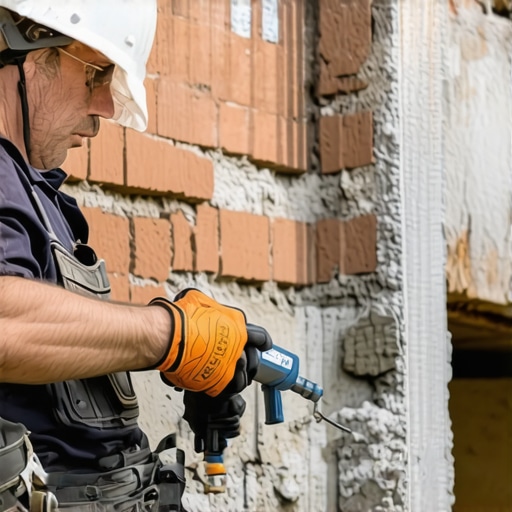
The Forensic Scene: Beneath the Surface of a Failing Facade
The developer thought it was just a hairline crack, a minor blemish on a century-old industrial warehouse. He called it an ‘aesthetic touch-up.’ But when I climbed that forty-foot lift and put my borescope into the cavity, I didn’t see solid masonry. I saw a structural skeleton being eaten alive from the inside out. The historic brick salvage was crumbling because a previous contractor, likely looking for a ‘quick fix,’ had stuffed the joints with high-strength Portland cement. That rigid, modern mortar had trapped three decades of moisture behind the face, turning the interior brick core into a mushy, delaminated mess. It looked like a soldier course was standing tall, but it was essentially a row of hollowed-out shells held up by habit. This is the reality of commercial masonry: if you don’t understand the chemistry of what’s holding your building together, you’re just putting expensive makeup on a corpse.
“Water penetration is the single greatest threat to masonry durability, and the selection of an incompatible mortar is often the primary catalyst for accelerated decay.” – BIA Technical Note 1
The Physics of the Sacrificial Joint
In the world of stone facade restoration and historic brickwork, there is a fundamental law often ignored by modern ‘slick-and-stick’ crews: the mortar must be weaker and more permeable than the masonry units it surrounds. This is the ‘Sacrificial Principle.’ When we talk about crumbling mortar joint repair, we aren’t just filling gaps; we are managing the building’s respiration. Old-world bricks are porous. They act like sponges. In a historic context, the mortar serves as the ‘lung,’ allowing vapor to escape through the joints rather than through the brick face. If you use a hard, modern Type S mortar on soft, handmade bricks, the moisture cannot escape. When the freeze-thaw cycle hits, that trapped water expands by 9%, and because it can’t push through the hard mortar, it blows the face off the brick—a process we call spalling. Tuckpointing weatherproofing isn’t about sealing the building in plastic; it’s about ensuring the ‘mud’ has the right ‘tooth’ to bond while remaining soft enough to accommodate thermal movement.
Micro-Zooming: The Chemistry of Lime vs. Cement
To do a real commercial tuckpointing project right, you need a deep mortar analysis. This isn’t just eyeballing a color match. We look at the sand gradation under a microscope and perform acid digestion to determine the binder-to-aggregate ratio. Modern cement hardens through a chemical hydration process that happens in hours. Historic lime mortar, however, hardens through carbonation—absorbing CO2 from the air over decades. This creates a flexible, ‘self-healing’ crystalline structure. If a small fissure develops, rain dissolves a bit of the free lime and redeposits it into the crack. You don’t get that with the rigid, brittle nature of advanced masonry adhesives used in modern brick veneer installation. When we provide flush pointing services for a commercial client, we are looking at the ‘suction’ of the brick. If the brick is too dry, it sucks the water out of the ‘mud’ before it can properly set, leading to a ‘burnt’ joint that will fail within two seasons. We call this ‘flash setting,’ and it’s the hallmark of a rushed job.
Foundation Integrity and Sustainable Solutions
Sometimes the issue goes deeper than the facade. When I’m called for concrete block foundation repair, I’m looking for hydrostatic pressure. The ground is a living, moving weight. If your concrete block foundation shows horizontal cracking, it’s bowing under the weight of saturated soil. We are seeing a rise in the use of self-healing concrete foundations and sustainable block cutting techniques to mitigate these environmental stresses. But for the average commercial property, the solution is often simpler and more mechanical: drainage and proper repointing. Using a hawk and a slicker to properly butter a joint isn’t just for show; it’s about ensuring there are no ‘voids’ or honeycombing inside the wall where water can pool. A cold joint—where new mortar fails to bond to the old because of poor surface prep—is an invitation for disaster. True stone facade restoration requires grinding out the old joints to a depth of at least two times the width of the joint to ensure the new material has enough ‘grab’ to resist the lateral forces of the wind.
“Mortar should be designed to be compatible with the masonry units, with Type N or Type O typically preferred for restoration to prevent unit damage.” – ASTM C270 Standard Specification
The Reality of Modern Restorations
Too many ‘handyman specials’ rely on high-build coatings to hide bad masonry. They’ll slap a layer of sealant over a crumbling mortar joint repair and call it a day. But those sealants often trap more moisture than they keep out. We advocate for a return to the fundamentals: analyze the substrate, match the compressive strength of the original materials, and respect the thermal expansion joints. In a long commercial wall, the sun can cause the masonry to expand significantly. Without proper relief joints, the wall will develop ‘stair-step’ cracks. No amount of tuckpointing weatherproofing will save a wall that isn’t allowed to move. Whether you are dealing with historic brick salvage or a new brick veneer installation, the physics remains the same: you are managing energy and water. Don’t let a contractor talk you into a ‘one-size-fits-all’ mortar mix. Your building is a unique chemical environment, and it deserves a forensic approach. Do it once, or do it twice—the choice is usually written in the mortar.