
The Forensic Scene: Why Your Wall is Falling Apart
The homeowner looked at the jagged fissure running through his 14-inch limestone capstone and told me it was probably just a bad batch of stone. I didn’t say a word; I just pulled my fiber-optic scope from the kit and slid it into the dark void beneath the masonry. What I saw wasn’t a stone defect; it was a structural autopsy in progress. The internal steel reinforcement, exposed by years of micro-cracks, had oxidized so severely it was ‘blooming’—expanding to three times its original thickness and literally jacking the stone off its bed. This isn’t just a cosmetic issue. It is a failure of the thermal envelope and a complete breakdown of the moisture management system.
When we talk about masonry repair services, most people think of a bucket of pre-mix and a cheap trowel. That is how you end up calling me three years later to fix a wall that has finally surrendered to gravity. To replace a capstone without turning your backyard into a slurry pit, you have to understand the forensic physics of why that stone cracked in the first place. Usually, it’s the freeze-thaw cycle. In our northern climate, water is the ultimate wedge. It finds a hairline path into the mortar, and when the temperature drops, that water expands by 9% in volume. That pressure is enough to shatter granite, let alone limestone or cast concrete. This ‘ice jacking’ is the primary culprit behind the need for chimney crown repair and stone balustrade restoration alike.
“Water penetration is the single greatest threat to masonry durability. Without proper moisture control, even the finest craftsmanship will succumb to the relentless pressure of hydrostatic forces.” – BIA Technical Note 7
The Physics of the Bond: Why Your ‘Mud’ Matters
Let’s talk about ‘mud’—the mortar. If you go to a big-box store and buy a bag of high-strength Portland cement for a 1920s wall, you are committing architectural malpractice. Modern cement is too hard and too brittle for historic masonry. You need sustainable tuckpointing mortars that allow for vapor permeability. I look for high-performance mortar mixes that prioritize lime over Portland. Why? Because lime is ‘self-healing.’ Through a process called carbonation, lime reacts with CO2 to seal micro-cracks over decades. If your mortar is harder than your stone, the stone will be the thing that breaks when the wall shifts. In forensic masonry, we call the mortar the ‘sacrificial element.’ It is meant to weather so the stone doesn’t have to.
Step-By-Step: The Mess-Free Surgical Extraction
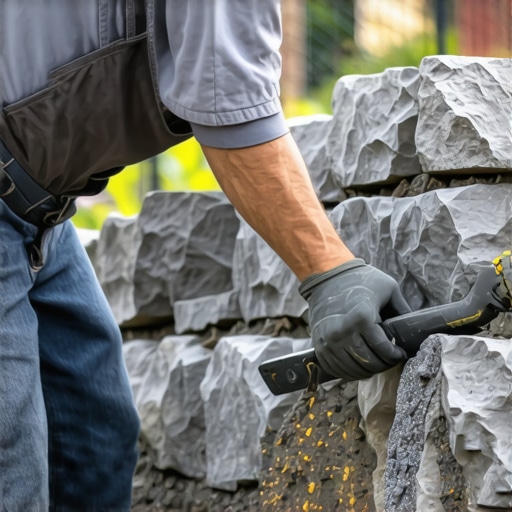
To perform a clean replacement, we don’t use a sledgehammer. We use a diamond-blade oscillating saw to ‘surgicalize’ the bed joints. This prevents the vibration from traveling down the wall and causing honeycombing or loosening the soldier course below. Once the old ‘mud’ is cleared, we use a hawk and a slicker to keep the work clean. You ‘butter’ the stone—applying the mortar to the underside of the new cap—rather than slopping it onto the wall. This ensures 100% coverage without the ‘squeeze-out’ that stains your vertical faces.
If the wall itself is leaning, we move into retaining wall batter correction. A wall shouldn’t be perfectly vertical; it needs to lean back into the earth it’s holding. If that batter is lost, the capstone will be the first thing to pop as the soil pressure pushes the top of the wall outward. During a full repointing services job, we often find that brick quoin repair is also necessary at the corners where the stresses are highest.
“The architect should ensure that the masonry units are laid in such a manner that the mortar serves as the cushion, absorbing the movements of the earth without fracturing the face of the stone.” – Vitruvius, De Architectura (Adapted)
The Chemistry of High-Performance Mortar Mixes
When we micro-zoom into the hydration process, we see that commercial tuckpointing often fails because of ‘flash setting.’ If the stone is too dry, it sucks the water out of the mortar before the chemical bond can form. This creates a ‘cold joint’—a bond that looks solid but has zero structural integrity. I always mist the stones down first to satisfy the ‘suction’ of the masonry. This is critical for tuckpointing brick walls and especially for chimney crown repair, where the sun is beating down and trying to bake the moisture out of your mix before it can cure.
When to Call a Forensic Specialist
If you see a crack that you can fit a nickel into, or if you see white powder (efflorescence) blooming on the surface, your wall is screaming for help. This isn’t a job for a ‘handyman special.’ You need someone who understands the difference between Type N and Type S mortar and who knows how to calculate the hydrostatic pressure behind a retaining wall batter correction project. Doing it right once is always cheaper than doing it twice. Whether it’s stone balustrade restoration or a simple capstone swap, the goal is a fix that outlives the person who installed it. That is the old-world way.