
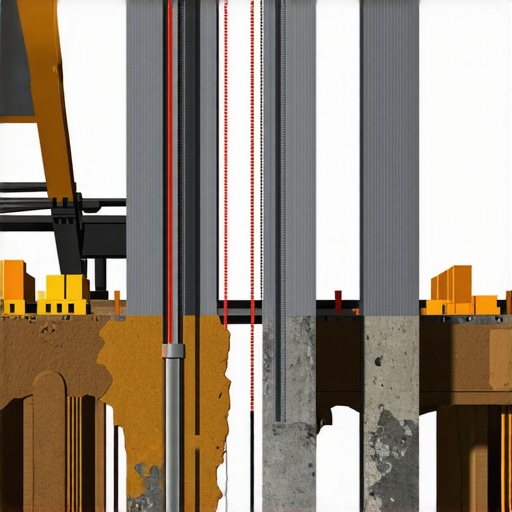
The Forensic Scene: When a Hairline Crack Becomes a Structural Grave
The homeowner in the aging industrial corridor of the North End thought it was just a cosmetic nuisance—a slender, wandering hairline crack tracing its way through the mortar joints of her 1920s bungalow. But when I inserted the fiber-optic borescope into a bored-out weep hole, the reality was much grimmer. Inside the cavity, the structural steel lintel was no longer steel; it was a bloated, flaky mass of iron oxide that had expanded to three times its original thickness. This is the ‘rust jacking’ phenomenon, a silent killer in masonry. But the real horror lay further down. The foundation was no longer sitting on stable soil; it was floating on a soup of saturated silt. This wasn’t a case for a bucket of mud and a trowel; this was a case for deep foundation underpinning.
“Water penetration is the single greatest threat to masonry durability, leading to the gradual degradation of both the units and the structural substrate.” – BIA Technical Note 7
The Geotechnical Nightmare: Freeze-Thaw Physics and Hydrostatic Pressure
In our climate, we deal with the brutal reality of the freeze-thaw cycle. Physics doesn’t care about your renovation budget. When water enters a porous brick or a poorly consolidated mortar joint, it sits there. When the temperature drops below 32 degrees Fahrenheit, that water undergoes a phase change, expanding by exactly 9% in volume. This exerts an internal pressure that can exceed 100,000 psi—far more than the tensile strength of any brick ever fired. This leads to freeze-thaw damage restoration needs that go beyond the surface. If your foundation isn’t pinned to the load-bearing strata (the ‘good dirt’ deep below), the frost heave will literally jack your house out of the ground every winter and drop it back down every spring. This constant movement leads to tuckpointing brick walls every five years because the ‘mud’ keeps cracking. You aren’t fixing the problem; you’re just putting a band-aid on a broken leg.
Micro-Zooming: The Chemistry of Fiber-Reinforced Mortars
When we talk about fiber-reinforced mortars, we aren’t just talking about mixing in some plastic hairs. We are talking about the creation of a secondary reinforcement matrix at the microscopic level. In a standard Type N mortar, once a micro-crack initiates due to thermal expansion, it propagates until it hits a void or the edge of the unit. However, with fiber reinforcement, those tiny polypropylene or alkaline-resistant glass fibers bridge the crack. This is the ‘crack-bridging’ capacity. It changes the fracture mechanics from a brittle failure to a ductile one. When we perform brick infill panel repair on a commercial facade, we use these advanced mortars to ensure the new work can handle the vibration of the city without popping out. You ‘butter’ the brick with a high-bond, fiber-rich mud, and it stays where you put it.
The Underpinning Cure: Helical Piers and Torque Physics
To stop settlement, we have to look past the dirt we can see. Deep foundation underpinning involves driving helical piers—essentially giant steel screws—deep into the earth until they hit a specific torque rating. This torque is a direct proxy for the soil’s load-bearing capacity. We aren’t just ‘digging a hole’; we are engineering a new support system. Once those piers are set, we use hydraulic jacks to lift the foundation back to its original elevation. Only after the structure is stabilized can we begin the commercial masonry facade maintenance. If you try to fix the brickwork before the underpinning is done, the first time the ground shifts, your new masonry will unzip like a cheap jacket.
The Art of the Joint: Tuckpointing Machine Services vs. The Slicker
There is a lot of talk about tuckpointing machine services lately. While a vacuum-shrouded grinder is great for cleaning out old, crumbling joints without making a dust cloud that would choke a horse, the actual ‘repointing’ (which most laymen call tuckpointing) is a matter of hand-eye coordination. You take your hawk, pile it with a stiff mix of mud, and use a slicker—a narrow jointer tool—to pack that mortar in. You don’t just smear it on. You pack it in layers. This prevents honeycombing, where air pockets get trapped behind the surface. If you have air pockets, you have a place for water to hide. And we already know what water does when it freezes. When we are doing tuckpointing brick walls, we ensure the new mortar is slightly softer than the brick itself. If the mortar is harder (like modern Portland cement on old lime-brick), the brick will be the thing that breaks. We call that the ‘sacrificial’ principle of masonry.
“Standard practice for repair of masonry structures dictates that the replacement mortar must be compatible with the existing masonry units in terms of compressive strength and water vapor permeability.” – ASTM C1713
The Roof of the Wall: Stone Coping Installation and Chimney Flashing Repair
Water doesn’t just come through the face of the wall; it comes from the top. Stone coping installation is the most overlooked part of structural health. Think of the coping as the umbrella for your wall. If the joints in your limestone or granite coping are failed, water is pouring directly into the core of the masonry. This leads to efflorescence—those white salty stains—and eventually, the total failure of the brick infill panel repair you just paid for. Coupled with this is the chimney flashing repair. The junction where the masonry meets the roof is a high-stress area. If the lead or copper flashing is buckled or pitted, water will travel down the chimney stack, rusting out the firebox and necessitating an outdoor fireplace rebuild or a full interior chimney restoration. We use high-grade sealants and proper ‘step flashing’ to ensure a watertight seal that survives the 100-degree swings of the local climate.
Hardscape Realities: Brick Paver Driveway Repair
It’s not just walls that settle. I’ve seen brick paver driveway repair jobs where the pavers looked like a rolling sea. This is almost always a failure of the sub-base and compaction. You can’t just throw an inch of sand over dirt and expect a 3,000-pound SUV not to leave ruts. You need a 6-to-8-inch base of crushed aggregate, compacted to 95% Modified Proctor density. Only then do you lay your bedding sand and your pavers. If you skip the compaction, you’re just wasting money on pretty stones that will be underwater the next time it rains. It’s about the physics of load distribution. A properly compacted base spreads the weight of the vehicle across a wider area, preventing the localized soil failure that causes sinking.
Final Verdict: Do It Once or Do It Twice
Masonry is a game of patience and physics. Whether it’s stopping structural settlement with deep foundation underpinning or a simple outdoor fireplace rebuild, the principles remain the same: manage the water, respect the material chemistry, and never trust a ‘handyman’ with a bag of premix and a dream. If the brick doesn’t ring when you tap it, or if your contractor doesn’t know the difference between Type S and Type O mortar, send them packing. Your home is a structural system, not a craft project. Do it once, do it right, and the masonry will outlive us all.