
The Forensic Scene: When the Bond Breaks
The homeowner thought it was just a hairline crack, a minor aesthetic nuisance on a stately brick arch restoration project. But when I put my scope inside that cavity, I saw the structural steel was rusted to dust and the traditional mortar had turned into a sandy silt that offered zero lateral support. It was a forensic nightmare. The masonry was hanging by a prayer and the friction of gravity alone. In the old days, we relied entirely on the weight of the stone and the mechanical ‘tooth’ of the lime mud. But in today’s world of high-traffic vibrations, extreme thermal swings, and ‘lick-and-stick’ veneers, that old-school thinking can get someone killed. This is why we are increasingly turning to high-stress masonry adhesives—not as a shortcut, but as a structural necessity to ensure a bond that outlives the building itself.
The Chemistry of the Grip: Beyond Crystalline Structures
Standard mortar creates a mechanical bond. It flows into the microscopic pores of a brick—the suction—and crystallizes as it hydrates. It’s a beautiful process, a dance of calcium hydroxide and CO2. However, it is brittle. When you are dealing with retaining wall capstone replacement or heavy coping stones on a parapet, mechanical bonding often isn’t enough to fight the sheer force of thermal expansion. High-stress masonry adhesives, typically polyurethane or MS-polymer based, create a chemical bond that is both tenacious and flexible. While cementitious ‘mud’ has high compressive strength, its tensile strength is abysmal. Adhesives bridge that gap.
“The durability of a masonry assembly is fundamentally limited by the tensile bond strength between the unit and the mortar, particularly in high-wind or seismic zones.” – ASTM C270 Standard Specification for Mortar
The Enemy: The Freeze-Thaw Cycle and Hydraulic Pressure
In the North, we fight a war against water. Water expands by 9% when it turns to ice. If you have a brick patio restoration project where the pavers are set in a rigid, non-flexible bed, that 9% expansion acts like a slow-motion explosion every winter. The result is spalling—where the face of the brick literally pops off because the moisture trapped inside has nowhere to go. This is the same reason retaining wall weep hole cleaning is the most overlooked maintenance task in the industry. If the water can’t get out, the hydrostatic pressure will push a three-ton wall over like it’s made of LEGOs. High-stress adhesives allow for a bit of ‘give’—a microscopic elasticity that absorbs the shock of the freeze-thaw cycle without breaking the primary seal. They act as a gasket as much as a glue.
Brick Arch Restoration and the Geometry of Stress
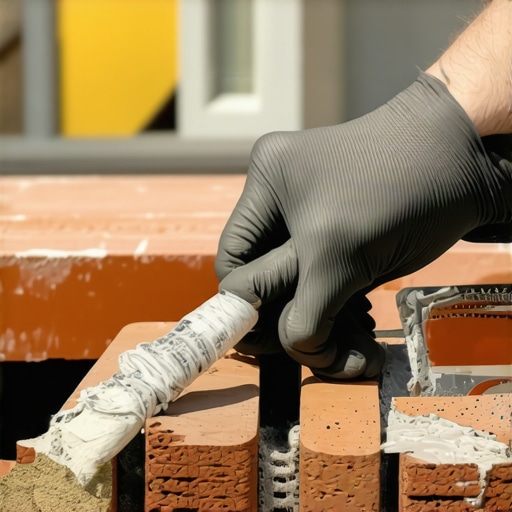
An arch is a masterpiece of compression. Every brick is a wedge pushing against its neighbor. But in modern brick arch restoration, we often find that the surrounding structure has shifted, changing the load path. When we perform tuckpointing curved walls, we have to be surgically precise. We use the ‘hawk’ to hold our specialized lime-rich mud, and the ‘slicker’ to pack it deep into the joints, but for the keyway or the voussoirs that have lost their original ‘tooth,’ a high-stress adhesive can provide the secondary safety net needed to prevent a catastrophic collapse. It’s about reinforcing the geometry with modern polymer science.
“Water penetration is the single greatest threat to masonry durability. Without proper drainage and bonding, even the finest craftsmanship will succumb to the elements.” – BIA Technical Note 7
Chimneys and the Physics of Thermal Shock
Chimneys are the most abused part of any home. They are exposed to the elements on all four sides and subjected to 800-degree temperature spikes. This is where chimney flue liner installation and chimney damper repair become critical. Traditional mortar in a chimney throat will eventually ‘burn out’ and crumble. When we are ‘buttering’ bricks for a chimney crown, we now look for adhesives that can handle high-heat cycles. A failure here isn’t just a crack; it’s a fire hazard. The same logic applies to facade cleaning; you have to be careful not to blast away the fragile carbonated skin of old bricks, or you’ll expose the soft core to even faster degradation.
The Process: From Mud to Modern Polymers
When providing concrete flatwork services or flush pointing services, the preparation is 90% of the job. You can’t just slap new material over old, dusty ‘honeycombing’ concrete. You have to grind it back to ‘bright’ stone to get a clean surface. For adhesives, this is even more critical. There can be no ‘cold joint’—a weak point where new material fails to bond to the old. We ‘butter’ the back of the unit, ensuring 100% coverage to avoid voids where water can pool. Whether it’s a soldier course of bricks over a window or a massive granite slab, the goal is a monolithic bond. We are seeing a shift where ‘lick-and-stick’ veneers, which I usually despise for their cheapness, are being elevated by these high-stress adhesives, making them actually viable for long-term use if—and only if—the drainage plane behind them is handled correctly.
Conclusion: The Master Mason’s Final Word
I’ve spent forty years with a trowel in my hand and lime dust in my lungs. I love the smell of wet mortar, but I’m not a fool. Modern masonry demands modern solutions. When you’re looking at a structural failure, you don’t want a ‘handyman special’ with a tube of caulk. You want a forensic approach that understands the chemistry of the bond. Whether we are talking about tuckpointing curved walls or installing a complex new drainage system, the bond is everything. Do it once, do it right, and use the best science available to ensure that wall is still standing when your grandkids are my age.