
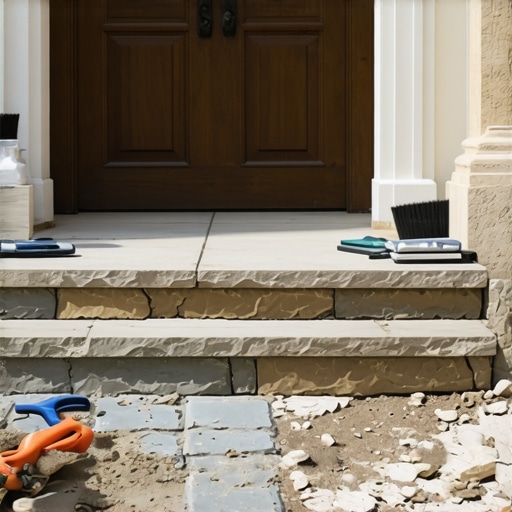
The Forensic Scene: When a Hairline Crack Becomes a Structural Threat
The homeowner in the historic district of Boston thought it was just a cosmetic blemish—a thin, hairline fracture running through the lintel of an 1890s limestone entryway. But when I inserted my fiber-optic scope into the void behind the ashlar, the reality was grim. The original wrought-iron anchors, intended to tie the stone to the backup wall, had been subjected to decades of moisture infiltration. They hadn’t just rusted; they had undergone ‘oxide jacking.’ As the iron oxidized, it expanded to nearly four times its original thickness, exerting thousands of pounds of pressure per square inch. This internal force was literally bursting the stone from the inside out. This is the reality of masonry forensics: the most dangerous failures are the ones you can’t see until you look past the ‘skin.’ What many call ‘weathering’ is often a slow-motion chemical explosion triggered by the wrong materials and poor physics.
The Chemistry of Breathability: Why Modern Portland Kills Old Stone
To understand historic mortar analysis, you have to understand the fundamental difference between modern cement and historic lime. Before the 1930s, masonry was a ‘flexible’ system. We used lime and sand. This mud was softer than the stone itself, allowing for thermal expansion and, more importantly, moisture evaporation. Modern Portland cement is a different beast entirely. It is hard, brittle, and virtually waterproof. When a well-meaning handyman uses a high-strength Type S mortar to patch a weathered stone entryway, they are signing a death warrant for the stone. Because the new mortar is harder than the stone, any structural movement will cause the stone to crack rather than the mortar. Furthermore, the cement traps moisture within the stone. When that trapped water hits the freeze-thaw cycle, it expands by 9% and pops the face of the stone off. This is what we call spalling.
“Water penetration is the single greatest threat to masonry durability, especially when combined with high-strength, non-breathable mortars that prevent natural evaporation.” – BIA Technical Note 7
Micro-Zooming into the Hydration and Carbonation Cycle
Let’s talk about the physics of the ‘Sacrificial Principle.’ In a properly restored entryway, the mortar should be the sacrificial element. It is meant to erode over 50 years so the stone lasts 500. When we perform a brick wall restoration or stone repair, we analyze the ‘Initial Rate of Absorption’ (IRA). If the stone has a high suction, it will pull the water out of the mortar too quickly—a process we call ‘burning’ the mud. This results in a weak, powdery joint that never properly cures. To prevent this, we ‘butter’ the stone only after it has been pre-moistened to a saturated surface-dry state. We aren’t just sticking things together; we are managing the hydration of silicates and the carbonation of lime. Lime mortar doesn’t ‘dry’ in the traditional sense; it absorbs CO2 from the air to revert back into calcium carbonate. This process can take weeks, which is why we cover the work with damp burlap to ensure the ‘tooth’ of the stone is fully engaged by the binder.
The Art and Physics of Brickwork Pointing Styles
Restoration isn’t just about the mix; it’s about the ‘strike.’ Brickwork pointing styles are not just aesthetic choices. For example, a ‘weathered joint’ is angled to shed water away from the stone’s edge. A ‘grapevine joint’ or a ‘beaded joint’ provides specific shadow lines but requires a steady hand with a slicker tool. When we are mortar repointing services professionals, we use a hawk to hold our mud and small jointers to compress the mortar into the back of the joint. Compression is key. If you just smear the mud on the surface, you create a cold joint. You must pack the mortar in layers, no more than 1/4 inch at a time, to prevent shrinkage cracks. This ensures the mortar has a mechanical bond with the rough interior surfaces of the stone, creating a watertight seal that still allows the building to breathe.
“The durability of masonry depends not upon the hardness of the unit, but upon the compatibility of the mortar and the efficiency of the drainage.” – ASTM C270 Standard Specification
Modern Solutions: 3D Printing and Modular Masonry
While I have a deep respect for the old ways, I’m not blind to progress. 3D printed masonry repairs are becoming a lifeline for entryways with missing ornate carvings that would cost a fortune to hand-carve. We can scan a remaining corbel, 3D print a mold, and cast a matching piece using a mineral-based restoration lime that mimics the original stone’s density and porosity. Similarly, in modular masonry construction, we are seeing metallic brick colors application that allows new additions to blend with historic facades that have unique mineral patinas. But even with these high-tech tools, the fundamentals of drainage remain supreme. A retaining wall drainage upgrade is often the first step in saving a sunken entryway. If the soil behind the wall is saturated, the hydrostatic pressure will push the entryway stairs out of alignment, leading to spalled concrete steps repair needs that are often symptoms of a much deeper water problem.
The Restoration Process: A Master’s Workflow
First, we never use grinders if we can help it; we use pneumatic chisels to avoid ‘scarring’ the stone edges. Once the joints are cleaned to a depth of at least 1 inch, we perform a historic mortar analysis to match the aggregate size and color. We aren’t just looking for ‘gray’; we are looking for the specific local river sand used 100 years ago. After the joints are packed and struck, we address stone veneer repair if the entryway has had cheap modern updates. We strip away the lick-and-stick ‘Z-brick’ and return to authentic stone. We check for ‘honeycombing’ in the backup wall—voids where water collects—and fill them with grout injection. This isn’t a ‘handyman special’ fix; it’s a structural intervention. If you see a mason who doesn’t wash their stone before they start, or who uses a bag of pre-mixed cement from a big-box store on a 19th-century building, fire them immediately. They aren’t building a legacy; they are building a future pile of rubble. Do it once, do it right, and that stone entryway will be there to greet your grandchildren’s grandchildren.