
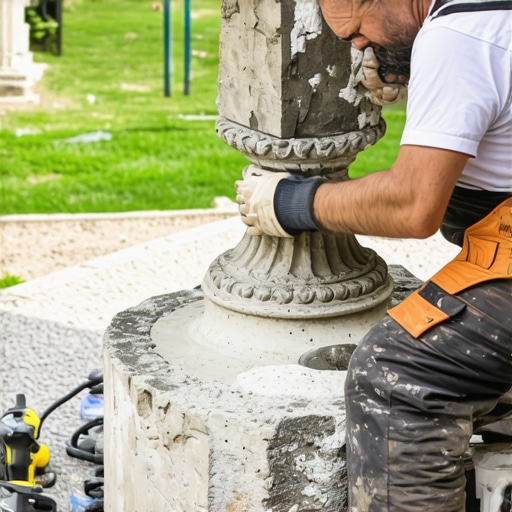
I remember standing over a 1920s tiered fountain in a courtyard that smelled of wet earth and decay. The homeowner thought it was just a hairline crack, a minor cosmetic annoyance. But when I slid my fiber-optic scope into the void behind the brick veneer, the reality was grim: the internal structural core was a graveyard of rusted rebar and saturated lime that had the consistency of wet oatmeal. This is the forensic reality of masonry restoration. When you deal with a fountain pedestal, you aren’t just stacking stones; you are fighting a constant, microscopic war against hydrostatic pressure and capillary suction.
The Anatomy of Failure: Why Pedestals Crumble
Most modern ‘contractors’ see a crumbling fountain and reach for a bag of high-strength Portland cement and a tub of hardware-store concrete patch. That is a death sentence for historic masonry. In my forty years of dragging a hawk and trowel, I’ve seen more damage done by ‘repairs’ than by time itself. The physics of a fountain pedestal are unique. Unlike a chimney or a wall, a fountain is often saturated from both the inside (the water reservoir and plumbing) and the outside (the elements).
When you apply a dense, non-breathable brickwork sealants application over old, soft-fired brick, you trap moisture. In a freeze-thaw climate, that water expands by 9% in volume. Since the hard sealant or modern mortar won’t give, the face of the brick explodes. This is called spalling. To fix it, we have to look at the chemistry of the bond. We have to talk about the ‘tooth’ of the substrate. If the old masonry doesn’t have the right suction, your new mud won’t grab. It will just sit there like a cold joint, waiting for the first frost to pop it loose.
“Water penetration is the single greatest threat to masonry durability. Moisture must be managed, not merely blocked, to ensure the longevity of any load-bearing structure.” – BIA Technical Note 7
The Forensic Investigative Phase: Historic Mortar Analysis
Before I even mix a batch of mud, I perform a historic mortar analysis. I take a thumb-sized chunk of the original bedding and crush it. I’m looking for the aggregate—the sand. Is it sharp river sand? Is it local pit sand with traces of shell? Modern masonry fails because we use ‘clean’ manufactured sand that lacks the interlocking geometry of the old stuff. If we are working on a pre-1940s pedestal, we are likely looking at a lime-putty mix. These mortars are ‘sacrificial.’ They are designed to be softer than the brick, allowing the joints to breathe and wick moisture away from the structural units.
If you see a white, crusty film on the surface, that’s brick efflorescence removal territory. But don’t just scrub it with acid. Efflorescence is the masonry’s way of screaming that there is an internal leak. It is the crystallization of water-soluble salts left behind as moisture evaporates. If you don’t fix the source of the water—perhaps through better foundation waterproofing at the base of the pedestal—the salts will just return, blowing out your new joints from the inside.
The Restoration Process: Beyond the Buttering
Restoring a pedestal requires a surgical touch. We start by grinding out the failed joints to a depth of at least one inch, or until we hit sound material. I don’t use a heavy demo hammer; I use a small pneumatic chisel to avoid rattling the whole structure. This is where we see the brick veneer detachment repair issues. Often, the tie-wires holding the veneer to the core have rusted to dust. In these cases, we use advanced masonry adhesives or helical stainless steel anchors to stitch the skin back to the skeleton.
When it comes time to lay the new material, we ‘butter’ the bricks with a precision that would make a jeweler nervous. We don’t just slap the mud on. We ensure there is no honeycombing—those air pockets that act as reservoirs for future ice. We use a slicker or a jointer tool to strike the joints in a style that matches the historic pointing styles of the original era. A weathered joint or a grape-vine joint isn’t just for looks; it sheds water away from the core.
The Chimney Analogy and Structural Integrity
I often tell my apprentices that a fountain pedestal is just a short, wet chimney. Many of the same principles apply. If the top of the pedestal—where the basin sits—isn’t properly sealed, it’s like a chimney crown repair gone wrong. Water enters the top and migrates down through the center of the masonry. You must have a ‘wash’—a slight slope—to ensure water runs off the masonry and into the basin rather than soaking into the vertical joints. If the top is cracked, we use a specialized concrete patch modified with polymers, but only on the horizontal surfaces where it won’t trap rising damp in the walls.
“The durability of masonry is dependent upon the compatibility of the units and the mortar. A mortar that is too hard will inevitably lead to the destruction of the masonry unit.” – ASTM C270 Standard Specification
The Finishing Touch: Masonry Staining and Protection
Once the structural work is done and the mud has cured (we keep it damp for days to prevent ‘flash setting’), we look at the aesthetics. If the new bricks don’t match the weathered originals, we employ masonry staining. This isn’t paint. Paint is a film that peels. Staining is a chemical bond that penetrates the silicate structure of the brick, allowing it to remain breathable while evening out the color. Finally, we might consider a silane-siloxane brickwork sealants application, but only if the substrate is completely dry and the product is vapor-permeable. You want a shield that stops liquid water but lets water vapor escape. Otherwise, you’re just gift-wrapping a bomb.
Restoring a masonry fountain isn’t a weekend DIY project. It’s a forensic challenge that requires an understanding of thermodynamics, chemistry, and the patient hands of a craftsman who knows that ‘good enough’ is the first step toward a pile of rubble. Do it once, do it right, and that pedestal will be standing long after the ‘lick-and-stick’ veneer on the neighbor’s house has fallen into the grass.