
The Forensic Scene: When a Hairline Crack Becomes a Structural Autopsy
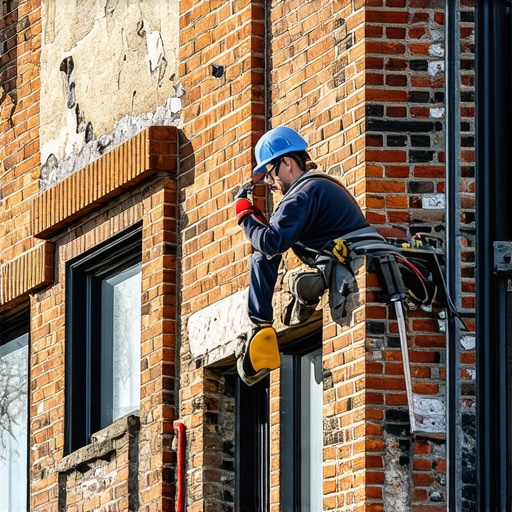
The homeowner called me out to look at what they described as a ‘minor cosmetic issue’ on their 1920s brick facade. From the sidewalk, it looked like a standard case of weathered joints. But the moment I climbed the scaffolding and pressed my thumb against a header brick, the facade gave way like a wet cardboard box. When I inserted my bore scope into the void, I didn’t see solid masonry; I saw a cavity where the structural steel lintel had rusted to a puff of orange dust, expanding to three times its original thickness and jack-potting the surrounding brick wall restoration efforts. This wasn’t a cosmetic fix; it was a forensic emergency. Most people think masonry is permanent. It’s not. It’s a living, breathing system of compression and moisture management that will fail the moment you stop respecting its physics.
The Chemistry of Destruction: Why Modern ‘Mud’ Kills Old Brick
If you’re trying to restore a facade on a budget, your first instinct is to head to a big-box store and grab a bag of Type S Portland cement. That is the fastest way to turn your ‘budget repair’ into a total building loss. To understand why, we have to micro-zoom into the hydration process. Modern Portland cement creates a dense, crystalline lattice of Calcium Silicate Hydrate (C-S-H) that is incredibly hard—often exceeding 2,500 PSI. Historic bricks, however, were fired at lower temperatures and are relatively soft and porous. They rely on the sacrificial principle of masonry.
“Mortar should always be weaker than the masonry units it binds, ensuring that stresses from thermal expansion or moisture movement are relieved within the mortar joints rather than the units themselves.” – BIA Technical Note 1: All About Brick
When you slap hard cement into a soft brick wall, the water trapped inside the brick can’t escape through the joint. During the freeze-thaw cycle, that water expands by 9%, and since the cement joint won’t budge, the face of your brick pops off in a process called spalling. To do this on a budget, you don’t need expensive chemicals; you need the right historic pointing styles and a lime-heavy mix, like Type O or a pure lime putty, which allows the wall to ‘breathe’ and move without self-destructing.
The Professional’s Hawk and Trowel: Re-pointing Services Done Right
True re-pointing services start with the removal of the old, failing material. I see ‘handyman specials’ where they use a diamond blade on a grinder and zip through the joints, accidentally nicking the top and bottom of every brick. That’s a crime against craftsmanship. You want to rake the joints to a depth of at least twice the width of the joint, ensuring you have enough ‘tooth’ for the new mud to grab onto. When you’re ready to fill, you need to check the ‘suction’ of the brick. If the brick is bone-dry, it will suck the moisture out of your mortar before it can properly hydrate, leading to a ‘burned’ joint that crumbles under a fingernail. We mist the wall down until it’s saturated but surface-dry—what we call SSD (Saturated Surface Dry).
Then comes the ‘buttering.’ Using a hawk and a narrow tuckpointing tool, you pack the mortar in layers, or lifts, no more than 1/4 inch at a time. This prevents shrinkage cracks. You don’t just smear it on; you ‘slick’ it. Once the mortar is thumbprint hard, you strike the joint. Whether you’re doing a weathered joint or a concave joint, that compaction is what seals the wall against the elements. It’s the difference between a wall that lasts ten years and one that lasts a century.
Addressing the Skeleton: Foundation Underpinning and Wall Batter
Sometimes the facade isn’t the problem; it’s the messenger. If you see stair-step cracks that are wider at the top than the bottom, your facade is telling you the ground is moving. This is where foundation underpinning becomes unavoidable. You can’t fix a crumbling skin if the bones are sinking. Similarly, for those dealing with a leaning exterior boundary, retaining wall batter correction is critical. A wall that has lost its ‘batter’—its slight inward lean toward the soil—is a wall under massive hydrostatic pressure. We often have to install weep holes or corrective drainage before even touching the masonry. Without drainage, you’re just putting a fresh coat of paint on a sinking ship.
The Future of the Trade: 3D Printing and Robotic Masonry Repair
While I’m a stickler for the old ways, the industry is shifting. 3D printed masonry repairs are starting to emerge for complex brick arch restoration where custom shapes are required but the budget doesn’t allow for hand-carving. We are seeing robotic masonry repair units that can grind out miles of mortar joints with surgical precision that no human can match over an eight-hour shift. However, a robot doesn’t have the ‘feel’ for the mud. It doesn’t know when the mix is too ‘short’ or if the lime hasn’t been slaked long enough. High-tech tools are great for the grunt work, but the final strike—the part that ensures the ‘slick’ of the joint—still requires a master’s eye.
The Lick-and-Stick Scam: A Warning on Stone Veneer Over Brick
I’ve seen too many contractors suggest stone veneer over brick as a ‘budget’ way to hide a crumbling facade. Let me be clear: that is a death sentence for your home. Lick-and-stick stone creates a secondary barrier that traps moisture against the original brick. Because you can’t see the brick anymore, you won’t notice it turning into mush until the entire veneer sheets off the wall, often taking the outer wythe of brick with it. If you can’t afford a full restoration, leave the brick exposed and do a proper concrete block foundation repair if needed. Never trap moisture behind a synthetic stone curtain.
“The selection of mortar for restoration should be based on the physical properties of the existing masonry units, with special attention to vapor permeability and compressive strength.” – ASTM C270 Standard Specification for Mortar
The Master Mason’s Verdict
Restoring a facade on a budget isn’t about finding the cheapest materials; it’s about not doing the wrong thing twice. If you use the wrong mortar, you’ll be paying me five times as much in ten years to fix the damage you caused. Buy some lime, find a good slicker, and respect the suction. Masonry is a game of patience, physics, and a little bit of mud under your fingernails. If you do it right, your great-grandchildren will be the ones worrying about the next re-pointing services cycle, not you.