
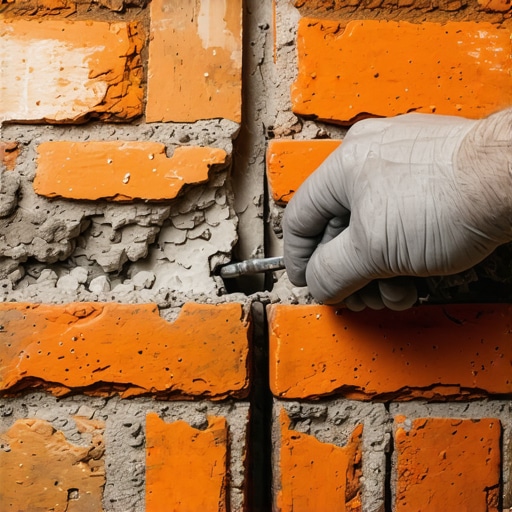
I remember a late November morning on a scaffolding six stories up a mid-century commercial facade. The homeowner, a property manager for a tech firm, thought the slight bulge in the brickwork was just a cosmetic quirk, a bit of ‘character’ from the building’s 1960s origin. But when I inserted the fiber-optic borescope into a clogged weep hole, the reality was grim. I wasn’t looking at a stable wall; I was looking at a structural ghost. The corrugated galvanized ties—the only thing holding 40 tons of brick to the steel studs—had oxidized into nothing more than orange dust and brittle flakes. This wasn’t a case for a bucket of mud and a prayer; it was a forensic emergency where the veneer was literally breathing with every gust of wind, detached from its anchor and leaning toward the sidewalk below.
The Anatomy of the Air Cavity: Why Veneers Fail
To understand why a brick veneer begins to bow or separate, you have to stop thinking of it as a wall and start thinking of it as a rain screen. In modern construction, the brick doesn’t hold up the house; it protects the house from the elements. Between the brick and the inner sheathing lies the ‘air cavity,’ a crucial space for drainage and ventilation. However, this cavity is also a breeding ground for galvanic corrosion. When moisture lingers due to poor commercial masonry facade maintenance, the zinc coating on wall ties undergoes a sacrificial reaction until it’s gone, leaving the raw steel to rot. As that steel rusts, it expands up to seven times its original thickness—a phenomenon known as ‘oxide jacking’—which can actually push the brick courses apart before the tie eventually snaps. This is where cracked brick wall repair moves from aesthetic to structural.
“Water penetration is the single greatest threat to masonry durability, and its control is the primary function of the building envelope.” – BIA Technical Note 7
The physics of separation is often driven by hydrostatic pressure and thermal expansion. In hot climates, a long soldier course or a massive expanse of running bond can expand significantly during the day. Without proper control joints, that expansion has nowhere to go but out. If the ties are already compromised, the wall ‘bellies.’ You’ll see the first signs of trouble in the tuckpointing brick walls—hairline fractures that don’t follow the mortar joints but cut right through the units themselves. This is the wall screaming for help.
The Forensic Solution: Remedial Helical Ties
For decades, the only answer to a separating veneer was the ‘tear-down,’ a messy, expensive, and soul-crushing process of stripping the building to its bones. Today, we use advanced masonry adhesives and helical tie systems to perform what I call ‘masonry bypass surgery.’ We drill a pilot hole through the brick and into the substrate—be it wood, concrete, or steel. We then drive a stainless steel helical anchor through the hole. The anchor’s fins ‘bite’ into both the veneer and the backup material, creating a mechanical connection that’s often stronger than the original ties. We use torque-sensing drivers to ensure each anchor is set to the exact foot-pound of resistance required by the engineer’s digital twin masonry projects, which map every stress point on the facade in a virtual environment before we ever pull a trigger.
“The flexural bond strength of the mortar-to-unit interface is the primary determinant of lateral load resistance in unreinforced masonry.” – ASTM C1329
Once the anchors are set, we don’t just ‘slap some mud’ over the holes. We use color-matched 2-part epoxies or 3D printed masonry repairs for complex ornamental sections like a stone balustrade restoration. The goal is a repair that is invisible to the eye but detectable by a magnet. This process saves the historical ‘tooth’ of the original brickwork while providing the lateral stability necessary to withstand seismic or wind-load events. It is the surgical alternative to the sledgehammer.
The Art of the Mud: Repointing and Finishing
After the wall is stabilized, we address the skin. This is where the full repointing services come in. You can’t just use any bag of pre-mix from a big-box store. If you’re working on a pre-1940s building, the brick is likely softer than modern Portland-based cement. If you use a hard Type S mortar on a soft clay brick, the brick will lose the fight. During the next freeze-thaw cycle, the mortar will stay rigid while the brick expands, causing the face of the brick to pop off in a process called spalling. I always mix my ‘mud’ to be slightly weaker than the masonry unit—the sacrificial lamb principle. We use a hawk and a slicker to deeply pack the joints, ensuring there are no ‘honeycombing’ pockets where water can hide. For the transitions to the ground, we might even look at masonry joint sand repair for the surrounding hardscape to ensure the entire drainage plane is coherent.
Mechanical Systems and Final Integrity
While the wall is being serviced, a true forensic mason looks at the secondary systems. Is the chimney damper repair necessary because moisture is migrating from the flue into the veneer? Are the weep holes clear, or did some ‘handyman’ caulk them shut because he thought they were ‘holes the bugs get into’? We often find that veneer separation is a symptom of a larger systemic failure. By using modern tech—like thermal imaging to find cold joints and moisture pockets—we can ensure the repair lasts another fifty years. We don’t just ‘butter’ the joints and leave; we restore the breathability of the assembly. A wall that can’t breathe is a wall that’s dying. Don’t let a ‘lick-and-stick’ contractor tell you otherwise; true masonry is about the balance of chemistry, physics, and a deep respect for the materials that outlive us all.