
The Forensic Scene: The Whispering Crack
The homeowner thought it was just a hairline crack, a seasonal quirk of an old Pennsylvania house. But when I put my scope inside that horizontal fissure, I didn’t just see a gap; I saw a foundation screaming under the weight of three wet tons of silty-clay. The structural steel reinforcement, what little there was from the original 1950s pour, was rusted to a fine orange dust. The wall wasn’t just cracked; it was deflecting. In the world of masonry forensics, we call this the ‘hydrostatic hammer.’ Every time the sky opens up and the ground saturates, that water pushes against the masonry with a lateral force that no unreinforced block wall was ever meant to withstand. You see it first as a horizontal line, usually three or four courses down. That’s the pivot point. If you don’t catch it there, you’re looking at a total blowout.
The Physics of the Bow: Why Walls Fail
To understand why we use carbon fiber, you have to understand the failure. A standard concrete block wall is fantastic at handling compressive strength—the vertical weight of the house pushing down. But it has almost zero tensile strength. When the soil outside freezes and expands—remember, water expands exactly 9% when it turns to ice—it creates a wedge. This freeze-thaw damage restoration isn’t just about fixing the face of the brick; it’s about addressing the structural shift. As the soil pushes, the inside of the wall is forced to stretch. Since concrete doesn’t stretch, it snaps.
“Water penetration is the single greatest threat to masonry durability, leading to both aesthetic degradation and structural compromise.” – BIA Technical Note 7
This is where the old-school guys would tell you to dig out the whole yard, jack up the house, and build a new wall. That’s a $40,000 headache that most folks can’t stomach. But modern material science has given us a way to ‘butter’ the wall with something stronger than steel.
The Carbon Fiber Revolution: Space-Age Mud
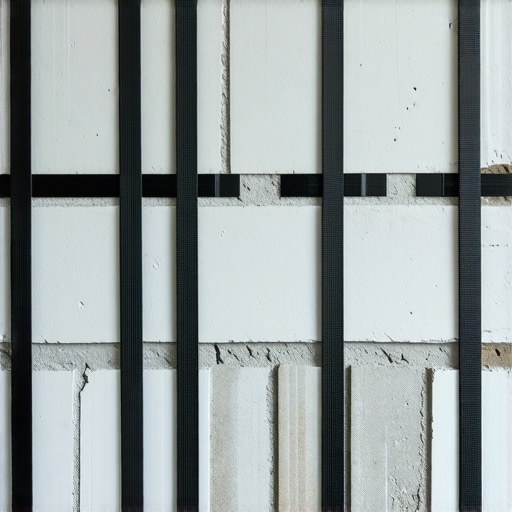
Carbon fiber straps aren’t a ‘handyman special’ fix. We’re talking about a material with a tensile strength exceeding 50,000 psi. When we apply these to a bowing wall, we are essentially giving the masonry a new set of tendons. The process is surgical. We don’t just slap them on. First, we have to prep the substrate. If there is masonry staining or efflorescence—that white salty powder—it has to be ground away. We use a diamond-shroud grinder to get back to ‘bright’ concrete. This creates the ‘tooth’ the epoxy needs to bite into. We’re looking for an open-pore structure so the resin can achieve a monolithic bond.
The Bonding Process: More Than Just Glue
Once the wall is prepped, we apply a base coat of high-viscosity epoxy resin. This isn’t your hardware store variety; this stuff is engineered to migrate into the microscopic fissures of the block. We then ‘butter’ the back of the carbon fiber strap. When the strap is pressed into the wall, the resin saturates the weave. This is the hydration of the repair system. As it cures, it doesn’t just sit on the wall; it becomes part of the wall’s molecular structure. Unlike steel I-beams, which require huge bolts and can actually concentrate stress in small areas of the floor joists, carbon fiber distributes the load across the entire height of the wall. It’s the difference between holding a book with your fingertips and holding it with your entire palm.
Beyond the Foundation: The Chimney and the Crown
Often, a bowing wall is just one symptom of a larger water management failure. If your chimney crown repair has been neglected, water is trickling down the interior cavity of your masonry, softening the mortar from the inside out. A cracked crown is a funnel. We see it all the time: the chimney cap replacement was ignored for a decade, and now the mortar repointing services needed for the chimney stack are the least of the owner’s worries. The water reaches the basement, saturates the backfill, and boom—hydrostatic pressure starts the bowing process.
“The chimney crown must be sloped to shed water and must have an overhang to prevent water from running down the masonry chimney walls.” – ASTM C1283
When we perform tuck pointing services on these old structures, we aren’t just making them look pretty with facade cleaning. We are restoring the ‘breathing’ capability of the building. Using a hard Portland cement on an old, soft-fired brick is a death sentence. The mortar must be the sacrificial lamb; it needs to be softer than the brick so that when the house breathes, the mortar yields, not the clay.
The Tech of Tomorrow: Robotic Masonry Repair
In high-density urban environments, we’re starting to see the rise of robotic masonry repair. These systems can map a facade with LIDAR and identify cracked brick wall repair needs that the human eye misses. While it sounds like sci-fi, it’s the same principle as my grandfather’s ‘ring test.’ He’d tap a brick with his trowel—if it didn’t ‘ring’ like a bell, it was dead inside. Today, we use ultrasonic pulse velocity to find those dead spots. Whether it’s patio stone realignment or stabilizing a skyscraper, the physics remains the same: manage the water, respect the expansion joints, and never trust a wall that doesn’t have a solid ‘tooth’ in its mortar.
The Mason’s Verdict: When to Repair vs. Rebuild
If a wall has moved more than 2 inches out of plumb, or if the ‘smile’ crack is wider than a quarter-inch, you’re past the point of a simple slicker and some mud. But carbon fiber straps can often save a wall that’s deflected up to 3 or 4 inches, provided the base is still pinned. It’s a permanent, non-invasive cure that doesn’t require destroying your landscaping. Don’t let a ‘lick-and-stick’ contractor tell you a bit of epoxy injection is enough. You need the tensile strength of the fiber. Do it once, do it right, and keep the water away from the ‘bones’ of your home. If you see the brick face spalling or the soldier course leaning, don’t wait. The earth doesn’t stop pushing just because you’ve ignored it.