
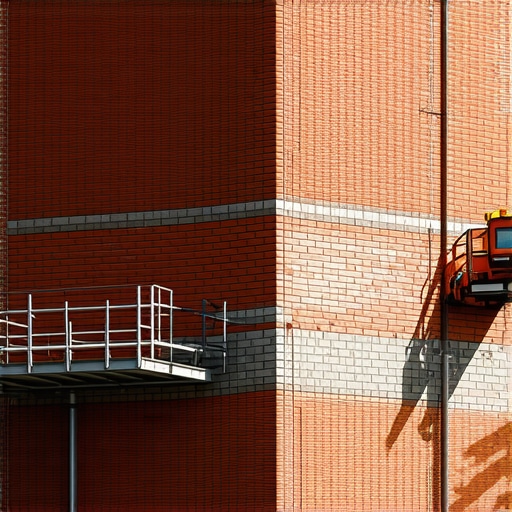
The Anatomy of a Failing Facade: A Forensic Perspective
The homeowner thought it was just a hairline crack snaking across the third-story header. But when I inserted the fiber-optic scope into the void, I didn’t see solid masonry; I saw a skeletal remains of a structural steel angle that had rusted to orange dust. This is the reality of masonry forensic work. What looks like a cosmetic blemish is often the external symptom of internal decay caused by decades of water infiltration and poor maintenance. On large-scale commercial facades, this decay isn’t just an eyesore—it’s a liability that can lead to catastrophic masonry displacement. When you are staring down 20,000 square feet of failing mortar joints, the traditional ‘hawk and trowel’ method is like trying to drain the ocean with a thimble. This is where machine tuckpointing and specialized weatherproofing become the only viable path to salvation.
The Physics of the Freeze-Thaw War
In our climate, the enemy isn’t just time; it’s the molecular expansion of H2O. When water enters a compromised mortar joint, it sits there, waiting for the temperature to drop. As it hits the freezing point, that water expands by approximately 9% in volume. This exerts an internal pressure that can exceed 100,000 psi—far more than any clay brick or stone can withstand. The result is spalling, where the face of the brick literally pops off, leaving the soft, porous interior exposed to the elements.
“Water penetration is the single greatest threat to masonry durability. Proper mortar joint integrity is the primary defense against moisture ingress into the wall system.” – BIA Technical Note 7
This is why tuckpointing weatherproofing is not a luxury; it is a structural necessity. If you ignore the joints, you’ll soon find yourself needing spalled concrete steps repair or, worse, a full-scale brick lintel replacement because the steel above your windows has expanded due to rust jacking, a process where oxidizing steel grows to several times its original thickness, lifting the masonry above it.
Machine Tuckpointing: Efficiency Meets Precision
Machine tuckpointing, often utilizing pneumatic or auger-driven mortar guns, has revolutionized how we approach large facades. In the old days, a mason would spend half his day just ‘buttering’ the slicker. With a machine system, the ‘mud’ is delivered directly into the back of the joint under consistent pressure. This ensures that the joint is packed from the back to the front, eliminating the internal voids that often occur with hand-pointing. When we talk about mortar matching services, machine application allows for a more consistent mix, ensuring that the new ‘mud’ has the same ‘tooth’ and compressive strength as the original material. This is critical because if your new mortar is harder than the brick—a common mistake with modern Portland-heavy mixes—the brick will fail first during thermal expansion. The mortar must always be the sacrificial element of the wall.
The Geotechnical Reality of Foundation Integrity
A facade is only as stable as what it sits on. Often, while inspecting a facade, I find that the root cause of the cracking isn’t the brickwork itself, but foundation wall bowing repair issues caused by hydrostatic pressure in the soil. When the earth around a building becomes saturated, it pushes against the foundation. If the drainage is poor, you get ‘honeycombing’ in the concrete and eventually, a structural shift that manifests as stair-step cracks in the brickwork above. In these cases, we might look at foundation slab jacking or self-healing concrete foundations for the repair, but for the exterior masonry, we must ensure the retaining wall capstone replacement and retaining wall geogrid installation are handled correctly to manage the soil pressure and water runoff. You can’t just slap new mortar into a crack caused by a moving foundation; you have to stop the movement first.
The Process: From Grinding to Striking
The restoration of a large facade begins with the ‘grinding out’ phase. We use dust-shrouded angle grinders to remove the failing mortar to a depth of at least 3/4 of an inch. We don’t just scratch the surface; we need a clean, square-bottomed channel to give the new mortar a mechanical bond. After the joints are cleaned and pre-wetted to manage suction—preventing the dry brick from sucking the moisture out of the ‘mud’ and causing it to ‘flash set’—the machine tuckpointing begins.
“The selection of mortar should be based on the physical properties of the masonry units. A mortar that is too strong can cause distress in the masonry.” – ASTM C270 Standards
We then ‘strike’ the joint using a slicker or jointer tool to compact the material and create a profile that sheds water effectively. This meticulous process, combined with masonry water damage repair techniques, ensures that the building can breathe while remaining watertight. It’s the difference between a ‘handyman special’ that peels off in three years and a master-grade restoration that lasts for a century.