
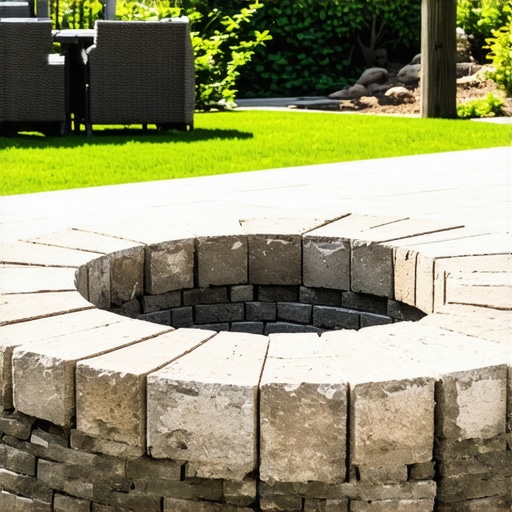
The Forensic Scene: The Anatomy of a Backyard Explosion
I was called out to a high-end property last July where a ‘designer’ fire pit had essentially self-destructed during a mid-summer barbecue. The homeowner thought it was just a hairline crack appearing in the mortar, a minor cosmetic flaw in a ten-thousand-dollar installation. But when I slid my fiber-optic scope into the void between the firebrick and the stone veneer, the reality was much grimmer. The structural steel reinforcement had been subjected to such intense thermal cycling without relief that it had warped, pushing the outer stone shell outward like a slow-motion explosion. This wasn’t a case of bad luck; it was a case of ignoring the fundamental physics of heat and moisture. Most modular fire pits sold today are ticking time bombs because they ignore the ‘tooth’ of the material and the inevitable expansion of the core. When you build with masonry, you aren’t just stacking heavy things; you are managing a thermodynamic system that wants to tear itself apart.
“Thermal expansion is a physical property of all masonry materials. Failure to provide adequate movement joints will result in cracking or structural distress.” – BIA Technical Note 18
The Micro-Zoom: Why Your Fire Pit is a Pressure Cooker
To understand why most DIY and ‘handyman special’ fire pits fail within two seasons, we have to look at the chemistry of the heat-affected zone. A standard red clay brick is a porous creature. When it rains, that brick sucks up water like a sponge. When you light a fire inside that pit, you are rapidly heating that trapped moisture. In a standard brick, the water turns to steam, and because it has nowhere to go, it creates internal pressure. This leads to spalling—where the face of the brick literally pops off in shards. To avoid this, a professional build requires high-alumina firebrick. These aren’t your average ‘mud’ blocks; they are dense, refractory units designed to withstand temperatures exceeding 2,000 degrees Fahrenheit without the rapid expansion that shatters standard masonry. We butter these bricks with a specific refractory mortar, often referred to in the trade as ‘mud,’ but it’s actually a sophisticated blend of fireclay and silica sand that chemically bonds under heat.
The Hardscape Truth: It’s All About the Base
Before you ever pick up a hawk or a slicker, you have to contend with the soil. A fire pit is a concentrated point load. If you build it on four inches of loose gravel, it will sink, tilt, and eventually require foundation slab jacking to level. The base must be a monolithic pour or a heavily compacted sub-base of 3/4-inch minus crushed stone, reinforced with retaining wall geogrid installation techniques to prevent lateral shifting. We’re talking about creating a foundation that can withstand the 9% expansion of water during the freeze-thaw cycle if you’re in the North, or the intense soil desiccation in the South. Without a stable base, you’ll be looking for foundation crack repair services before the second winter is over. We often use BIM masonry projects to model the weight distribution of the final structure, ensuring the soil’s bearing capacity isn’t exceeded by the heavy natural stone veneer.
“Refractory mortars used in firebox construction must comply with ASTM C199 to ensure they do not soften or lose their bond at elevated temperatures.” – ASTM C1283-15
The Engineering of the Air Gap
The single biggest mistake in modular fire pit construction is the ‘lick-and-stick’ method—applying stone veneer directly to the firebrick. This creates a cold joint that will fail as soon as the inner ring gets hot. Stone and firebrick have different thermal expansion coefficients; they grow at different rates. The secret to a pit that lasts fifty years is the ‘Air Gap.’ You must build an inner refractory liner and an outer decorative shell with at least a one-inch void between them. This gap acts as a thermal break, allowing the inner ring to expand independently of the outer stone balustrade restoration-grade masonry. Without this gap, the outward pressure of the hot firebrick will snap the mortar joints of your beautiful brickwork pointing styles on the exterior.
Refractory Mud and the Art of Buttering
When we talk about ‘buttering’ the bricks, we’re talking about achieving 100% coverage on the head and bed joints. Any void in the mortar is a place where water can collect, freeze, and blow the joint apart. In chimney rebuild services, we see this all the time—hollow joints that lead to total structural failure. For a fire pit, you want to use a soldier course for the top cap to shed water away from the core. The pointing of these joints isn’t just for looks; using full repointing services techniques ensures the joints are ‘struck’ hard to compact the mortar and create a weather-tight seal. If you see honeycombing in the mortar, you’ve failed. You need a dense, smooth finish that resists the soot and acidic byproduct of wood combustion.
The Rescue: When Disaster Strikes
If you’re already seeing cracks, you’re in the territory of masonry rescue after disaster. A hairline crack in the capstone is often the first sign that the internal brick lintel replacement logic was ignored. At this stage, you might need to disassemble the top two courses and install a proper expansion joint. If the core is shattered, it’s often cheaper to perform a full teardown than to attempt a patch job that will only last a season. Longevity in masonry isn’t about the strength of the cement; it’s about the intelligence of the assembly. Whether you are doing stone balustrade restoration or building a simple modular pit, the physics remains the same: Respect the heat, manage the water, and never trust a ‘lick-and-stick’ solution for a high-temperature environment. [{“@context”:”https://schema.org”,”@type”:”HowTo”,”name”:”How to Build a Crack-Resistant Masonry Fire Pit”,”step”:[{“@type”:”HowToStep”,”text”:”Excavate 12 inches and install a reinforced concrete footing with geogrid stabilization.”},{“@type”:”HowToStep”,”text”:”Lay an inner ring of ASTM C64 firebrick using refractory mortar, leaving a 1-inch air gap.”},{“@type”:”HowToStep”,”text”:”Construct the outer veneer using natural stone, ensuring no contact with the inner firebrick liner.”},{“@type”:”HowToStep”,”text”:”Cap the structure with a sloped soldier course or solid stone ring to prevent water ingress.”}]}]