
The Forensic Scene: A Ticking Time Bomb in the Backyard
The homeowner called me out because of what they described as a “hairline crack” in a twenty-foot stretch of landscape wall. When I arrived, I didn’t even need my level to see the disaster. The wall was leaning like a prize fighter about to hit the canvas. But it wasn’t until I put my fiber-optic scope into a weep hole that I saw the truth: the structural steel inside that poured concrete was rusted to red dust, a victim of chloride ion penetration and poor vibration during the pour. That wall wasn’t just cracking; it was breathing its last breath. This is the reality of masonry forensics. Whether you are looking at brick wall restoration or building a new barrier against gravity, the choice between modular blocks and poured concrete isn’t about looks—it is about the brutal physics of soil and water.
The Anatomy of Failure: Why Walls Fall
In the North, we fight a war every winter. The enemy is the freeze-thaw cycle. Water is the only substance on earth that expands as it freezes, increasing its volume by roughly 9%. When that water is trapped in the pore structure of a rigid poured wall, it exerts internal pressure that can exceed 30,000 psi. If your concrete doesn’t have the right air-entrainment—tiny microscopic bubbles for that water to expand into—the face of your wall will start spalling, peeling off like a bad sunburn. This is why I often sneer at “handyman specials” where the mud is mixed too wet just to make it easier to butter the forms.
“Water penetration is the single greatest threat to masonry durability. Without proper drainage and material selection, hydrostatic pressure will compromise any rigid structure over time.” – BIA Technical Note 7
Modular Blocks: The Segmental Gravity Specialist
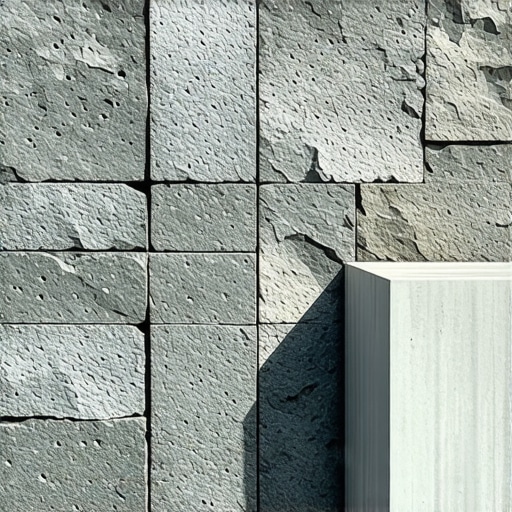
Modular blocks, or Segmental Retaining Walls (SRWs), are the “New World” answer to ancient dry-stack stone. These are not just heavy bricks; they are engineered units that rely on mass and friction. One of the greatest advantages of a modular system is its ability to move. Because there is no mortar (no “mud”) holding them into a rigid monolith, the wall can shift slightly with the soil’s natural heaving without cracking. Micro-zooming into the interface of these blocks, we see the importance of the “tooth” or the shear key. This mechanical connection prevents the blocks from sliding forward under the active soil pressure (Ka). For walls of significant height, retaining wall geogrid installation is non-negotiable. Geogrid is a high-tenacity polymer mesh that extends back into the soil, essentially turning the entire hillside into a reinforced mass. Without geogrid, you’re just stacking Legos against a landslide.
Poured Concrete: The Rigid Monolith
Poured concrete is the “heavy hitter.” It is a monolithic structure that, when done correctly, can outlast the person who paid for it. However, it is far less forgiving than modular blocks. The chemistry of a poured wall is a complex dance of hydration. As the Portland cement reacts with water, it forms Calcium Silicate Hydrate (C-S-H) crystals. If the concrete is poured in stages, you risk a cold joint—a literal weak point where the two pours didn’t bond chemically. If the contractor didn’t use a vibrator to settle the mix, you get honeycombing, which are air pockets that invite water in to start the rusting of your rebar. In forensic inspections, I often see foundation wall bowing repair being necessary on poured walls because the original builder ignored hydrostatic pressure. Once a poured wall bows, retaining wall batter correction is nearly impossible without total excavation.
The Scars of Time: Restoration and Maintenance
If you are dealing with an existing structure, you might be looking at stone facade restoration or even tuckpointing on an old brick retaining wall. I’ve seen people try to hide structural issues by applying stone veneer over brick. It’s a classic cover-up. If the underlying brick is failing due to salt saturation or rising damp, that veneer will pop off in three seasons. When we perform mortar matching services, we aren’t just looking at color; we are looking at the compressive strength. You never put a high-strength Portland mortar on a soft, historic brick. The mortar must be the “sacrificial lamb”—softer than the masonry unit itself so that it absorbs the stress. This same logic applies to tile grouts on masonry copings; if the grout is too rigid, it will crack and allow water to bypass your drainage system.
“Concrete masonry units shall conform to ASTM C1372, ensuring the physical requirements for strength and absorption are met for the intended environment.” – ASTM Standards
The Verdict: Which Lasts Longer?
If you are in a high freeze-thaw zone with expansive clay soils, a modular block wall with professional retaining wall geogrid installation often has the longest service life because it doesn’t fight physics—it flows with it. Poured concrete can technically last longer, but only if the drainage is perfect, the rebar is epoxy-coated, and the footing is deep below the frost line. If you start seeing cracks, don’t wait. Whether it’s brick wall restoration or a full foundation wall bowing repair, the longer you wait, the more gravity wins. I’ve seen too many soldier course accents on walls that were leaning 10 degrees out of plumb; no amount of metallic masonry finishes can hide a failing skeleton. Do it once, do it right, or get used to the smell of a damp, failing basement wall.