![4 Stone Balustrade Restoration Tactics for Wobbly Rails [2026]](https://masonryrescue.com/wp-content/uploads/2026/04/4-Stone-Balustrade-Restoration-Tactics-for-Wobbly-Rails-2026.jpeg)
4 Stone Balustrade Restoration Tactics for Wobbly Rails [2026]
The Forensic Scene: When a Hairline Becomes a Hazard
I was called out to an estate last October where the homeowner complained that their limestone balustrade felt a bit ‘spongy’ when they leaned on it. From ten feet away, it looked like a masterpiece of 1920s craftsmanship. But when I put my scope inside a minor vertical fissure, the truth was ugly: the structural steel dowels were rusted to dust. They hadn’t just oxidized; they had undergone what we call ‘rust jacking.’ As that iron converted to iron oxide, it expanded up to seven times its original volume, exerting thousands of pounds of internal pressure that was literally exploding the stone from the inside out. This isn’t just an aesthetic issue; it’s a structural failure waiting for a lawsuit. People think a stone rail is a permanent mountain, but without the right internal physics, it’s just a stack of heavy rocks waiting for a nudge.
“Water penetration is the single greatest threat to masonry durability.” – BIA Technical Note 7
To understand why these rails fail, we have to look at the chemistry of the bond. Modern ‘lick-and-stick’ stone veneer over brick has taught a whole generation of masons that glue is the answer. It isn’t. In a structural balustrade, the rail must withstand lateral loads, which means the physics of the connection is everything. If you’re using high-slump concrete pump masonry mixes for repairs, you’re already behind. You need a mix that respects the modulus of elasticity of the original stone. When I’m tuckpointing curved walls or specialized balusters, I’m looking for a ‘sacrificial’ mortar. The mortar must be softer than the stone so that the inevitable stresses of thermal expansion and contraction crush the mortar, not the priceless limestone or granite. If you use a hard Portland cement on soft historic stone, the stone will lose every single time.
Tactic 1: The Stainless Steel Internal Skeleton
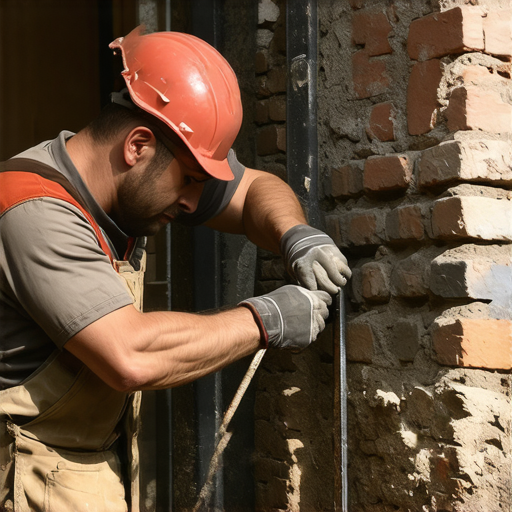
When we find a wobbly rail, the first step is surgery. We don’t just ‘butter’ the joints and pray. We drill and pin. I use 316-grade stainless steel all-thread because it won’t react with the alkalinity of the mud. This is a mechanical fix, not just a chemical one. In a retaining wall geogrid installation, you’re using friction and mass; here, you’re using shear strength. We drill through the handrail, through the baluster, and into the plinth. Then, we ‘butter’ the hole with a high-strength, non-shrink grout. This creates a continuous structural spine. Without this, you’re just stacking blocks and hoping gravity does your job for you.
Tactic 2: Vapor Permeability and the Lime Secret
The biggest mistake in 2026 is the obsession with sealing everything tight. Stone needs to breathe. If you trap moisture behind a non-breathable masonry waterproofing solutions, you’re inviting spalling. In northern climates, that trapped water hits the freeze-thaw cycle, expands 9%, and pops the face of your stone off like a bottle cap. I stick to Type N or Type O mortars for restoration. We’re talking about the carbonation process—where the lime in the mortar absorbs CO2 from the air over decades to return to its original stone state. It’s a slow-motion chemical hardening that modern masons don’t have the patience for. They’d rather use a fast-set outdoor kitchen masonry build epoxy that’ll brittle out in five years.
“The strength of a masonry wall depends more upon the quality of the mortar and the workmanship than upon the strength of the individual units.” – ASTM C270 Standards
Tactic 3: Managing the Plinth and Sub-Base
A rail is only as steady as what it sits on. Often, wobbly rails are the result of settlement in the main structure. Just like retaining wall block replacement, if the footing is moving, the top will scream. We look for ‘honeycombing’ in the concrete base or signs that the chimney flue liner installation has caused moisture to migrate into the masonry attic, weakening the supports. We use a slicker to ensure our joints are ‘bucket-handle’ or ‘V-jointed’ to shed water away from the core. If water sits on the plinth, it finds a way in. We check the chimney sweep and repair logs if the rail is near a stack, as acidic soot can eat away at the lime mortar over time.
Tactic 4: Precision Tuckpointing on the Radius
Restoring a wobbly rail usually involves tuckpointing curved walls at the baluster base. This is where you see the difference between a pro and a ‘handyman special.’ You need a hawk and a small slicker tool to compress the mortar into the joint. If you don’t compress it, you leave micro-voids. Those voids are the highways for water. We match the ‘tooth’ of the original stone by adding specific sands to our mud. We don’t want a cold joint where the new material meets the old. We pre-hydrate the stone so it doesn’t suck the moisture out of the mortar too fast—if it ‘burns’ the mortar, you’ll have no bond, just a dry, crumbly mess that will fail before the season is out. For high-end chimney repair services or balustrade work, this attention to the hydration curve is what separates a 50-year fix from a 5-month patch job.
Ultimately, a stone balustrade isn’t just a decoration; it’s a structural barrier. Whether you’re integrating it into an outdoor kitchen masonry build or restoring a 100-year-old balcony, the physics remain the same. Respect the stone’s need to move, keep the water out of the core with proper pinning and masonry waterproofing solutions, and never, ever trust a contractor who doesn’t know the difference between a lime-based mud and a bag of cheap premix. You do it once, or you do it twice—and the second time always costs triple.
![Emergency Masonry Repair: 3 Signs Your Wall Might Collapse [2026]](https://masonryrescue.com/wp-content/uploads/2026/03/Emergency-Masonry-Repair-3-Signs-Your-Wall-Might-Collapse-2026.jpeg)