5 Smokestack Repair Fixes to Prevent 2026 Safety Fines
The Forensic Scene: What Lies Beneath the Surface
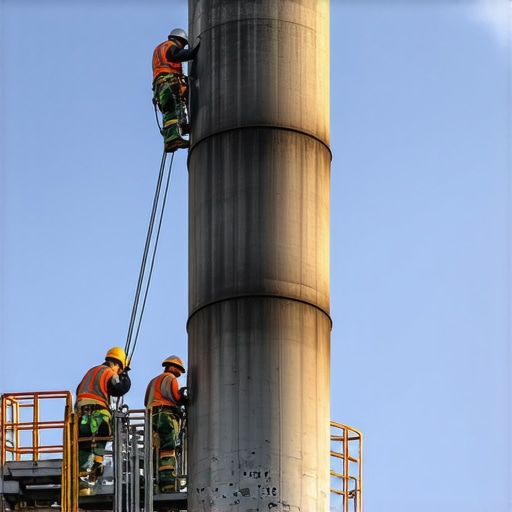
The homeowner, or in this case, the plant manager, thought it was just a hairline crack. A thin, jagged lightning bolt running down the north face of a 120-foot industrial stack. But when I put my borescope inside that fissure, the reality was a gut-punch. The structural steel hoops, meant to provide the tensile strength that masonry lacks, were rusted to orange dust. They had undergone a process of heavy oxidation, expanding to four times their original thickness and acting like a wedge, splitting the brickwork from the inside out. This is the hidden cancer of industrial masonry. By the time you see a crack on the exterior, the internal ‘skeleton’ is often already failing. With the 2026 safety audits looming, these structures are no longer just ‘old buildings’—they are ticking financial time bombs.
1. Deep-Level Repointing: The Sacrificial Joint Principle
Most industrial stacks built before the mid-century were designed with a specific understanding of vapor permeability. You cannot just slap any hardware-store bag of ‘Portland’ on these joints. When we talk about tuckpointing tools for DIY or professional chimney repair services, we are really talking about managing the migration of moisture. The mortar must be softer than the brick. This is the ‘Sacrificial Principle.’ If the mortar is too hard, the freeze-thaw cycle won’t crush the ‘mud’—it will crush the brick.
“Mortar should be designed to be weaker than the masonry units so that any stress-induced cracking occurs in the mortar joints where it can be easily repaired.” – BIA Technical Note 7
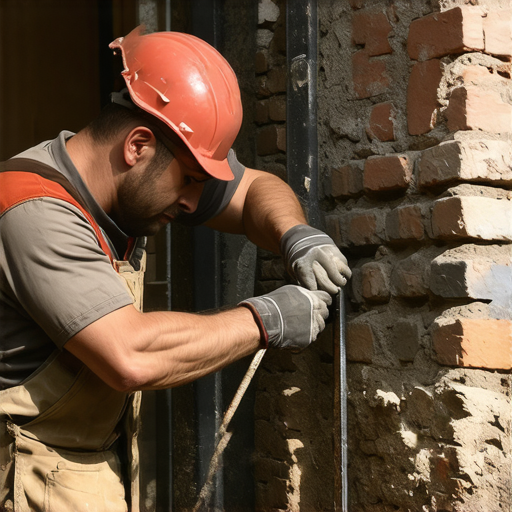
During the tuckpointing process, we grind out the failing joints to a depth of at least one inch. We don’t just ‘butter’ the surface. We use a hawk and a slicker to pack the mortar in ‘lifts,’ ensuring there are no voids. Voids are where water collects, and in the North, that water is a demolition crew. When it freezes, it expands by 9%, popping the faces off the brick in a process called spalling.
2. Structural Brick Column Repair and Load-Bearing Stability
An industrial smokestack is essentially a massive, circular brick column repair project that never ends. The physics of a vertical masonry structure involve immense compressive stress. Every brick at the base of a 100-foot stack is carrying the weight of thousands of its brothers above it. When you see vertical cracking, you aren’t just looking at ‘settlement’; you are looking at axial loading failure. To fix this, we often have to perform ‘dental work’—removing and replacing individual bricks without compromising the stack’s integrity. We look for ‘ringing’ bricks. If you tap a brick with a hammer and it gives a dull ‘thud’ instead of a high-pitched ‘ping,’ the internal molecular structure has been compromised by heat or acid saturation. These must be cut out and replaced with units that match the original’s compressive strength and absorption rate.
3. High-Performance Concrete Patching and Thermal Shock
The concrete cap, or the ‘crown,’ is the most abused part of the stack. It sits in the direct path of sulfurous exhaust and the beating sun. A concrete patch at this height isn’t about aesthetics; it’s about preventing hydrostatic pressure from entering the wall cavity. We use air-entrained concrete for these repairs. The ‘micro-bubbles’ in air-entrained concrete provide a ‘pressure relief valve’ for freezing water. Without these microscopic voids, the concrete will delaminate in a single season. When applying a patch, we ensure there is no honeycombing—those nasty pockets of air that occur when the mix isn’t vibrated or packed correctly. A cold joint, where new concrete meets old without a bonding agent, is a recipe for a 2026 safety violation fine.
4. Geogrid Reinforcement and Retaining the Base
Many stacks are part of larger complexes where retaining wall geogrid installation is necessary to stabilize the surrounding soil. If the soil shifts, the stack leans. A lean of even one degree on a tall stack can increase the pressure on the ‘toe’ of the foundation by thousands of pounds per square foot. We use biaxial geogrids to lock the aggregate together, creating a stable ‘raft’ for the masonry. This isn’t a brick patio restoration; this is geotechnical engineering. The tensional force of the soil must be countered, or the stack will eventually experience differential settlement, leading to catastrophic failure.
“The use of geosynthetic reinforcement allows for the construction of stable slopes and walls by providing tensile resistance to the soil mass.” – ASTM D6637
5. Metallic Brick Colors and Specialized Protective Coatings
In modern industrial stone facade restoration and smokestack work, we are seeing the rise of metallic brick colors application. These aren’t just for looks. These specialized glazes and coatings often contain metallic oxides that reflect UV radiation and provide a non-porous barrier against acid rain. While green roofing masonry integration is popular for office buildings, smokestacks require ‘breathability’ through their vertical surfaces but ‘impermeability’ on their caps. We often see ‘lick-and-stick’ repairs failing because the contractor didn’t understand capillary suction. If the brick is too dry when the mortar is applied, it ‘sucks’ the water out of the mud too fast. The mortar ‘burns’ or ‘flashes,’ failing to create a chemical bond. We always ‘pre-wet’ the masonry to ensure the hydration process happens slowly, allowing the calcium silicate hydrates to form a dense, interlocking matrix.
Final Verdict: The Cost of the ‘Handyman Special’
Whether you are building an outdoor kitchen masonry build or repairing a 150-foot flue, the physics remain the same. Gravity never sleeps, and water always wins. If you think hiring a professional for chimney repair services is expensive, wait until the safety inspector hands you a five-figure fine in 2026 because your stack is shedding ‘brick-bats’ onto the parking lot. Masonry is a language of weight and breath. If you stifle the breath with the wrong materials or ignore the weight, the building will eventually stop talking and start screaming.

![4 Signs Your Brick Ties Are Failing (And How to Fix Them) [2026]](https://masonryrescue.com/wp-content/uploads/2026/04/4-Signs-Your-Brick-Ties-Are-Failing-And-How-to-Fix-Them-2026.jpeg)