Why Your Office Building’s Emergency Roof Leak is Actually a Masonry Issue
It’s 2:00 AM on a Tuesday, and a heavy Midwestern thunderstorm is battering your commercial property. Your phone buzzes on the nightstand – it’s the facility manager. There is a significant intrusion of water in the third-floor executive suite, and it’s dripping directly onto a $15,000 conference table. Your first instinct, and the instinct of almost every building owner in this situation, is to search for an Emergency Roof Leak for Office Building repair team.
You assume the membrane has failed. You assume there’s a puncture, a backed-up drain, or a failed seam. But when the roofing crew arrives the next morning, they find the membrane is perfectly intact. There are no holes. The drains are clear. Yet, the water continues to migrate inward. This is the “Roof Fallacy” – the belief that because water is coming from above, the roof must be the culprit. As a Building Envelope Consultant, I frequently have to deliver the surprising news: your Commercial Roof Leak isn’t a roofing problem at all; it’s a masonry failure.
In the industry, we call this “saturation leakage.” It occurs when the exterior masonry of your building becomes so overwhelmed by moisture that it can no longer hold water, allowing it to penetrate the interior. To solve these “mystery leaks,” we have to stop looking at the roof as a lid and start looking at the building as a cohesive, interconnected system known as the Building Envelope.
Understanding the Building Envelope: More Than Just a Lid
The Building Envelope (or building enclosure) is the physical separator between the conditioned interior of your office and the unconditioned exterior environment. It includes the foundation, the walls, the windows, and, of course, the roof. In the mind of a facility manager, these are often treated as separate silos. In reality, they are deeply interdependent.
Most modern office buildings utilize masonry – brick, stone, or concrete masonry units (CMU) – because of its durability and aesthetic appeal. However, unlike glass or metal panels, masonry is inherently porous. It breathes. It absorbs. Under normal conditions, a brick wall absorbs a certain amount of moisture and then releases it back into the atmosphere through evaporation. But during sustained driving rain, that masonry can reach its “hydrostatic limit.”
When the masonry becomes fully saturated, gravity takes over. The water doesn’t just sit there; it travels. If the internal drainage systems of the wall are compromised, that water will find the path of least resistance, which often leads directly into your ceiling plenum, mimicking the appearance of a roof leak. Before you call an Emergency Commercial Roofer, it is critical to understand if the water is coming *through* the roof or *around* it.
For a deeper dive into the technical details of these inspections, see my guide on Beyond the Surface: What We Look for During a 50-Point Masonry Check.
The Usual Suspect: The Parapet Wall
If you are experiencing a leak near the perimeter of your building, the first place I look isn’t the flat roof membrane – it’s the parapet wall. A parapet is the extension of the wall that rises above the roofline. While they provide safety and architectural flair, they are the most vulnerable point in the entire building envelope.
Why are parapets so problematic? Because they are exposed to the elements on three sides: the exterior face, the top (the “cap”), and the interior “back” side that faces the roof. This exposure makes them highly susceptible to rapid saturation and thermal expansion. When the sun hits a wet parapet, the moisture inside turns to vapor, creating internal pressure that can blow out mortar joints or cause “Cap Leaks.”
Common Parapet Failures
- Failing Mortar Joints: Over time, the mortar between bricks erodes. During high winds, rain is forced into these gaps, bypassing the brick entirely.
- Coping Cap Failures: The metal or stone “hat” on top of the wall is designed to shed water. If the joints in the coping are cracked, water pours directly into the center of the wall.
- Termination Bar Issues: This is where the roof membrane is fastened to the wall. If the sealant at the top of the termination bar fails, water running down the masonry gets behind the membrane, making it look like the roof is leaking.
Many owners realize too late that Fixing the Edge: Why Commercial Parapet Wall Repair Can’t Wait is the only way to stop recurring interior damage. Furthermore, Waterproofing Commercial Parapets: Protecting Your Building’s Roof Line is often a more effective long-term solution than simply patching the roof membrane.
Saturation Leakage vs. Membrane Failure
Distinguishing between a membrane failure and saturation leakage is the hallmark of professional Commercial Roofing analysis. A membrane failure is usually localized. If there is a hole in the TPO or EPDM, the water will generally appear directly under that hole shortly after the rain starts.
Saturation leakage, however, behaves differently. It often manifests as a “slow-motion” leak. The rain might stop at 4:00 PM, but the ceiling continues to drip until 10:00 PM. This is because the masonry is slowly draining its stored moisture into the building. To diagnose this, I look for “The Three Signs of Masonry Distress”:
1. Efflorescence
This is the white, powdery substance you see on the exterior of brick walls. It is caused by water moving through the masonry and dissolving internal salts. When the water evaporates at the surface, the salt is left behind. If you see heavy efflorescence, you have a water migration problem.
2. Spalling
Spalling occurs when water trapped inside the brick freezes and expands, causing the face of the brick to flake or pop off. This is a clear indicator that the “sponge” is full and the masonry is deteriorating.
3. 30-Degree Cracks
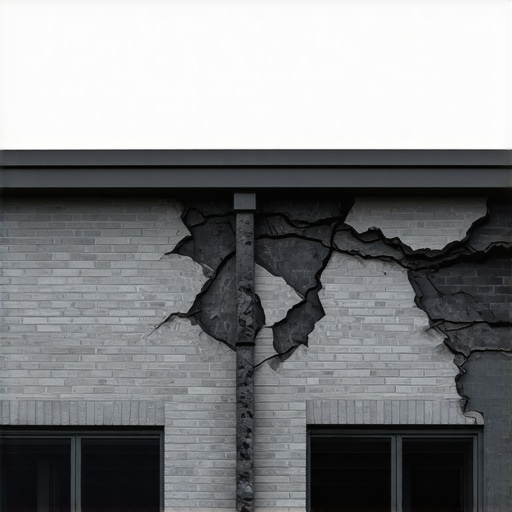
Cracks that follow mortar joints in a stairstep pattern or diagonal cracks at 30-to-45-degree angles often indicate structural shifting or thermal stress, both of which create massive entry points for water.
If your building shows these signs, applying a topical sealer might seem like the answer, but be careful. You must understand The Problem with Sealing Old Bricks: When to Use Breathable Sealants. Using the wrong sealer can trap moisture inside, accelerating the destruction of your wall.
The Role of Through-Wall Flashing and Lintels
One of the most misunderstood components of the building envelope is through-wall flashing. In a properly constructed masonry wall, there is a small cavity between the exterior brick and the interior backup wall. Any water that penetrates the brick is supposed to hit a waterproof flashing layer and be directed back outside through “weep holes.”
However, in many older office buildings, this flashing was either installed incorrectly, has degraded over time, or the weep holes have been mistakenly painted over or caulked shut by overzealous maintenance crews. When the water has no way to exit the wall, it builds up until it overflows the flashing and enters the interior.
Similarly, the steel lintels – the horizontal supports over windows and doors – are often a source of “roof” leaks. When these steel beams rust, they expand (a process called “rust jacking”), which cracks the surrounding masonry. If you notice a leak specifically above a window line, it’s rarely the roof; it’s likely a lintel failure. Knowing What to Do When a Brick Lintel Suddenly Drops can save you from a catastrophic facade failure and a very expensive interior repair bill. For immediate assistance with structural exterior issues, reaching out to Peak to Peak Roofing & Exteriors can help bridge the gap between roofing and masonry expertise.
Why a “Roofer-Only” Fix Often Fails
When you call a standard roofing contractor for a Commercial Roof Leak, they are looking at the world through the lens of their specialty. They will check the seams, the flashing boots, and the perimeter metal. If they see a potential gap, they’ll apply a bead of caulk or a patch of membrane.
This is often just a band-aid. If the source of the water is saturation through the parapet or a failed through-wall flashing, the roofer’s patch won’t do a thing. The next time a wind-driven rain hits the building, the water will simply bypass the new patch by entering the masonry three feet above it.
This is why an independent Building Envelope Consultant is vital. We don’t sell “patches”; we provide forensic analysis. We use infrared thermography and moisture meters to track the actual path of the water from the exterior skin to the interior ceiling. Without this holistic view, you end up in a cycle of “repair and repeat,” wasting thousands of dollars on roofing “fixes” that never address the root cause. This is exactly Why your commercial masonry maintenance plan needs a mid-year check – to catch these envelope breaches before they become midnight emergencies.
Conclusion & Preventative Strategy
The next time you are faced with an Emergency Roof Leak for Office Building, take a moment to look at the walls. Is there efflorescence? Are the mortar joints crumbling? Is the leak located near a parapet or a window lintel?
Stopping water intrusion requires more than just a bucket of tar; it requires an understanding of how your building’s skin interacts with its lid. Don’t wait for the next storm to test your building’s limits. A proactive building envelope audit can identify saturation risks, failing flashings, and parapet vulnerabilities before they turn into executive-suite disasters.
At Masonry Rescue, we specialize in the “Whole Building” approach. We don’t just look at the leak; we look at the physics of your building. Contact us today for a professional assessment, and let’s stop your “roof” leak at the source – the masonry.