
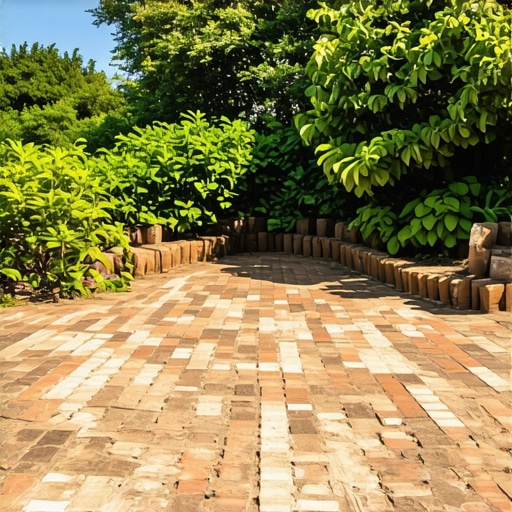
The Forensic Reality of the ‘Vintage’ Dream
The homeowner thought it was just a hairline crack running through the perimeter of their newly laid reclaimed brick patio. They had spent a fortune on ‘authentic’ material from a demolished textile mill, lured by the promise of sustainable masonry materials and that weathered, historical aesthetic. But when I knelt down and put my digital scope into the void beneath the soldier course, I saw the truth: the structural integrity was non-existent. The soil hadn’t been compacted to 95% Proctor density, and those century-old bricks were essentially dissolving from the bottom up. What looked like a charming patina was actually the early stages of catastrophic brick spalling prevention failure. You don’t just ‘lay’ recycled brick; you perform a surgical installation on a patient that’s been dead for a hundred years. If you don’t understand the mineralogy and the physics of the suction—what we pros call the Initial Rate of Absorption (IRA)—that recycled clay will suck the life out of your bedding sand and leave you with a wavy, dangerous mess within two seasons.
“Water penetration is the single greatest threat to masonry durability, particularly in salvaged units where the original fire-hardened skin may be compromised.” – BIA Technical Note 7
The Physics of the Salvaged Unit: Why ‘Old’ Isn’t Always ‘Gold’
To understand why recycled brick is the ultimate green choice, we have to look at the chemistry. Modern bricks are fired in computer-controlled tunnel kilns where every unit is identical. Old-world bricks were fired in periodic kilns where temperatures varied wildly. You have your ‘clinkers’—the over-fired, glassy units near the heat source—and your ‘salmons’—the under-fired, soft units from the edges. When you’re sourcing sustainable masonry materials for a patio, you’re basically playing a game of forensic sorting. If you accidentally put a ‘salmon’ brick in a high-traffic area, the first freeze-thaw cycle will turn it into a red paste. Because water expands by 9% when it turns to ice, it exerts internal pressure that exceeds the tensile strength of the weathered clay. This is why brick spalling prevention starts with the selection process, not the sealer. You’re looking for units that ‘ring’ with a high-pitched metallic note when tapped with a 24-ounce hammer. That sound is evidence of a tight crystalline structure, likely a mix of hematite and quartz that has vitrified into a durable matrix.
The Foundation: It’s All About the Base
Most handymen think a four-inch dump of gravel is enough. It’s not. For a recycled brick patio that won’t shift like a tectonic plate, you need a geotechnical approach. We’re talking about a multi-layered sub-base of crushed aggregate, compacted in two-inch ‘lifts.’ If the patio sits near a slope, we’re looking at retaining wall geogrid installation to ensure the lateral pressure doesn’t blow out the sides. Geogrid acts like the rebar of the soil, locking the aggregate together so the heavy recycled units don’t migrate. I’ve seen foundation work on high-end estates where they skipped the geogrid, and three years later, the $50,000 patio was sliding into the koi pond. You have to respect the hydrostatic pressure. When I’m providing masonry repair services, 80% of the time I’m fixing a failure of the invisible work—the dirt and the stone you’ll never see. We use a ‘hawk’ and a ‘slicker’ to finish any joints, but the real magic happens in the compaction. If you don’t use a vibratory plate compactor until your teeth rattle, you’re just wasting your time with the mud.
The Restoration of Vertical Elements
A patio isn’t just a floor; it’s an environment. Often, these projects involve tuckpointing curved walls that frame the space or an outdoor masonry fountain restoration that uses the same reclaimed material. This is where the ‘Mud’ (mortar) becomes critical. You cannot use modern Type S Portland cement on 19th-century recycled bricks. The cement is harder than the brick. When the wall expands in the summer sun, the brick will crush itself against the mortar. We use a high-calcium lime putty or a Type O mortar—a ‘sacrificial’ material. The mortar must be the weakest link in the chain so that it can be easily replaced during masonry repair services without destroying the irreplaceable brick. For any vertical chimneys or pillars, chimney flue liner installation and stone coping installation are mandatory to shed water away from the face. If water gets behind the recycled brick face on a vertical surface, gravity and the freeze-thaw cycle will peel the wall like an orange.
“The use of lime-based mortars allows for the autogenous healing of hairline cracks, a property essential for the longevity of historic masonry assemblies.” – ASTM C270 Standards
The Anatomy of a Lasting Installation
When we get into chimney structural repair or building out a new outdoor fireplace with these green materials, we’re looking at the thermal expansion coefficients. Recycled bricks have already lived one life; they’ve already undergone their primary shrinkage. This makes them incredibly stable if—and only if—you manage the moisture. We ‘butter’ the ends of the bricks to ensure 100% head joint saturation. No ‘holidays’ (gaps) in the mud. For the edges, stone coping installation provides a ‘drip edge’ that keeps the runoff from saturating the patio’s base. If you’re doing tuckpointing curved walls, you’re looking at a labor-intensive process of striking the joints to a ‘weathered’ or ‘V’ profile to ensure water doesn’t sit on the ledge. It’s the difference between a patio that lasts 10 years and one that lasts 100. Don’t listen to the ‘lick-and-stick’ contractors who want to use thin-set on a concrete pad. A true recycled brick patio should be flexible, breathable, and structurally sound from the sub-grade up. That is the only way to honor the material and the ‘Green’ promise. Anything less is just an expensive pile of rubble waiting to happen. If you see ‘honeycombing’ in the mortar or a ‘cold joint’ in the concrete edge restraint, stop the job. That’s the forensic investigator in me talking—do it once, or do it twice and pay me to tell you why it failed.