
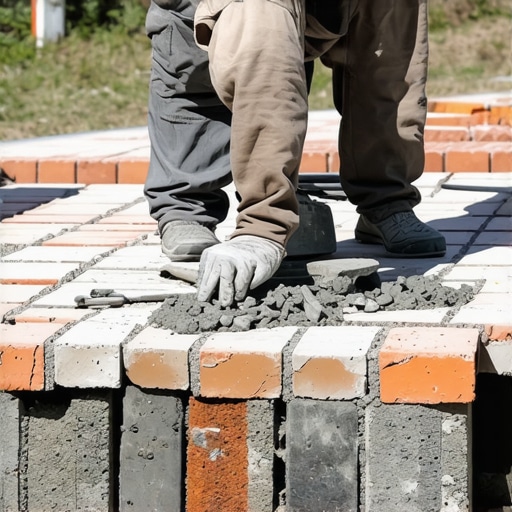
The Ghost of a Ruined Hearth: A Warning from the Field
I remember standing before a massive outdoor hearth in the middle of a November freeze. The homeowner had spent a small fortune on a stone facade restoration that looked like a million bucks from the driveway, but every time they lit a fire, they heard a sound like a pistol shot. When I pulled my inspection mirror out, I didn’t see soot; I saw structural suicide. The previous contractor had used standard Type S ‘mud’ to butter the firebricks. Under the heat, the mortar hadn’t just cracked—it had vitrified and then shattered, leaving the entire chimney assembly hanging by a prayer. My mentor once had me press a wet thumb against a finished joint in a forty-year-old industrial kiln. He told me, ‘If the mud feels like glass under the heat, it’s refractory; if it feels like sandpaper and crumbles, it’s a death trap waiting to take the house with it.’ That lesson stayed with me through every chimney leak detection job and fireplace rebuild I’ve ever touched. When we talk about fire, we aren’t talking about masonry; we are talking about thermodynamics and the physics of destruction.
“Water penetration is the single greatest threat to masonry durability, but in high-heat environments, thermal expansion is the silent killer that turns stable structures into rubble.” — BIA Technical Note 7
The Physics of the Burn: Why Standard Mud Fails
To understand why we insist on refractory mortar for every outdoor fireplace rebuild, you have to micro-zoom into the chemistry of the bond. Traditional mortars—your Type N, S, or O—rely on a calcium silicate hydrate (CSH) crystalline structure. It’s a beautiful, rigid lattice that works perfectly for a soldier course on a garden wall or when performing tuckpointing brick walls in a standard residential setting. However, CSH has a fatal flaw: it contains chemically bound water. When your outdoor fireplace hits 800°F, that microscopic water doesn’t just evaporate. It undergoes a violent phase change, turning into steam inside the crystal lattice of the mortar joint. This creates internal ‘spalling’ on a molecular level, blowing the bond apart from the inside out. This is why you see joints ‘powdering’ in old fireboxes. By contrast, refractory mortar uses calcium aluminate cement and calcined kaolin clays. Instead of a water-heavy bond, it creates a ceramic bond that actually strengthens as it reaches higher temperatures, surviving the ‘thermal shock’ that occurs when you throw a log onto a 30-degree hearth and spike the temperature to 1,200 degrees in minutes.
The Restoration Reality: Stone Veneer and Hidden Dangers
Often, homeowners come to us for stone veneer over brick or stone facade restoration because they want the aesthetic of a rugged, mountain-lodge hearth. But what’s happening behind that pretty face is what matters. If the interior firebox isn’t built with the right ‘mud,’ the heat transfer will eventually cause the exterior veneer to de-laminate. I’ve seen masonry staining occur not from external water, but from the condensation of combustion gases leaching through failing joints in the firebox and hitting the cooler exterior stone. In the world of historic masonry preservation, we see this often: a well-intentioned ‘handyman’ uses Portland cement to patch an old fireplace, and the lack of ‘breathability’ and thermal flexibility causes the original soft bricks to crack. We always advocate for sustainable masonry materials that respect the original movement of the structure. Even when using modern tech like 3D printed masonry repairs for intricate decorative elements, the core of the fire-handling assembly must remain rooted in high-alumina refractory science.
“The firebox and smoke chamber shall be lined with firebrick or other approved materials… laid with medium-duty refractory mortar conforming to ASTM C199.” — ASTM Standards for Residential Fireplaces
The Forensic Approach: From Footing to Cap
A fireplace is a massive weight, and if you’re building outdoors, you’re fighting the earth as much as the heat. This is where retaining wall batter correction logic comes into play. If your fireplace is built into a slope, the hydrostatic pressure of the soil wants to push the structure forward. We use self-leveling masonry lifts to ensure the foundation is perfectly plumb before we ever lay the first course of firebrick. If the base isn’t right, the expansion and contraction of the refractory joints will be uneven, leading to structural ‘honeycombing’ in the core. During our chimney leak detection phases, we don’t just look for water coming in; we look for heat going out. A ‘cold joint’ in a chimney is a recipe for disaster. We ‘butter’ every firebrick with a thin, 1/8-inch joint of refractory mud to ensure maximum contact and minimum expansion. It’s tactile work—you feel the ‘suction’ of the brick as it grabs the mud. If it doesn’t grab, the mix is wrong, and the fire will find that weakness.
The Long Game: Preserving Value
In the end, masonry is about the long game. You can do it once, or you can do it twice. A ‘lick-and-stick’ contractor will use a bag of cheap premix and walk away with your check. A third-generation mason looks at the chemistry of the stone and the physics of the flame. Whether we are performing tuckpointing brick walls on a century-old chimney or installing a high-end stone facade restoration, the refractory core is the heart of the project. Don’t be fooled by a pretty face; ensure the ‘mud’ in the middle is built to survive the fire. It’s the difference between a lifetime of warm memories and a pile of scorched rubble in your backyard.