
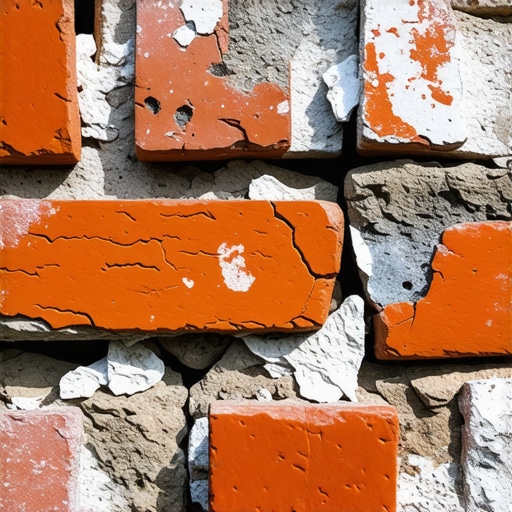
The Forensic Scene: A Wall Suffocating in Silence
The homeowner called me out because she thought she was being proactive. She’d spent three thousand dollars having a ‘waterproofing contractor’ spray her 1910 red-clay brick bungalow with a high-gloss silicone-based sealer. From the curb, it looked shiny, almost like a glazed donut. But when I stepped onto the porch, I smelled it—that unmistakable scent of damp earth and stagnant rot that shouldn’t exist on an exterior wall. I pulled my inspection scope from my kit and looked at a hairline fissure near the soldier course. What I saw inside wasn’t just moisture; it was a microscopic war zone. The structural steel lintels were rusted to orange dust, and the interior of the brick had the consistency of wet kinetic sand. The silicone had created a plastic bag around the house, and the house was drowning from the inside out.
As a third-generation mason, I’ve seen this ‘handyman special’ ruin more historic masonry preservation projects than fire or earthquakes ever could. People treat brick like it’s a solid, inert block of stone. It’s not. Brick is a living, breathing respiratory system. It’s a porous ceramic that moves water through its capillaries via suction and evaporation. When you slap a silicon-based film on that surface, you aren’t keeping water out; you are trapping it in. This is the fundamental failure of modern ‘lick-and-stick’ mentalities applied to ‘Old World’ craftsmanship.
“Water penetration is the single greatest threat to masonry durability, but the inability for that moisture to escape is what causes catastrophic material failure.” – BIA Technical Note 7
The Physics of the Pore: Why ‘Breathability’ Isn’t Just a Buzzword
To understand why silicone is a death sentence, we have to micro-zoom into the hydration and evaporation cycle. Old-growth clay bricks, fired in kilns before the 1940s, have a massive network of interconnected pores. When it rains, these bricks drink. That’s okay. They are designed to hold that moisture and then release it through ‘vapor transmission’ as the sun comes out. This is the ‘breathability’ factor. Silicone sealants are ‘film-forming.’ They create a non-permeable molecular chain across the surface. Think of it like putting a raincoat on a person who is sweating profusely. The sweat has nowhere to go.
In the trade, we talk about the ‘critical saturation point.’ When the moisture content in the brick exceeds roughly 80% of its pore volume, and then the temperature drops, you hit the 9% expansion rule. Water expands by nearly a tenth of its volume when it turns to ice. In a natural, unsealed wall, there’s enough ‘tooth’ and open space for that pressure to dissipate. But behind a silicone barrier, that 9% expansion has nowhere to go but forward. It pushes against the plastic film, and eventually, the entire face of the brick—the ‘crust’—pops off in a process we call spalling. I’ve seen spalled concrete steps repair jobs where the homeowner thought the salt killed the concrete, but it was actually the ‘protective’ sealer trapping water and freezing the face off the aggregate.
The Chemistry of Subflorescence: The Invisible Killer
It’s not just the freezing that kills the wall; it’s the salt. All groundwater and even the mud (mortar) contain dissolved mineral salts. In a healthy wall, these salts travel in solution to the surface of the brick, the water evaporates, and the salt leaves a white powder called efflorescence. You can brush it off with a stiff broom. However, when you apply a silicone-based sealant, the water evaporates behind the sealer. The salts are left behind inside the brick pores. This is called subflorescence. These salt crystals grow with a literal hydraulic force of up to 100,000 PSI. They shred the internal structure of the clay from the inside out. By the time you see the bubbles in the sealer, the brick is already hollowed out. This is why AI masonry assessment is becoming a vital tool; we can now use thermography and acoustic sensors to hear the ‘hollow’ ring of a brick that looks fine to the naked eye but has been gutted by salt crystallization.
Chimneys and the ‘Hot Zone’ Failure
Nowhere is this failure more evident than in chimney repair services. A chimney is the most exposed part of your home’s masonry. It deals with internal heat from the fireplace and external cold from the wind. If you seal a chimney with silicone, you are asking for a collapse. I’ve performed chimney leak detection on hundreds of homes where the owner complained of a damp firebox. They thought the brick was leaking. In reality, the heat from the flue was pulling moisture from the house into the masonry, and the silicone was preventing it from escaping. This leads to a saturated chimney flue liner installation that eventually cracks. Instead of a ‘magic spray,’ what these homes actually needed was a chimney cap replacement to stop the vertical entry of water and a proper lime-based repointing job to allow for lateral evaporation.
“The mortar should always be softer and more permeable than the masonry units themselves to act as a sacrificial element in the moisture management system.” – ASTM C270 Standards
The Sacrificial Principle: Why We Use Lime, Not Silicone
In historic masonry preservation, we live by the sacrificial principle. We want the mortar to be the ‘wick’ of the building. We use Type O or Type K lime mortars because they are soft and highly permeable. They ‘breathe’ better than the brick. If there’s going to be salt damage or freeze-thaw pressure, we want it to happen in the mortar joint, which is easy to butter and slicker back into place, rather than in the brick itself. When a ‘contractor’ uses a hard Portland cement and then tops it with a silicone sealer, they have essentially turned the wall into a ticking time bomb. The brick becomes the softest point, and therefore, the brick is what fails.
For those dealing with larger structural issues, such as a leaning wall or a sinking stoop, the solution isn’t a chemical in a can. You’re looking at foundation slab jacking or concrete block foundation repair. If a retaining wall is bowing, you don’t seal the face; you address the hydrostatic pressure from behind with retaining wall geogrid installation and proper drainage. Water is a physical force, not a ghost. You don’t exorcise it with silicone; you manage it with physics.
The Professional’s Verdict: What to Do Instead
If you genuinely need to protect a wall—perhaps because it’s a soft sandstone in a high-pollution area—we don’t use silicone. We use silanes or siloxanes. These are ‘penetrating’ water repellents, not ‘film-forming’ sealers. They are vapor-permeable, meaning they have a molecular structure large enough to stop a liquid water droplet but small enough to let a water vapor molecule pass through. But even then, we use them sparingly. Most old brick just needs a good mason who knows how to grind out a joint and strike it correctly. Don’t fall for the ‘maintenance-free’ lie. A house that doesn’t breathe is a house that won’t last. If you see a guy show up to your 100-year-old house with a five-gallon bucket of silicone and a sprayer, tell him to keep driving. Your bricks will thank you for another century.