The Forensic Scene: When a Hairline is a Heart Attack
The homeowner called me out because of what she described as a ‘cosmetic nuisance.’ It was a single, diagonal hairline crack snaking across a 1920s Flemish bond facade. From the sidewalk, it looked like nothing. But when I pulled my bore-scope out and threaded it through a mortar joint, the truth was ugly. The structural steel lintel behind the brick was rusted to the point of exfoliation—expanding like a puff pastry and pushing the masonry apart from the inside. This is the reality of forensic masonry; what you see on the surface is rarely the whole story. Cracked brick wall repair isn’t just about slapping some ‘mud’ into a hole; it is about understanding the terminal velocity of moisture and the physics of load distribution.
The Physics of ‘Mud’: Why Standard Mortar Fails
Most modern contractors treat mortar like glue. They think the harder it is, the better it holds. That is the first step toward a total facade failure. In the world of historic tuckpointing and restoration, we live by a different code: the mortar must always be softer than the brick. If you use a high-strength Portland cement on 100-year-old clay units, the brick becomes the weakest link. When the wall shifts—and it will shift—the hard mortar won’t give. Instead, the brick face will snap, a process we call spalling. This is where freeze-thaw damage restoration becomes a nightmare. Water enters those cracks, expands by 9% when it turns to ice, and pops the face of your historic brick salvage right off the wall.
“Mortar should be designed as a sacrificial element of the masonry transition, allowing for moisture vapor transmission and thermal movement without inducing stress into the masonry units.” — ASTM C270 Standard Specification for Mortar for Unit Masonry
This is where fiber reinforcement enters the forensic equation. By integrating micro-polypropylene or basalt fibers into a Type O or Type N lime-rich mortar, we are essentially creating a three-dimensional web of tensile strength. Standard mortar is great under compression (being squashed), but it is garbage under tension (being pulled). The fibers act as bridge-work, catching micro-fractures before they become structural failures. It’s the difference between a piece of chalk and a piece of high-tensile rope.
The Micro-Zoom: Chemical Hydration vs. Fiber Interlocking
To understand why fiber-reinforced mortar is superior for masonry repair services, we have to look at the ‘tooth’ of the material. When you mix your ‘mud,’ the hydration process begins—a chemical dance where calcium hydroxide reacts with water. In traditional mixes, as that water evaporates, it leaves behind microscopic voids. These voids are the birthplaces of cracks. When we introduce fibers, we are ‘buttering’ the joints with a material that has a much higher modulus of elasticity. The fibers bridge those microscopic voids, preventing the ‘shrinkage cracks’ that plague failing retaining wall repair jobs. Unlike self-healing concrete foundations which rely on encapsulated bacteria to plug holes, fiber-reinforced mortar prevents the hole from opening in the first place.
The Enemy Below: Hydrostatic Pressure and Retaining Walls
I’ve seen $100,000 walls bow like a longbow because of a lack of retaining wall weep hole cleaning. If water can’t get out, the weight of the saturated soil behind the wall becomes an unstoppable force. You can have the best fiber-reinforced mortar in the world, but if you don’t manage the ‘suction’ of the earth, that wall is coming down. When we perform failing retaining wall repair, we aren’t just fixing the joints; we are re-engineering the drainage. We use a ‘slicker’ to strike the joints deep, ensuring the fiber-mesh is fully encapsulated, and then we clear those weep holes. Without a path for water, the freeze-thaw cycle will turn your beautiful stone into a pile of rubble within three winters.
The ‘Slicker’ and the ‘Hawk’: The Art of the Joint
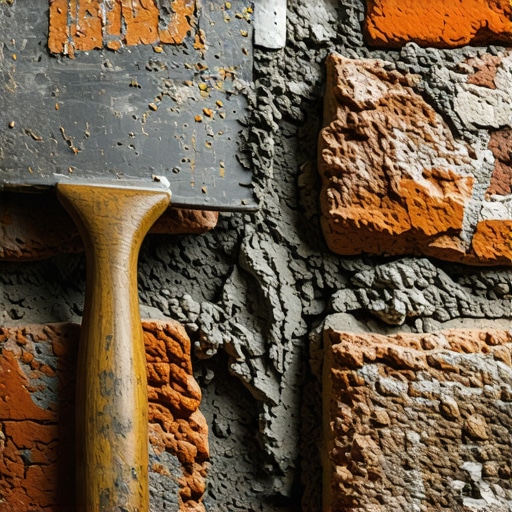
Watching a master work the ‘hawk’—the square board that holds the mortar—is like watching a surgeon. We don’t just shove mud in. We ‘butter’ the brick, ensuring ‘suction’ is achieved. If the brick is too dry, it sucks the life out of the mortar before it can hydrate, leading to ‘flash setting.’ This is a death sentence for historic tuckpointing. We often pre-wet the historic brick salvage to ensure the bond is chemical, not just mechanical. For those looking for a modern aesthetic, we might even incorporate metallic masonry finishes into the final strike, but the structural integrity always comes from the fiber-base below.
“Water penetration is the single greatest threat to masonry durability, and the mortar joint is the primary line of defense.” — BIA Technical Note 7
Chimneys and Foundations: The Overlooked Vitals
People often ignore the top and the bottom. A chimney is a vertical pier that takes the brunt of the weather. If you don’t stay on top of chimney damper repair and cap maintenance, water pours down the flue and rots the masonry from the inside out. Similarly, your foundation is the anchor. While self-healing concrete foundations are an exciting development for new builds, for the 1890s Victorian, we rely on deep-injection lime mortars reinforced with fibers to stabilize the rubble stone. We aren’t just filling a gap; we are restoring a legacy.
The Final Verdict: Do It Once or Do It Twice
In my forty years of ‘striking joints,’ I’ve learned that the cheapest quote is usually the most expensive one in the long run. The ‘handyman special’ will use a bag of pre-mix from a big-box store that is too hard, lacks fiber, and has no breathability. Within five years, you’ll be calling me to perform freeze-thaw damage restoration on the very wall they ‘fixed.’ Fiber-reinforced mortar is the bridge between Old World aesthetics and New World material science. It allows the wall to breathe, to move, and to survive another century of weather. Don’t let a ‘cold joint’ or a lack of drainage ruin your investment. Demand the fiber. Demand the tooth. Demand the craft.