
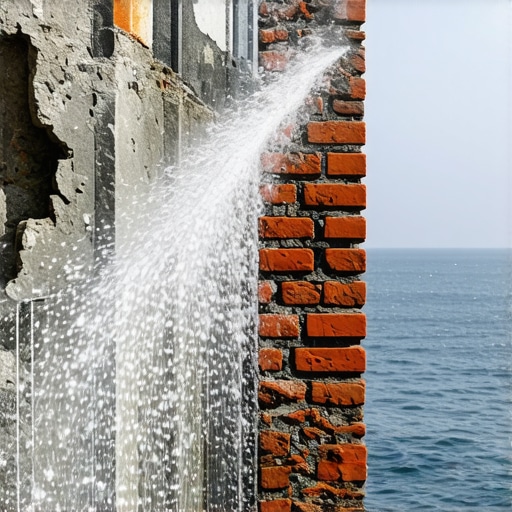
The ocean breeze is a siren song for homeowners, but for a mason, that salty mist is a slow-motion wrecking ball. I’ve spent thirty years watching the Atlantic and the Pacific eat through what people thought were ‘permanent’ structures. Most folks think a brick is a solid, impenetrable block. They’re wrong. A brick is a lung; it breathes, it absorbs, and in a coastal environment, it inhales salt until its very guts explode. To understand coastal masonry, you have to stop looking at the surface and start looking at the molecular war happening inside the pores.
The Forensic Scene: Beneath the White Powder
The homeowner thought it was just a hairline crack. But when I put my scope inside the cavity of that 1920s seaside manor, I saw the structural steel was rusted to dust. They had called me for what they thought was a routine brick wall restoration, pointing at some white fuzz on the surface. They called it ‘aesthetic weathering.’ I called it a structural autopsy. The salt air had bypassed the brick, found the fire-rated masonry installation behind the facade, and corroded the wall ties until the outer wythe was essentially standing by habit alone.
“Water penetration is the single greatest threat to masonry durability, but when that water carries dissolved salts, the rate of deterioration increases exponentially through subflorescence.” – BIA Technical Note 7
This isn’t just about looks; it’s about the physics of salt crystallization pressure. When salt water enters the ‘tooth’ of the brick and the water evaporates, the salt crystals grow. These crystals can exert upward of 2,000 psi of internal pressure. Since the average historic brick only has a tensile strength of about 500 to 800 psi, the brick loses. It spalls. It flakes. It turns to dust.
The Physics of the Coastal Kill-Zone
In a coastal environment, the enemy is hygroscopic action. Salt attracts more water. A salty brick stays damp longer than a clean one. In northern coastal climates, this leads to a lethal freeze-thaw cycle. Water expands 9% when it turns to ice, but if that water is trapped behind a ‘crust’ of salt or a modern, non-breathable sealant, it pops the face of the brick off like a bottle cap. I see this often in commercial smokestack repair where the height of the stack catches the full brunt of the salt spray. The masonry at the top becomes a sponge. If you use a hard Portland-based mud to patch a soft, salt-damaged brick, you’ve just signed its death warrant. The mortar must be the sacrificial lamb—softer than the brick so the moisture and salt migrate there instead of the masonry unit. This is why we use Type O or specialized lime-based mortars for brick patio restoration in these zones.
The Cleaning Myth: Why Your Pressure Washer is a Weapon
The first instinct for a ‘handyman special’ is to blast the salt away with 4,000 psi of water. Stop. You’re just driving the salt deeper into the core. You’re ‘buttering’ the problem into the substrate. Proper cleaning requires a chemical neutralization and a low-pressure ‘soak and scrub’ method. We look for ‘honeycombing’—the deep pitting caused by salt—and use specialized detergents that pull the chlorides out. For severe cases, we might even use a sacrificial poultice. You apply a layer of specialized clay, let it draw the salt out as it dries, and then peel it off. It’s like a detox mask for a building. In modern AI masonry assessment, we now use thermal imaging and moisture mapping to see exactly where the salt concentrations are highest before we even touch a slicker or a hawk to the wall.
Modern Solutions and Disaster Recovery
Sometimes the damage is too far gone for a simple cleaning. After a hurricane or a major storm surge, we see masonry rescue after disaster where the salt saturation is total. In these cases, we might look at brick infill panel repair or even 3D printed masonry repairs to replicate intricate, salt-eaten cornices that are too expensive to carve by hand today. If you’re dealing with a failing retaining wall repair near the shore, the fix isn’t just more concrete; it’s better drainage and geocomposite drains that prevent the salt-laden groundwater from pushing against the back of the wall. Even an outdoor fireplace rebuild requires specific attention to the flue lining, as the combination of heat and salt can accelerate the degradation of standard firebricks. You do it once, or you do it twice. In the salt air, there is no middle ground. You either respect the chemistry of the stone, or the ocean will take it back, grain by grain.
“Materials used in masonry construction shall be selected based on their ability to resist the specific environmental loads of the site, including chloride exposure.” – ASTM C67 Standards