
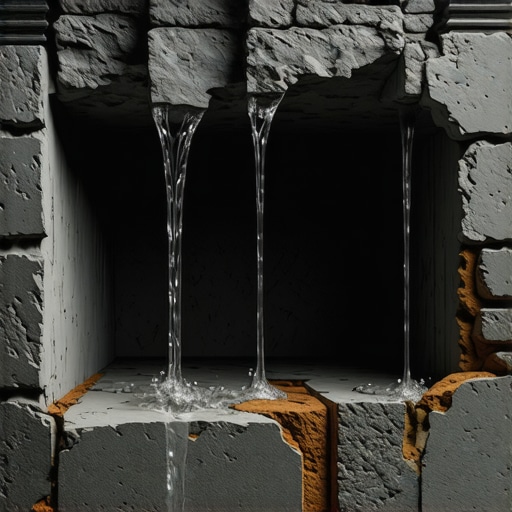
The Forensic Scene: When a Hairline Crack Becomes a Structural Disaster
The homeowner stood in their finished basement, pointing at a small, damp discoloration on the drywall near the floor. They thought it was a simple foundation issue, perhaps a localized patch job. But as a third-generation mason, I don’t look at the floor first; I look at the sky. I pulled out my digital borescope and threaded it through a small hole in the upper wall. The homeowner thought it was just a hairline crack on the exterior, but when I put my scope inside, I saw the structural steel was rusted to dust, and the wall cavity was a swamp of rotting mortar and saturated insulation. The culprit wasn’t the ground; it was thirty feet up. The stone coping on the parapet wall was improperly pitched, lacked a functional drip edge, and was ‘buttered’ with a hard Portland cement that had snapped like a dry twig under thermal stress. Water wasn’t just hitting the wall; it was being funneled into the heart of the masonry, traveling down the interior wythe of the brick through gravity and capillary suction until it pooled at the foundation level. This is the reality of forensic masonry damage assessment: the symptoms are often at the bottom, but the disease is at the top.
The Physics of the Drip Edge and Surface Tension
Most modern ‘contractors’ treat stone coping as a decorative lid. It is not. It is a hydraulic shield. In the trade, we talk about the ‘tooth’ of the stone—the microscopic profile that allows mortar to bite. But even the best bond fails if the physics of water shed are ignored. A properly designed stone coping must have a ‘reglet’ or a drip edge—a small groove cut into the underside of the stone that extends past the wall face. Without this, surface tension allows water to ‘wrap’ around the bottom of the stone and run directly down the face of the brick. This leads to what we call saturating flows.
“Water penetration is the single greatest threat to masonry durability, contributing to more than 90% of all masonry failures.” – BIA Technical Note 7
When water saturates the brick, it initiates a chemical breakdown. In the North, where the freeze-thaw cycle is the primary enemy, this water expands by 9% upon freezing. If that water is trapped behind a hard, non-breathable mortar, it exerts thousands of pounds of pressure, literally popping the face off the stone or brick in a process known as spalling. This is why emergency masonry repair is so often a result of simple negligence at the roofline.
The Chemistry of Decay: Brick Efflorescence and Salt Migration
When you see that white, powdery substance on a wall, that’s not just a stain; it’s the wall’s way of screaming. Brick efflorescence removal isn’t just about aesthetics; it’s about stopping a chemical migration. As water travels through the masonry from a leaking stone coping, it dissolves naturally occurring salts—sodium, potassium, and calcium sulfates—within the brick and mortar. As this solution moves toward the exterior (the side of evaporation), the water vanishes, leaving the salt crystals behind. If this happens on the surface, it’s efflorescence. If it happens just beneath the surface, it’s sub-florescence, which is far more dangerous. The crystal growth creates internal pressure that turns the brick’s internal structure into dust. To fix this, you don’t just wash it off; you have to stop the water source, which almost always leads back to the coping or a failing stone balustrade restoration that used the wrong materials.
The Sacrificial Principle: Historic Mortar Analysis
One of the biggest crimes in modern masonry is the use of Type S or Type M Portland cement on historic structures. In my grandfather’s day, we used lime putty. Why? Because the mortar must be the sacrificial element. It should be softer and more permeable than the stone or brick it holds together. During a historic mortar analysis, we often find that old buildings survived for a century because the lime mortar allowed the wall to ‘breathe,’ moving moisture out through the joints. When a ‘handyman’ comes along and repoints a 1920s wall with hard cement, they’ve created a dam. Moisture is now trapped inside the soft brick. The next winter, the brick fails because it’s the weakest link. In any masonry rescue after disaster, we must match the compressive strength and vapor permeability of the original ‘mud’ to ensure the longevity of the repair. Using a ‘slicker’ to strike a joint with the wrong mix is just a slow-motion way of destroying a building.
The Chimney Connection: Caps and Flue Liners
The chimney is the most exposed part of any structure, essentially a giant vertical radiator. If the stone coping or chimney cap replacement is done poorly, the entire stack becomes a chimney for water rather than smoke. A failing cap allows water to enter the core, leading to the need for a full chimney rebuild services. I’ve seen chimneys where the flue liner was completely disconnected because the mortar had been washed away by decades of water infiltration from a cracked crown. Proper chimney flue liner installation is critical because it protects the masonry from the corrosive byproducts of combustion. When those gases mix with water leaking from the top, they form acids that eat the mortar from the inside out. This is a common find during a routine masonry damage assessment that homeowners often overlook until the bricks start falling onto the lawn.
The Hard Truth About Foundation Leaks
We often see people spending thousands on interior French drains and sump pumps when the actual problem is the lack of a proper ‘soldier course’ or failing coping stones thirty feet up. Hydrostatic pressure at the foundation is often exacerbated by vertical water travel within the wall cavity. To truly fix a leaking basement, you must audit the entire envelope. This includes looking at the stone balustrade restoration projects that may have used non-breathable sealants, trapping moisture. If the stone coping isn’t pitched at a minimum of 15 degrees to shed water away from the building, you are essentially inviting the weather into your basement. Do it once, or do it twice—that’s the mason’s motto. Cutting corners on the ‘mud’ or the flashing today ensures an emergency masonry repair call five years from now.