The Curse of the Clean Brick
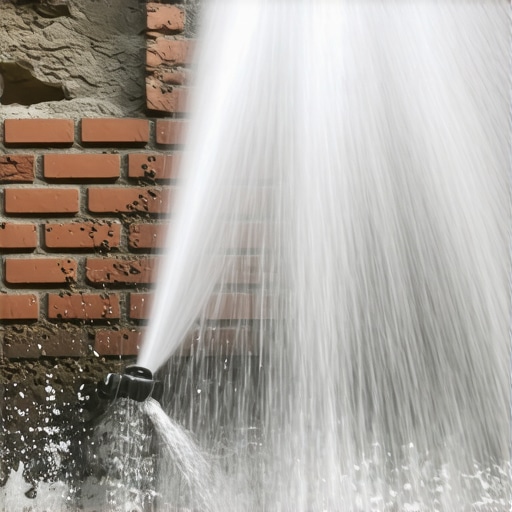
I remember an old timer named Pete, a man who had more lime in his lungs than blood in his veins, who once watched a ‘restoration crew’ fire up a 4000 PSI pressure washer on a 19th-century Federal-style rowhouse. He didn’t just walk away; he sat on his tool bucket and wept. ‘They aren’t cleaning it,’ he spat, ‘they’re skinning it alive.’ Pete knew what the homeowner didn’t: that the hard, fired skin of an old brick is the only thing standing between the structure and the relentless entropy of the freeze-thaw cycle. Once you blast that fire-skin off, you’ve turned a structural asset into a sponge. This is the reality of modern facade cleaning when it meets ‘Old World’ materials. We see it every day in forensic inspections—homeowners who wanted a ‘bright’ house and ended up with a crumbling ruin within five winters.
“The use of high-pressure water cleaning on historic masonry can cause irreversible damage to the surface of the masonry units and the mortar joints, leading to accelerated weathering and moisture penetration.” – BIA Technical Note 20
The Molecular Assault: Why Water Becomes a Scalpel
To understand why a pressure washer is a weapon, you have to micro-zoom into the chemistry of the mortar joint. Old mortar, primarily composed of lime and sand, isn’t a static rock. It’s a living, breathing lung. Over a century, the calcium hydroxide in the lime reacts with atmospheric carbon dioxide in a process called carbonation, turning the ‘mud’ into a semi-porous calcium carbonate matrix. This matrix has a specific ‘tooth’—a mechanical bond that grips the microscopic irregularities of the brick. When you hit that joint with 3000 or 4000 PSI, you aren’t just removing dirt. You are performing a microscopic excavation. The water is forced into the micropores, creating localized hydrostatic pressure that exceeds the tensile strength of the lime bond. You are literally shearing the mortar away from the brick at a molecular level, leaving behind ‘honeycombing’—small, jagged voids that invite water to sit, linger, and eventually freeze.
The Sacrificial Principle and the Freeze-Thaw Trap
In the North, where the freeze-thaw cycle is our primary antagonist, the physics of masonry is unforgiving. Water expands roughly 9% when it turns to ice. Historic masonry was designed with the ‘Sacrificial Principle.’ The mortar is intended to be softer and more permeable than the brick itself. If moisture gets into the wall, it should migrate to the mortar joint to evaporate. If that mortar has been blasted and then ‘repaired’ with a hard, modern Portland cement—a common ‘handyman special’—the moisture can’t escape. It gets trapped behind the hard cement face. When the temperature drops, that trapped water expands, and instead of the mortar giving way, it pops the face right off the brick. This is called spalling. You’ll see a soldier course or a stone facade restoration where the faces are falling off like scabs. It’s a death sentence for the wall, often requiring 3D printed masonry repairs or expensive stone veneer over brick replacements to restore any semblance of structural integrity.
“Mortar should always be weaker than the masonry units so that it acts as the sacrificial element in the wall system, allowing for movement and moisture dissipation without damaging the brick.” – ASTM C270
Forensic Signs of a Blasted Joint
When I conduct an AI masonry assessment, the first thing I look for is the ‘slicker’ mark. On a healthy joint, you can see where the mason’s tool compressed the mud to create a weather-shedding profile. After a high-pressure wash, those marks are gone. Instead, the joints look ‘fuzzy’ or recessed. This recession creates a shelf where water can pool. On a retaining wall, this is even more catastrophic. If the retaining wall capstone replacement wasn’t done with proper overhangs, and the joints have been eroded by pressure washing, water will bypass the retaining wall weep hole cleaning systems and saturate the core of the wall. This leads to efflorescence—that white, salty crust—which is the masonry’s way of screaming that it’s drowning. Eventually, the hydrostatic pressure builds until you need foundation slab jacking or a concrete pump masonry mixes to stabilize a wall that should have lasted another century.
The Tech-Driven Recovery: AI and 3D Solutions
We are moving into a new era of forensic masonry. We now use AI masonry assessment tools that scan the surface of a building to calculate the exact depth of mortar loss across thousands of square feet. This data allows us to specify precise concrete pump masonry mixes for deep-void grouting. For intricate ornaments that have been ‘melted’ by years of improper cleaning, we are even seeing the advent of 3D printed masonry repairs, where we scan a surviving fleur-de-lis or corbel and print a replacement in a lime-compatible medium. But all the tech in the world can’t replace the basic rule: stop the pressure. For facade cleaning, we use ‘soft washing’—low-pressure chemical mists that break the biological bond of algae and soot without fracturing the ‘tooth’ of the stone. We butter the joints with the right mud—Type O or Type K lime mortars—and we strike them with a slicker to ensure the water runs off, not in.
The Reality of the Hardscape
It’s not just walls. Look at a brick paver driveway repair. People think they can blast the weeds out of the joints with a power washer. All they are doing is evacuating the polymeric sand or the stone dust base that provides the friction lock between the pavers. Once that ‘interlock’ is broken, the pavers shift, tilt, and sink. You end up with a ‘wavy’ driveway that requires a full lift and relay. Whether it’s a chimney or a patio, the lesson is the same: masonry is about mass and gravity, held together by a delicate chemical balance. If you treat it with the violence of high-pressure water, you are simply accelerating its return to the earth as dust. Do it once, do it right, and keep the ‘mud’ where it belongs.