
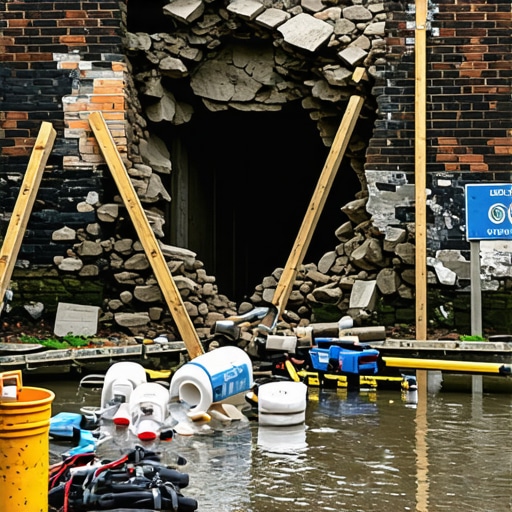
The Forensic Scene: When the Dust Settles but the Wall Doesn’t
The homeowner stood there, ankle-deep in the drying silt of a receding flood, pointing at what he called a ‘hairline crack’ in his foundation. To the untrained eye, it was a cosmetic nuisance. But when I put my digital scope inside that fissure, the reality was a nightmare: the structural steel reinforcement was rusted to red dust, and the soil behind the wall had been scoured out, leaving a void where a footing should be. This wasn’t just a repair job; it was a race against gravity. I’ve seen million-dollar homes nearly split in half because people don’t understand the physics of water. When a flood hits, it’s not just the water you see that’s the problem—it’s the hydrostatic pressure and the internal chemical shifts within the mud that dictate whether a wall stands for another century or collapses by next Tuesday.
“Water penetration is the single greatest threat to masonry durability.” – BIA Technical Note 7
The Physics of Settlement: Why Your Wall is ‘Walking’
A brick wall isn’t a static object; it’s a living, breathing assembly of mineral units and binder. When a flood occurs, the soil saturates, and the ‘angle of repose’—the steepest angle at which soil remains stable—flattens out. This creates a massive lateral load. In my thirty years of forensic inspection, I’ve seen walls bow 6 inches off-center before the first brick pops. This is hydrostatic pressure in action. Water weighs 62.4 pounds per cubic foot. When it saturates the backfill behind a retaining wall or foundation, it’s like a giant invisible hand pushing the masonry toward the street. If you don’t have proper drainage, that wall is going to ‘walk’—it will tilt and eventually fail at the base, often creating a cold joint separation where the wall meets the footing.
Micro-Zoom: The Chemistry of Saturated Masonry
Let’s talk about the tooth of the stone and the suction of the brick. After a flood, the masonry is saturated. This triggers several chemical disasters. First, there’s the leaching of calcium hydroxide. As water moves through the brick, it dissolves the lime in the mortar. When it evaporates, it leaves behind white crusty efflorescence. But it’s what stays inside that’s worse. If you use modern, hard Portland-based high-performance mortar mixes on old, soft, flood-damaged bricks, you’re creating a tomb. The moisture gets trapped. When the temperature drops, that water expands by 9%. This is the freeze-thaw cycle. It doesn’t just crack the wall; it ‘spalls’ it, popping the face of the brick right off like a scab. In these cases, spalled concrete steps repair or brick face restoration requires a delicate touch and often sustainable masonry materials like natural hydraulic lime that allow the wall to breathe again.
The Restoration Reality: Saving the Facade
Saving a collapsing wall starts with stabilization. We often use BIM masonry projects—Building Information Modeling—to map the lean of the wall in three dimensions. This allows us to see exactly where the stress concentrations are. If the wall is a decorative piece, like tuckpointing curved walls in a historical garden, we have to be surgically precise. We don’t just ‘slap some mud’ in the cracks. We use a slicker or a jointer tool to pack mud deep into the joints after grinding them out. If the wall is structural, we might need helical piers to bypass the scoured soil and hit bedrock. When it comes to stone veneer repair, the flood often destroys the ‘lick-and-stick’ mortar because there’s no mechanical bond. We have to strip it back and butter each stone individually to ensure a 100% bond. This isn’t a handyman’s weekend project; it’s a forensic reconstruction.
Chimneys and Outdoor Structures: The High-Rise Danger
Floods often come with secondary damage. I’ve seen outdoor fireplace rebuild projects where the floodwater undermined the massive hearth, causing the whole structure to tilt and pull away from the house. This almost always impacts the chimney system. A chimney crown repair is vital because even a minor tilt can crack the crown, letting rainwater right down the center of the masonry. If you’re rebuilding, you must look at fire-rated masonry installation and proper chimney flue liner installation. The heat of a fire combined with the moisture still trapped in the masonry after a flood can cause a steam explosion inside the wall. It sounds like a gunshot, and it can blow a chimney apart from the inside out.
“The quality of the masonry depends entirely on the bond between the mortar and the unit, which is governed by the water-retention of the mortar and the initial rate of absorption of the brick.” – ASTM C270 Standards
The Fix: The Band-Aid vs. The Cure
Don’t be fooled by the ‘Asphalt Gypsies’ who come around after a flood offering to ‘seal’ your cracks with a bucket of epoxy. That’s a Band-Aid on a bullet wound. The ‘Cure’ involves addressing the water. You need high-performance mortar mixes that are site-specific. If I’m working on a pre-1940s home, I’m mixing sustainable masonry materials like lime putty because the mortar must be the sacrificial element—it must be softer than the brick. For modern structures, we look at carbon-neutral binders that offer higher sulfate resistance to prevent ‘delayed ettringite formation’ (DEF), which causes mortar to expand and crumble when wet. Whether it’s tuckpointing curved walls or a massive outdoor fireplace rebuild, the physics remains the same: manage the water, respect the material, and never trust a wall that doesn’t ‘ring’ when you tap it with a trowel. If your wall sounds dull or thuddy, it’s delaminated. It’s hollow. It’s a ghost. The final verdict? If you see a horizontal crack at the frost line or a stair-step crack wider than a quarter, don’t wait for the next rain. Get a pro who knows the difference between a hawk and a handsaw, and fix it before gravity does it for you.