
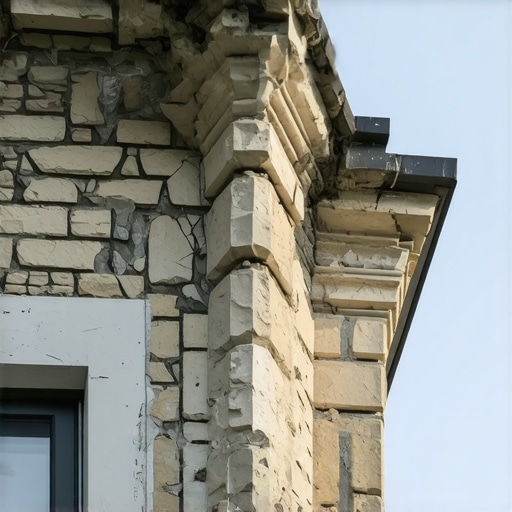
I was standing in a damp alleyway in the historic district last October, looking at a set of massive limestone quoins that looked like they were trying to jump off the building. The homeowner, a guy who spent too much money on a ‘handyman special’ restoration three years prior, thought it was just a hairline crack he could fill with some caulk. But when I slid my fiber-optic scope into the void behind the stone, I didn’t see solid masonry. I saw structural brick ties that had rusted to orange dust and a cavity where the back-up wall was literally bowing outward. This wasn’t a cosmetic issue; the house was shedding its skin because the bones were shifting. This is the reality of forensic structural masonry inspection: the stone tells a story of what the dirt is doing beneath your feet.
The Anatomy of the Quoin: More Than Just Decoration
In traditional architecture, quoins are those prominent blocks at the corner of a building. Historically, they were the ‘teeth’ of the structure, providing lateral stability by interlocking the two meeting walls. When we talk about stone facade restoration, we aren’t just looking at the surface beauty. We are looking at the cornerstones of the building’s integrity. When you see a vertical or diagonal fracture running through these blocks, you aren’t looking at a stone failure; you’re looking at a gravitational surrender.
“Water penetration is the single greatest threat to masonry durability. When moisture reaches the structural core, it initiates a cycle of decay that manifests as visible cracking long before the collapse occurs.” – BIA Technical Note 7
The physics of a corner are brutal. In a freeze-thaw climate, moisture trapped behind these heavy blocks undergoes a 9% volume expansion every time the mercury drops. This creates internal hydrostatic pressure that can pop a 200-pound granite block right off its bed. If your historic tuckpointing was done with modern, hard Portland cement instead of a breathable Type O lime mortar, the water has nowhere to go. It gets trapped, the pressure builds, and the stone—which is softer than the modern ‘mud’ used to butter it—shatters. This is the ‘sacrificial’ principle of masonry: your mortar should always be softer than your stone. If it’s not, the building will destroy itself to breathe.
The Tell-Tale Crack: Reading the Foundation
A stair-step crack in the running bond of a wall is one thing, but a clean shear through a corner quoin is a siren song for masonry damage assessment experts. It usually indicates differential settlement. If the soil beneath one corner of the house is more saturated or less compacted than the rest, that corner sinks. Because masonry has high compressive strength but near-zero tensile strength, it cannot bend. It snaps. We call this ‘rotational failure.’ The quoin, being the furthest point from the center of mass, acts as a lever. A quarter-inch drop at the footing can result in a two-inch gap at the cornice.
When I’m performing a structural masonry inspection, I look at the ‘tooth’ of the crack. If the edges are sharp, the movement is recent. If they’re rounded and filled with old soot, the building has been groaning for decades. In cases of structural brick ties replacement, we often find that the original galvanized wire has succumbed to electrolysis. Without those ties, the facade becomes a freestanding curtain wall, completely vulnerable to wind loads and the slow pull of gravity.
The Chemical War: Portland vs. Lime
Modern contractors love to use Type S mortar because it sets fast and they can go home early. But in an outdoor fireplace rebuild or a stone facade restoration on a pre-1940s home, Type S is a death sentence. Old bricks and stones were fired at lower temperatures; they are porous and flexible. Portland cement is rigid and waterproof. When you butter a soft brick with hard mud, you create a ‘cold joint’ that won’t bond. During thermal expansion, the brick wants to grow, the mortar refuses to budge, and the brick face spalls off in a shower of red dust. That’s not just an eyesore; it’s a failure of material science. Proper tuckpointing requires a forensic match of the original binder—often requiring a mix of hydrated lime and specific sand aggregates to match the vapor permeability of the original wall.
“The strength of a masonry wall lies not in the hardness of its units, but in the flexibility of its joints to accommodate the movements of the earth.” – ASTM C270 Standard Specification for Mortar
We see similar failures in modular retaining walls. People think they can just stack blocks and call it a day. But without proper drainage and geogrid reinforcement, the soil behind that wall becomes a hydraulic ram. I’ve seen 12-inch thick concrete blocks snapped like toothpicks because the installer didn’t account for the weight of water-logged clay. In sustainable block cutting, we try to minimize waste, but when a wall is designed poorly, the entire structure becomes waste within a decade.
The Advanced Frontier: Green Roofs and Parapet Stress
One of the most complex challenges today is green roofing masonry integration. You’re adding thousands of pounds of wet soil and vegetation to the top of a structure that was never designed for it. This weight pushes down and out. If the parapet walls aren’t reinforced or if the flashing is compromised, you get moisture migrating down into the core of the wall. This leads to ‘honeycombing’—where the interior of the wall dissolves, leaving a hollow shell. By the time you see the quoins cracking at the corners, the internal structure might be so compromised that a simple tuckpointing job is like putting a band-aid on a gunshot wound.
When I use my slicker to finish a joint, I’m not just making it look pretty. I’m ‘striking’ the joint to compact the mud, ensuring there are no voids where ice can take hold. Every hawk of mortar I mix is a calculated defense against the elements. If you see cracks in your quoins, don’t just call a guy with a bucket of cement. Call someone who understands the chemistry of the stone and the physics of the soil. Do it once, or do it twice—and the second time usually involves a bulldozer. The bottom line is this: masonry is a living, breathing system. Treat it with the respect its physics demand, or it will remind you of your mistakes with a pile of rubble.