
The Forensic Scene: When ‘Hairline’ Means Structural Failure
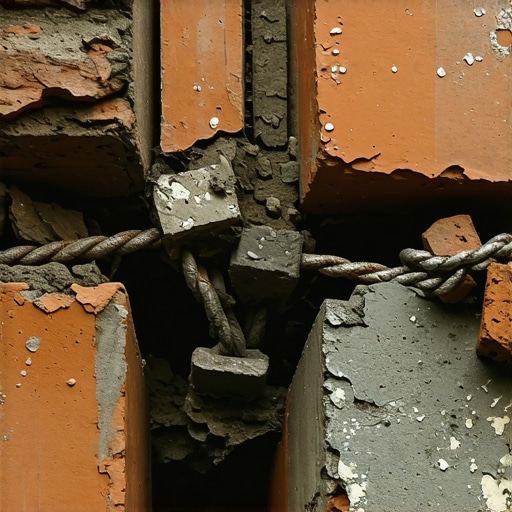
The homeowner pointed to a vertical split near the corner of the brick veneer, dismissing it as a simple settlement issue. I pulled out my fiber-optic scope and threaded it through a weep hole. What I saw wasn’t just a cavity; it was a graveyard of orange-red dust. The steel ties, meant to hold the wall to the frame, had swollen into serrated blades of rust. This is the forensic reality of Oxide Jacking. When steel corrodes, it doesn’t just get weaker; it gets bigger. It can expand up to ten times its original volume. This expansion creates a slow-motion explosion from the inside out, often called ‘brick bursting.’ If you see a row of bricks pushed outward or a horizontal crack that follows the spacing of your wall ties, you aren’t looking at a cosmetic blemish. You are looking at a structural emergency that requires more than a simple bucket of mortar and a DIY spirit.
The Physics of the Burst: Why Iron Oxide is a Silent Killer
To understand why your facade is failing, you have to look at the chemistry of the wall. In older commercial tuckpointing projects, builders often used carbon steel ties without sufficient galvanization. When moisture penetrates the masonry—whether through crumbling mortar joint repair neglect or poor flashing—the oxidation process begins. Iron (Fe) meets Oxygen (O2) and Water (H2O) to form Hydrated Iron Oxide. This isn’t just a color change; it is a physical transformation. This new material occupies significantly more space than the original steel. The pressure exerted by this expansion can exceed 10,000 PSI, which is far greater than the tensile strength of any brick or the bond strength of the mud holding it together. In the freeze-thaw cycles of the North, this process is accelerated as trapped water expands by 9%, further fracturing the masonry that has already been stressed by the rusted ties.
“The expansion of corrosion products on iron or steel can exert pressures sufficient to fracture the surrounding masonry, leading to significant structural displacement.” – BIA Technical Note 28B
The Sacrificial Principle: Why Your Choice of Mortar Matters
When providing re-pointing services for historic structures, we live by one rule: the mortar must be the sacrificial lamb. If you use a modern, high-strength Portland cement on a 1920s brick building, you are signing its death warrant. Old bricks are soft and porous. They need a soft lime-based mortar (Type O or Type K) that can breathe and move. If you use a hard mortar, the moisture cannot escape through the joints, forcing it into the brick and onto the steel ties. This trapped moisture is the primary fuel for masonry water damage repair calls. When I am on a hawk, mixing up a batch of restoration mud, I am looking for the right ‘tooth’ and ‘suction.’ You want the mortar to be slightly weaker than the masonry units so that when the wall shifts, the mortar cracks—not the brick. This is the difference between a 100-year repair and a 5-year failure.
The Professional Process: Beyond ‘Lick-and-Stick’ Repairs
Fixing a wall that is bursting from rusted ties isn’t about slapping some butter on a brick and shoving it back in. It requires a systematic approach. First, we must identify the failed ties using metal detection or borescope inspection. Often, we find honeycombing in the backup wall or failed chimney interior parging that has allowed water to sit in the cavity. For concrete block foundation repair, we might need to install helical piers if the bursting has led to settlement. For the brick itself, we use a slicker to pack new mortar into the joints, but only after the rusted ties have been bypassed or replaced with stainless steel alternatives. We are even seeing the emergence of 3D printed masonry repairs to replicate custom shapes in historic soldier courses where standard bricks no longer fit. This is a far cry from the modular retaining walls you see at big-box stores; this is forensic restoration.
“Water penetration is the single greatest threat to masonry durability and is the primary catalyst for the corrosion of embedded metals.” – ASTM C270 Standards
Modern Solutions and Warning Signs
Whether you are looking at tuckpointing brick walls on a Chicago brownstone or dealing with mortarless masonry systems in a new commercial build, the enemy remains moisture. If you notice a ‘cold joint’ where the mortar hasn’t bonded correctly, or if you see white powder (efflorescence) blooming on the surface, your wall is crying for help. Don’t be fooled by ‘handyman specials’ who offer cheap commercial tuckpointing by just grinding the surface. A proper repair involves deep-joint cleaning to ensure the new mud has a mechanical bond to the brick. If the steel ties are the culprit, we must address the masonry water damage repair at the source—usually the flashing and the weeps. Do it once, or do it twice. In this trade, there are no shortcuts that don’t eventually end up as a pile of rubble on the sidewalk.