
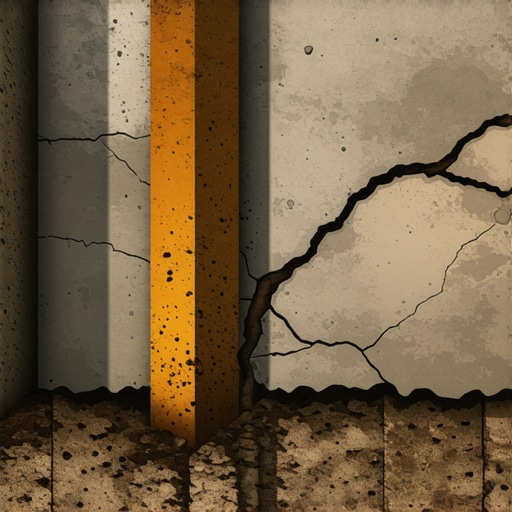
The Silent Bulge: Reading the Braille of a Failing Wall
When you’ve spent forty years with your hands in the mud, you stop looking at houses as homes and start seeing them as thermal-dynamic systems perpetually trying to return to the earth. Most homeowners see a crack and think it’s a cosmetic nuisance. I see it as a symptom of a subterranean war. Clay soil isn’t just dirt; it’s a living, breathing, expanding monster that exerts thousands of pounds of hydrostatic pressure against your foundation. If you don’t understand the physics of the soil, your fancy brickwork is just a pile of expensive rubble waiting for a place to fall.
The Forensic Scene: The $5 Hairline That Cost $80,000
Last October, I was called to a property where the owner was complaining about a ‘minor’ vertical separation in his brick quoin repair. On the surface, it looked like a standard settlement issue. But when I pulled out the borescope and slipped it into the cavity, the reality was a nightmare. The clay soil outside had saturated during the spring rains, expanded like a dry sponge in a bucket of water, and pushed the foundation wall inward by two inches. The structural steel reinforcement—the very bones of the wall—had been subjected to so much moisture and oxygen that it had oxidized into nothing but red dust. The brickwork was essentially floating, held up by nothing but habit and a prayer. This is the reality of forensic structural inspection: the worst damage is always invisible until the moment of catastrophic failure.
The Molecular War: Why Clay is Different
To understand why foundation crack repair is a multi-billion dollar industry, you have to micro-zoom into the soil chemistry. Unlike sandy soils that allow water to percolate through, clay is composed of microscopic, plate-like minerals—typically montmorillonite or illite. These plates carry a negative electrical charge. When water enters the soil, it is ‘adsorbed’ into the interlayer spaces between these plates. The water doesn’t just sit there; it chemically bonds and forces the plates apart. This is known as adsorption-induced swelling. In some regions, clay can expand by as much as 10% in volume. When that clay is trapped between a frozen top layer of earth and your basement wall, that 10% expansion has nowhere to go but through your masonry.
“Water penetration is the single greatest threat to masonry durability. When combined with expansive soil conditions, the lateral pressures can exceed the structural capacity of unreinforced masonry walls by a factor of five.” – BIA Technical Note 7
The Physics of the Freeze-Thaw and the Clay Trap
In the North, we deal with the brutal cycle of the freeze-thaw. If your masonry waterproofing solutions aren’t vapor-permeable, you’re building a tomb for your brickwork. Clay soil holds water against the foundation like a wet rag. When that water freezes, it expands by 9%. If your wall is built with a modern, high-strength Portland cement over old, soft-fired bricks, you’ve created a ‘hard shell’ over a ‘soft core.’ The frozen water behind the brick face has to go somewhere, so it pops the face of the brick right off. We call this spalling, and it’s the hallmark of a ‘handyman special’ where the wrong mud was used for the job.
The Fix: Foundation Underpinning and High-Performance Mortar Mixes
When the clay has already won the first round, we don’t just ‘butter’ the cracks and walk away. We look at foundation underpinning. This involves driving helical piers deep into the earth, past the active ‘heave zone’ of the clay, until they hit load-bearing strata or bedrock. We are essentially putting the house on stilts that the clay can’t touch. Once the structure is stabilized, we turn our attention to the mortar. For historic tuckpointing, I never touch a bag of Type S unless I’m building a skyscraper. You need a mix that has ‘tooth’ and breathability. High-performance mortar mixes today often incorporate crystalline additives that can actually react with incoming moisture to seal micro-cracks. This self-healing concrete foundation technology is the only way to combat the relentless pressure of the soil long-term.
The Chimney: The House’s Most Vulnerable Finger
Clay soil doesn’t just attack the basement; it telegraphs its movement all the way to the roof. Chimney structural repair is often the first sign of a foundation in distress. Because a chimney is a tall, heavy, narrow column, it acts like a lever. A half-inch of soil movement at the base can manifest as a six-inch lean at the crown. When I see a chimney pulling away from the house, I don’t just look at the brickwork; I look at the drainage at the base. If you don’t have a proper slope and brickwork sealants application to shed water away from that clay, you’re just wasting money on tuckpointing that will crack again in two seasons.
“The foundation of every structure must be laid on solid ground and with great care… where it is of a shifting or sandy nature, it must be dug up and the foundations built on piles of charred alder or olive.” – Vitruvius, De Architectura
The Professional’s Toolkit: From Slicks to Self-Healing Mixes
When I’m on a job, my ‘hawk’ is never empty of a custom-blended mud. We use metallic masonry finishes occasionally for aesthetic accents on quoins, but the real work is in the waterproofing. A proper masonry waterproofing solution isn’t a coat of paint—it’s a breathable silane-siloxane sealer that allows water vapor to escape while preventing liquid water from entering the pores of the brick. If you seal a wall with a non-breathable plastic coating, you are effectively trapping the clay’s moisture inside your wall, leading to ‘honeycombing’ of the concrete and the eventual rot of any internal timber. Every joint must be struck with a slicker to compact the mortar and create a ‘weather-struck’ profile that sheds water. If you leave a ‘cold joint’ where new mud meets old without proper preparation, you’re just inviting the clay to push its way back in.
Final Forensic Advice: Do it Once, or Do it Forever
If you live in a high-clay area, you are living on a geological trampoline. You cannot stop the earth from moving, but you can control how your home reacts to it. Invest in deep drainage, use the correct lime-based mortars for historic brick, and never trust a contractor who doesn’t talk about ‘hydrostatic pressure.’ Masonry isn’t about being hard; it’s about being smart. A wall that cannot breathe will eventually stop standing. That is the cold, hard truth from the end of a trowel.