
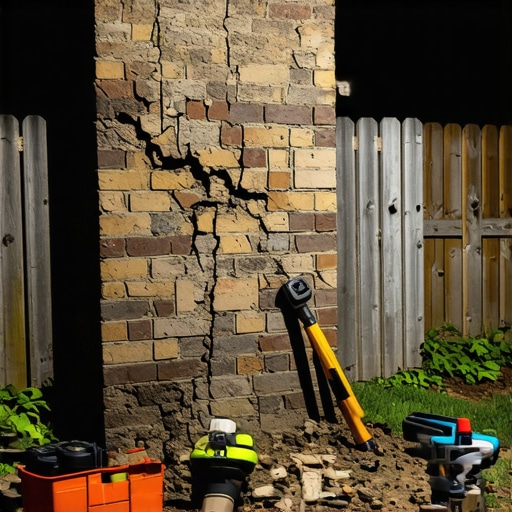
The Midnight Groan: When Your Foundation Speaks
The homeowner thought it was just a hairline crack. But when I put my scope inside the cavity of that leaning parapet, I saw the structural steel was rusted to dust, expanded to four times its original thickness, and literally pushing the brick skins apart. It wasn’t just a cosmetic issue; it was a 40,000-pound loaded spring waiting to let go. When a masonry wall shifts overnight, you aren’t dealing with a simple maintenance item. You are witnessing a failure of physics, often decades in the making, finally reaching its tipping point. This isn’t the time for a handyman and a bucket of pre-mix from the big-box store. This is a forensic emergency.
The Physics of the Overnight Shift: Hydrostatic Pressure and Soil Heaving
Why does a wall that has stood for eighty years suddenly decide to move two inches in a twelve-hour window? In my three decades of structural masonry inspection, the culprit is almost always water, but not in the way you think. We need to talk about pore pressure. When the soil surrounding a foundation becomes saturated—perhaps due to a burst lateral line or a flash freeze—the volume of the earth itself changes. In the North, we deal with the brutal reality of the freeze-thaw cycle. Water expands by 9% when it turns to ice. If that water is trapped in the microscopic voids of your mud or within the backup block, that expansion has nowhere to go but outward.
As the moisture enters the masonry through crumbling mortar joint repair sites that were ignored for seasons, it sits there. When the temperature drops, that water crystalizes, exerting thousands of pounds of pressure per square inch against the internal structure of the brick. This is what we call spalling on a molecular level, but when it happens across an entire course of soldier course brickwork, the whole facade can bow. This is the ‘bell’ my grandfather warned about; if the system doesn’t ring true, it’s because the internal bond is shattered.
“Water penetration is the single greatest threat to masonry durability.” – BIA Technical Note 7
The Crack Whisperer’s Guide: Diagnosing the Movement
When I walk onto a site where a wall is ‘walking,’ the first thing I look for is the crack geometry. A stair-step crack following the mud joints usually indicates a slow settlement of the foundation footing. But a horizontal crack—especially one that appears overnight—is a red flag for commercial parapet wall repair or serious hydrostatic load. It means the wall is literally being pushed off its seat. This is where masonry repair services often fail the homeowner; they try to ‘butter’ the crack with a hawk and trowel, hiding the symptom while the disease eats the house. You cannot fix a structural shift with a slicker and some Type S mortar.
In high-performance mortar mixes, we look for a specific ‘tooth’—the ability of the mortar to bite into the brick’s surface. If your wall is shifting, that bond has been sheared. I’ve seen honeycombing in concrete pours where the aggregate wasn’t vibrated properly, creating voids that become reservoirs for destructive moisture. When that moisture freezes, it creates a cold joint failure that can drop a wall in hours.
The Intervention: From Robotic Repair to Historic Pointing
Modern problems sometimes require futuristic solutions. We are now seeing the rise of robotic masonry repair, where LiDAR scanners map the displacement of a wall to the millimeter, allowing us to calculate the exact center of gravity shift. But even with robots, the fundamentals of historic pointing styles remain supreme. If you are working on a pre-1940s building, you cannot use modern Portland cement. It is too hard. It’s like putting a diamond between two pieces of chalk; the chalk will shatter every time the building breathes. We use lime-rich high-performance mortar mixes that are ‘sacrificial,’ meaning the mortar yields so the historic brick doesn’t have to.
For those dealing with commercial parapet wall repair, the solution often involves more than just re-laying the brick. We look at sustainable block cutting to replace damaged structural units and implement foundation waterproofing systems that redirect the water before it ever touches the masonry. If you don’t solve the drainage, you are just throwing money into a hole in the ground.
“The strength of the masonry is not in the stone alone, but in the union of the parts.” – Vitruvius, De Architectura
The Fix: The Band-Aid vs. The Cure
If your wall is moving, stop looking at the brick and start looking at the ground. Masonry repair services that don’t bring a transit or a level to the first meeting are just selling you a paint job. A real cure involves stabilizing the soil. This might mean helical piers or deep-tissue foundation waterproofing that uses crystalline technology to seal the concrete from the inside out. Once the structure is stable, we can address the crumbling mortar joint repair using matching historic pointing styles to ensure the aesthetic integrity remains. Don’t let a ‘handyman special’ ruin your building’s value with lick-and-stick stone veneer that will just trap more moisture and accelerate the rot.
When to Panic: The Final Warning
If you can see daylight through a crack, if your windows are suddenly sticking, or if you hear a ‘pop’ like a gunshot in the middle of the night—that is your building telling you it’s tired of holding itself up. You need a structural masonry inspection immediately. Do not wait for the sun to come up to see if it ‘settles back.’ Masonry has a memory, and once it has shifted, it rarely goes back to where it belongs without a fight. Do it once, or do it twice. The choice is yours, but the earth always wins the long game. “