
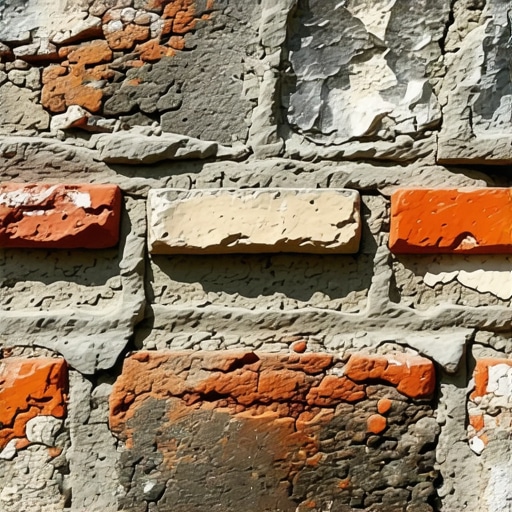
The Ghost of Craftsmanship Past
I remember walking onto a site in the old industrial district, a massive 19th-century warehouse that some developer thought he could ‘flip’ with a power washer and a bucket of cheap Portland cement. I put my fiber-optic scope into a hairline fracture near the corner of a load-bearing pier and what I saw was a graveyard. The structural steel lintels were rusted to flakes of orange dust, and the internal wythes of brick were literally turning back into sand. The homeowner thought it was just a cosmetic blemish, but the building was breathing its last. This is the reality of masonry forensics: the wall tells you everything if you know how to listen to the whisper of the lime.
The Physics of the Sacrificial Joint
To understand why your mortar is failing, you have to understand the fundamental physics of the wall. In a traditional masonry assembly, the mortar is the sacrificial lamb. It is designed to be softer and more permeable than the masonry units it holds together. This isn’t a flaw; it is a thermal relief valve. When the sun beats down on a South-facing wall, the bricks expand. When the temperature drops, they contract. If the mortar—the ‘mud’ as we call it on the hawk—is more rigid than the brick, that energy has nowhere to go. It doesn’t compress the mortar; it crushes the brick. This is why using modern, high-strength Type S cement on a 1910 facade is a death sentence for the building. True structural repointing requires a deep understanding of the modulus of elasticity.
“Mortar should always be weaker than the masonry units so that any cracks will occur in the mortar joints where they can be easily repaired by repointing, rather than in the masonry units.” – BIA Technical Note 7B
When we talk about the ‘tooth’ of the stone or the ‘suction’ of a dry-pressed brick, we are talking about the mechanical bond. If your mortar joints are receding more than a quarter-inch, the water is no longer shedding; it is pooling. This leads to the most feared phenomenon in the North: the freeze-thaw cycle. Water enters the joint, expands by 9% when it freezes, and exerts thousands of pounds of pressure per square inch. You’ll see the brick face literally pop off—that’s spalling. Once the hard-fired outer skin of the brick is gone, the soft interior ‘pulp’ dissolves. This is the point where you stop looking for a ‘handyman’ and start looking for emergency masonry repair before the wall begins to ‘belly’ out.
Identifying the Pathology of Failure
Look for the ‘stair-step’ crack. This is the classic symptom of settlement or foundation wall bowing repair needs. If the crack follows the mortar joints, the wall is still trying to move as a system. If the crack slices straight through the bricks themselves, you have a structural emergency. The load has exceeded the material strength of the clay itself. We often see this in brick arch restoration, where the original thrust lines of the arch have been compromised by shifting abutments. Repairing an arch isn’t about slapping some mortar in the gaps; it’s about re-establishing the geometric compression that keeps the keystone in place.
Then there is the issue of retaining wall batter correction. A retaining wall shouldn’t be vertical; it should lean back into the earth it holds. When you see a wall ‘tipping’ or losing its batter, it’s usually because the hydrostatic pressure behind the wall has nowhere to go. The weep holes are clogged, the drainage is non-existent, and the mortar is being pushed out from the inside. We’ve seen tuckpointing curved walls become a nightmare because the mason didn’t account for the radial tension in the joints. For those looking for the cutting edge, 3D printed masonry repairs are starting to fill the gaps in complex geometric failures, but for most historic homes, nothing beats a master with a slicker and a well-mixed batch of lime putty.
“The strength of a masonry wall is not in the hardness of its mortar, but in the integrity of its bond and the management of moisture.” – ASTM C270 Standards
The Craft of the Repoint: Butter, Mud, and Slickers
When I go to ‘butter’ a joint, I’m looking for the right consistency. It shouldn’t be ‘soupy’; it should stay on the trowel even if I turn it upside down. We grind out the old, failing joints to a depth of at least twice the width of the joint. You can’t just ‘smear’ new mud over the old—that’s a ‘lick-and-stick’ job that will peel off in two seasons. You have to get back to sound material. For high-end clients, we sometimes integrate metallic masonry finishes into the mortar to give a subtle, historic shimmer, or we deal with chimney flue liner installation while we are up on the scaffolding, because a chimney is just a vertical sewer for corrosive gases. If the mortar inside the flue is gone, the house is a fire trap.
Proper masonry repair services involve more than just aesthetics. It’s about chemical compatibility. In a world of ‘fast and cheap,’ the master mason is a forensic scientist. We test the existing mortar for lime-to-sand ratios. We match the color not with dyes that will fade in the UV light, but with the aggregate itself. This is the difference between a repair that lasts five years and one that lasts fifty. When you see your mortar turning to powder, or you see white salty stains (efflorescence) blooming on the surface, the building is crying for help. Ignore it, and you’re not just losing curb appeal; you’re losing the skeleton of your home.
[image-placeholder]