
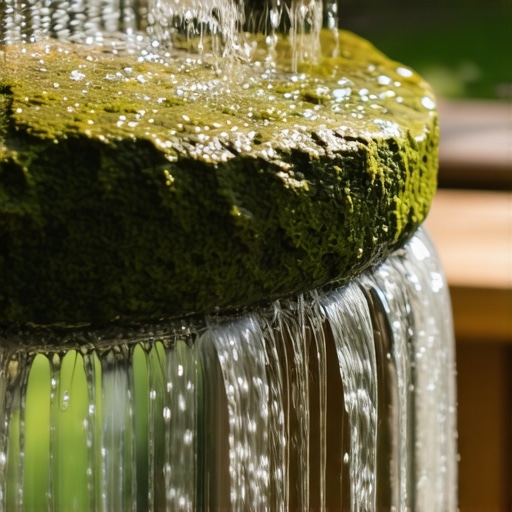
The Echo of the Stone: A Master’s Perspective
I remember watching my old man stand over a pallet of Indiana limestone destined for a tiered garden basin. He didn’t just look at the stone; he’d take his 10-ounce hammer and give each block a sharp, glancing blow. If the stone emitted a dull thud instead of a clear, metallic ring, he’d mark it with a red crayon and send it back. ‘That stone’s got a hidden fracture,’ he’d growl, ‘and water is a detective that never stops looking for a way in.’ That’s the reality of outdoor masonry fountain restoration. You aren’t just cleaning a pretty feature; you are performing surgery on a porous, breathing organism that has been drowning for decades. Most guys come in with a 4000 PSI pressure washer and a bag of high-strength Portland cement, thinking they’re doing a favor. In reality, they are signing the stone’s death warrant. When you blast the ‘skin’ off a piece of natural stone, you open up the capillary pores to aggressive salt crystallization and deep-seated biological rot. Restoration isn’t about making it look new; it’s about returning the structural logic to a system that has been compromised by time and chemistry.
“Water penetration is the single greatest threat to masonry durability.” – BIA Technical Note 7
The Physics of Porosity and the ‘Lick-and-Stick’ Trap
To understand stone wall repair in the context of a fountain, you have to understand subflorescence. This isn’t just the white powder (efflorescence) you see on the surface. Subflorescence happens when mineral salts are trapped just beneath the surface of the stone. As the water evaporates, these salts crystallize, expanding with enough force to pop the face right off your masonry—a process we call spalling. This is why tuckpointing weatherproofing is a double-edged sword. If you use a non-breathable sealant, you’re just trapping that moisture inside. The stone needs to breathe. In my thirty years of forensic inspections, I’ve seen more damage caused by ‘waterproofing’ than by the water itself. When we handle brick wall restoration or stone fountain work, we look at the ‘tooth’ of the material. A weathered stone loses its ability to grip new mud. You have to mechanically open the joints without shattering the internal crystalline structure of the surrounding block.
The Critical Art of Tuckpointing Curved Walls
Fountains aren’t flat. They are full of radii, ogees, and complex basins. Tuckpointing curved walls requires a different level of finesse than a standard chimney. You can’t just drag a standard slicker across a tight radius. You have to butter the joints with a specialized concave tool that matches the original profile. If the joint is too thick at the outer edge and thin at the back, the mortar will ‘bridge’ and fail within two seasons. This is where tuckpointing machine services often fail; a machine doesn’t feel the suction of the stone. A master mason feels the moisture being pulled out of the mortar and into the stone in real-time. If the suction is too high, the mortar ‘burns’—it loses its hydration too fast and turns into a crumbly mess that has no structural bond. We often pre-hydrate the stone for 24 hours, ensuring it’s saturated but surface-dry, to manage this thermal and chemical exchange.
“Mortar should always be weaker than the masonry units it binds, acting as a sacrificial element to protect the stone.” – ASTM C270 Standards
Why Drainage and Weep Holes Matter in Water Features
You’d think a fountain is designed to hold water, so drainage shouldn’t matter. Wrong. The ground behind a fountain or a retaining wall fountain build is constantly shifting. Retaining wall weep hole cleaning is perhaps the most neglected part of masonry maintenance. When those holes clog with silt or biological ‘slime,’ hydrostatic pressure builds up. That pressure can reach hundreds of pounds per square foot, eventually bowing the stone or forcing water through the mortar joints from the inside out. This leads to tuckpointing brick walls that fail prematurely because the moisture is attacking the bond from the back. In fountain restoration, we often install hidden chimney flue liner-style drainage channels or specialized weep tubes to ensure that internal condensation has an exit strategy. Without a way out, the freeze-thaw cycle will turn your stone into gravel.
The Restoration Process: A Step-by-Step Forensic Approach
We start by identifying the original mortar composition. Most historic fountains used a lime-rich mix, not the hard Type S cement found at big-box stores. Using a mortar that is harder than the stone is a cardinal sin. If the stone expands and the mortar doesn’t give, the stone breaks. Period. Our brick wall restoration and stone work always prioritize the ‘Sacrificial Principle.’ We want the mortar to fail before the stone does. When we perform a chimney rebuild services or a fountain overhaul, we grind the joints to a depth of at least twice the width of the joint. This ensures a deep mechanical ‘key.’ Then, we hand-pack the new mud in ‘lifts’ or layers, allowing each layer to reach initial set before adding the next. This prevents shrinkage cracks that are common in ‘handyman specials’ where the joint is slapped full in one go.