
The Echo of a Dying Facade
My mentor once told me that a building is a living organism. He didn’t mean it in some poetic, high-end architectural sense; he meant it literally. He would walk up to a hundred-year-old brick wall restoration project, press his palm against the clay, and tell you exactly how much ‘breath’ it had left. If he saw a wall that had been coated in a cheap, film-forming acrylic, he’d spit on the ground and walk away. He knew that the moment you seal a porous masonry surface with the wrong product, you aren’t protecting it—you are mummifying it while it’s still alive. I’ve spent thirty years carrying a hawk and a trowel, and I’ve seen the same tragedy repeated from historic downtowns to modern outdoor kitchen masonry builds. People see a little dampness and panic. They run to the big-box store, grab a bucket of ‘wet-look’ sealer, and slop it on like they’re painting a fence. They don’t realize they’ve just created a vapor barrier that will, in three to five winters, pop the faces off their bricks like bottle caps.
“Water penetration is the single greatest threat to masonry durability.” – BIA Technical Note 7
To understand why most sealants fail, you have to micro-zoom into the molecular structure of the material. A standard kiln-fired brick is a labyrinth of interconnected pores. When rain hits that wall, the brick doesn’t just sit there; it exhibits capillary suction. It drinks. But just as easily as it takes water in, it must be allowed to let it out as vapor. This is the ‘breathability’ or vapor permeance of the wall. When you apply porous stone sealers that are film-formers, you create a microscopic sheet of plastic over those pores. Liquid water might stay out, but vapor drive—driven by the sun heating the wall—forces moisture from the interior toward the exterior. That vapor hits the back of your ‘protection,’ can’t get out, and condenses back into liquid. Then the freeze-thaw cycle kicks in. Water expands by 9% when it turns to ice. That 9% expansion happens inside the ‘tooth’ of the brick’s surface, and the resulting pressure is enough to overcome the internal shear strength of the clay. That’s how you end up with spalling, where the beautiful red face of the brick falls off, leaving a soft, dusty orange core exposed to the elements.
The Chemistry of Protection: Silanes vs. Siloxanes
In the world of forensic masonry, we don’t use ‘sealants’ in the traditional sense; we use penetrating water repellents. We are looking for a chemical bond, not a physical coating. This is where silanes and siloxanes come into play. These molecules are significantly smaller than the pore structure of the brick. A silane molecule, for instance, is small enough to penetrate deep into the substrate—sometimes up to half an inch—where it reacts with the silica in the masonry to create a hydrophobic environment. It doesn’t plug the hole; it lines it. Imagine a pipe lined with wax; water can still pass through as a gas, but liquid water is repelled by surface tension. This is critical for stone coping installation and brick quoin repair, where the geometry of the masonry often leads to water pooling or high-stress concentrations.
“The use of water-repellent coatings should be approached with caution… they are not a substitute for proper design and flashing.” – ASTM C1403
When I’m looking at spalled concrete steps repair, I see the same physics at play. The patch material often fails because the ‘mud’ used for the repair has a different thermal expansion coefficient than the original slab. If you then seal that repair with a non-breathable product, you trap moisture at the ‘cold joint’—the interface between the old and new material. The hydrostatic pressure builds up until the patch simply delaminates. The same goes for stone veneer repair. Modern ‘lick-and-stick’ stone is notorious for trapping moisture behind the units because installers fail to provide a drainage plane. If you butter the entire back of a stone with advanced masonry adhesives and then seal the front with a film-former, you’ve built a vertical swimming pool. The moisture has nowhere to go but into your sheathing and studs.
The Process: Doing it Once vs. Doing it Twice
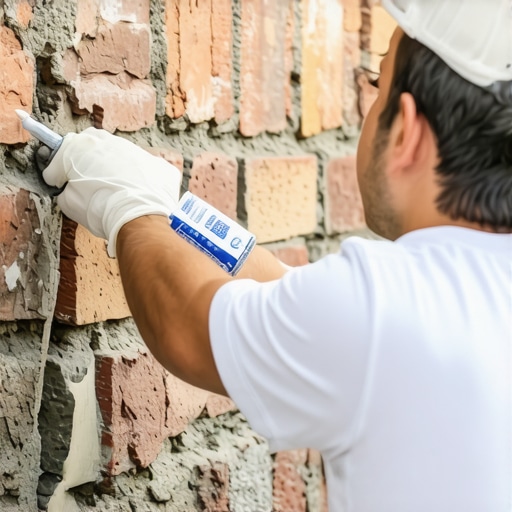
If you want to do this right, you start with the joints. You cannot seal your way out of a maintenance problem. If your mortar is crumbly, you need to grind it out and perform a proper repointing. I’m talkin’ about using a slicker to pack that mud in tight. Only after the mortar has cured and the pH has stabilized should you even think about a repellent. For masonry joint sand repair in paver systems, the same logic applies. You want a stabilizing sand that allows for drainage, not a solid slab of ‘poly-sand’ that acts like a dam. I’ve seen robotic masonry repair systems start to emerge in the industry that can laser-scan these voids, but even the best tech can’t override the laws of thermodynamics. You have to clean the substrate. If there’s efflorescence—that white, salty crust—it means the wall is already ‘bleeding’ salts. Sealing over efflorescence is like putting a bandage over an infected wound. You have to neutralize the salts, dry the wall completely, and then apply your repellent using a low-pressure ‘flood coat’ method. You start at the bottom and work up, or start at the top and let it run down eighteen inches, ensuring the material ‘bells’ out and soaks deep into the ‘tooth’ of the stone. This ensures that the outdoor kitchen masonry build you just spent ten grand on doesn’t look like a chalky mess in two years. [IMAGE_PLACEHOLDER] Don’t be fooled by the ‘handyman special’ advice. If a product promises a ‘high gloss’ or ‘enhanced color’ on a vertical brick wall, run the other way. You want a flat, invisible finish that keeps the water out but lets the building breathe. That is the difference between a repair that lasts a lifetime and a ‘fix’ that destroys the heritage of the home. Do it right, or don’t do it at all.