
The Anatomy of the Cap: Why Coping Stones Fail
In my forty years of swinging a hammer, I have seen the same tragedy play out on thousands of job sites: a beautiful stone wall or a poolside paradise slowly eaten from the top down. The coping stone is not just a decorative edge; it is the umbrella of your masonry structure. When that stone cracks, the umbrella has a hole, and the entire skeleton of the wall is at risk. Most homeowners see a hairline fracture and think it is an aesthetic nuisance. I see a gateway for hydrostatic pressure and the inevitable rot of the substructure. I remember my father taking me to a job in the dead of a New England winter. He pointed to a limestone cap that had literally exploded into three pieces. He told me, ‘The stone didn’t fail, the mason did. He choked the stone with a hard mud and gave the water nowhere to go.’ That stone had sucked up moisture like a sponge, and when the temperature dropped, that water expanded by 9%, blowing the stone apart from the inside out. This is the freeze-thaw cycle in its most violent form.
“Water penetration is the single greatest threat to masonry durability, specifically at horizontal surfaces where gravity accelerates the infiltration.” – BIA Technical Note 7
The Science of the Bond: Fiber-Reinforced Mortars and Suction
When you are performing a stone coping installation, you aren’t just laying a rock on a bed of wet sand. You are managing a chemical reaction. Most ‘lick-and-stick’ contractors use a standard Type N mortar for everything, but when you are dealing with the high-stress environment of a retaining wall or a chimney cap, you need the tensile strength of fiber-reinforced mortars. These mixes contain micro-strands of synthetic material that act like rebar on a microscopic level, preventing the crumbling mortar joint repair cycles that plague cheap work. Before you even think about putting ‘mud’ on a stone, you have to understand ‘suction.’ If you lay a dry, thirsty stone onto wet mortar, the stone will instantly rob the mortar of its hydration. This ‘burns’ the joint, leaving you with a cold joint that has no structural integrity. You have to dampen the stone to a ‘saturated surface dry’ state. It should look wet but have no standing water. This allows the cement crystals to grow into the pores of the stone, creating a mechanical lock that no winter can break.
The Mess-Free Surgical Strike: A Step-by-Step Recovery
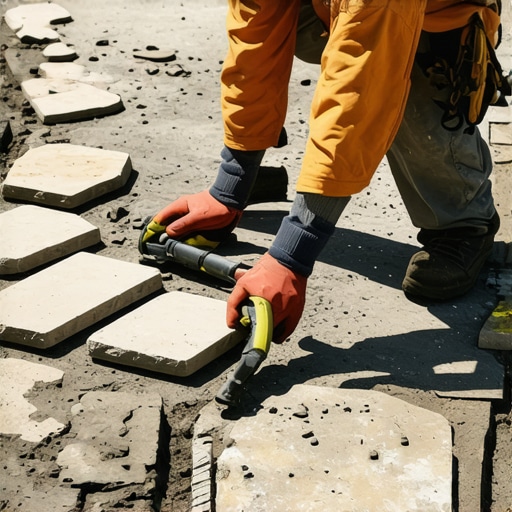
To replace a broken stone without ruining the rest of the wall, you have to be a surgeon, not a demolition man. The ‘mess’ usually comes from the dust of a dry saw or the ‘slop’ of stone coping installation. First, we use a shroud-protected diamond blade with a vacuum attachment to cut out the old crumbling mortar joint repair areas. We don’t just bash it with a sledgehammer; that sends shockwaves through the wall, creating new cracks five feet away. Once the stone is isolated, we use a small chipping hammer to vibrate the stone loose. This is where digital twin masonry projects are changing the game; for high-end historic restorations, we map the exact dimensions of the missing piece to ensure a zero-tolerance fit. After the old stone is out, you have to address the foundation waterproofing layer underneath. If the substrate is compromised, we apply a masonry waterproofing solutions membrane before the new stone goes down. We use a hawk and a slicker to ‘butter’ the back of the stone and the edges of the existing masonry. By using painter’s tape on the edges of the ‘good’ stones, we ensure that when we strike the joint, the excess mud doesn’t stain the face of the wall.
“The mortar shall be the sacrificial element of the masonry; it must be more permeable and softer than the masonry units it joins.” – ASTM C270 Standard Specification
Beyond the Stone: Structural Integrity and Reinforcement
If you are seeing multiple coping failures, your problem isn’t just the stones; it is the wall’s movement. This is where retaining wall reinforcement and foundation underpinning come into play. If the wall is heaving due to poor drainage, new coping will just crack again in twelve months. We look for honeycombing in the concrete core and ensure that chimney repair services include a proper drip edge. A coping stone without a drip edge is just a slide for water to run directly into your foundation waterproofing system. For modern builds, we are seeing a shift toward mortarless masonry systems that allow for thermal expansion without cracking, but for those of us who love the old ways, the secret is in the retaining wall reinforcement and the use of flexible sealants at control joints. Don’t let a ‘handyman special’ ruin your property’s value by using the wrong materials. High-performance masonry requires an understanding of physics, chemistry, and a deep respect for the materials that hold our world together. Do it once, do it right, or you’ll be paying me twice to fix the mess.