
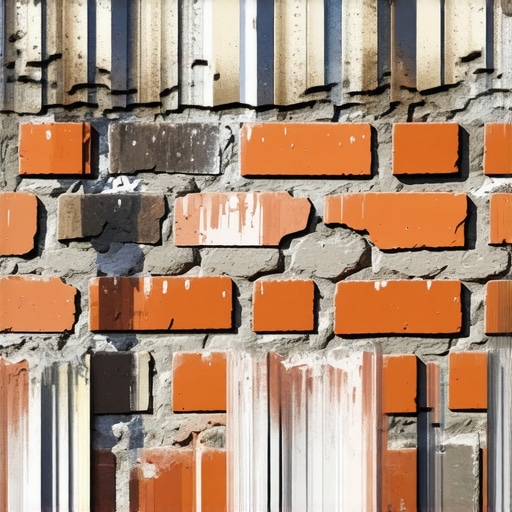
The Forensic Scene: The Silence of Structural Decay
The building manager called me out for what he described as a cosmetic nuisance. ‘Just a hairline crack,’ he said, pointing to a vertical fracture running through the soldier course of a mid-rise commercial block. To the untrained eye, it looked like a bit of settling. To me, it looked like a crime scene. I pulled out the borescope and slipped the fiber-optic lens into a weep hole that had been suspiciously dry for years. What I saw on the monitor wasn’t just brick and mortar. I saw a structural steel lintel that had oxidized so severely it looked like puff pastry—layers of rusted iron expanding and pushing the masonry outward. The structural steel was effectively being reduced to dust by a phenomenon known as ‘rust heave,’ fueled by moisture trapped behind a facade that was never allowed to breathe. This is the reality of modern masonry failure: by the time you see the crack, the battle is often already lost. Most contractors will tell you to just ‘caulk it and walk,’ but that is a death sentence for a commercial structure.
The Chemistry of Breathability: Why Mortar is a Sacrificial Lamb
In the world of forensic masonry, we talk about the ‘tooth’ of a brick—the microscopic pores that allow mortar to bite into the unit. When we perform a historic mortar analysis, we aren’t just looking at color; we are looking at the binder-to-aggregate ratio and the presence of lime. For over a century, lime-based mortars were the standard because they are ‘vapor permeable.’ They allow moisture to migrate out of the wall. Modern Portland cement, however, is often too dense and too hard. When a misguided mason uses a high-strength Type M mud to perform re-pointing services on an old commercial facade, they create a vapor barrier.
“Water penetration is the single greatest threat to masonry durability, as trapped moisture undergoes phase changes that can disintegrate even the strongest materials.” – BIA Technical Note 7
This lack of permeability leads to sub-fluorescence, where salt crystals grow inside the brick rather than on the surface, eventually blowing the face of the masonry off. In the freeze-thaw cycles of the North, this is catastrophic. When water trapped behind that hard cement freezes, it expands by 9%. Since the mortar won’t give, the brick must. That’s how you end up with spalling that destroys a 100-year-old exterior in less than a decade.
The Sin of ‘Lick-and-Stick’: Stone Veneer Over Brick
One of the most frequent forensic calls I get involves the disastrous trend of applying stone veneer over brick. It is the ‘handyman special’ of the commercial world. Here is the physics: brick is a reservoir cladding; it’s designed to get wet and then dry out. When you slap a thin-set stone veneer directly over it without a drainage plane, you are creating a sandwich of rot. I have seen foundation walls where the hydrostatic pressure from trapped water behind a veneer caused the interior plaster to bubble and peel. Without a proper air gap and weep system, gravity pulls that moisture down to the base, where it saturates the foundation waterproofing membrane. If that membrane has even a pinhole leak, the water finds its way into the rebar, causing ‘honeycombing’ and structural instability. It’s a cascading failure that starts with a bad aesthetic choice and ends with a failing retaining wall repair bill that can reach six figures.
Tuckpointing Curved Walls and the Geometry of Failure
When you are tuckpointing curved walls, the margin for error is non-existent. On a straight run, a mason can get away with a bit of ‘buttering’ and a quick pass with a slicker. But on a radius, the joint geometry changes. If the joint isn’t struck perfectly to shed water, the curve becomes a series of tiny shelves that catch rain. This is especially true with metallic brick colors application, where the surface tension of the glazed or metallic finish can actually pull water into the joints via capillary action. I’ve seen chimney sweep and repair jobs where the radius of the chimney was so poorly pointed that the water was literally funneled into the flue, rusting out the damper and compromising the masonry from the inside out. A proper re-pointing service on a curve requires a custom-ground hawk and a specialized jointer tool to ensure the mud is packed tight and the ‘tooth’ of the radius is fully engaged.
The Physics of Hydrostatic Pressure in Retaining Walls
A retaining wall installation isn’t a masonry project; it’s a hydraulic engineering project. Most guys just think about the weight of the stone, but I think about the weight of the water. Saturated soil can exert hundreds of pounds of pressure per square foot. When a wall fails, it’s rarely because the stone broke; it’s because the drainage failed. The ‘cold joint’ where the wall meets the footing is the first place I look during an inspection. If there isn’t a clear path for water to exit through weep holes, the wall becomes a dam. I’ve stood in front of massive commercial developments where the failing retaining wall repair involved excavating thirty feet of backfill because the original installer used ‘leftover material’ instead of clean 57-stone for drainage.
“The design of masonry must provide for the control of moisture and the movement of the structure to prevent distress.” – ASTM C270 Standards Commentary
You cannot fight gravity and you cannot fight water; you can only give them a controlled path to go where you want them to go.
The Verdict: Do It Once, or Do It Twice
Whether we are talking about chimney sweep and repair or a full-scale foundation stabilization, the rules of the Old World still apply. You cannot cheat the chemistry of the mud. You cannot ignore the vapor drive of the climate. If you are seeing white crusty powder—efflorescence—on your commercial masonry, don’t just wash it off. That is the building’s way of screaming that it has a fever. It’s a sign that foundation waterproofing is failing or that the internal drainage is blocked. Hire a professional who understands historic mortar analysis and knows that the ‘softness’ of a joint is its greatest strength. In this trade, there are no shortcuts—only long, expensive detours through the world of structural failure. Invest in the ‘mud’ today, or you’ll be investing in a demolition crew tomorrow.
{“@context”: “https://schema.org”,”@type”: “HowTo”,”name”: “How to Diagnose Trapped Moisture in Commercial Masonry”,”step”: [{“@type”: “HowToStep”,”text”: “Visual inspection for efflorescence or white salt deposits on the brick surface.”},{“@type”: “HowToStep”,”text”: “Use of a borescope to inspect the wall cavity through existing weep holes for rusted lintels.”},{“@type”: “HowToStep”,”text”: “Performing a historic mortar analysis to determine if the existing mud is vapor permeable.”},{“@type”: “HowToStep”,”text”: “Checking for spalling or ‘blown’ brick faces, indicating freeze-thaw damage from trapped water.”}]}