
The Whisper of Failing Clay: A Forensic Discovery
I was belly-crawling through the lightless void of a 19th-century warehouse crawlspace, the smell of ancient damp and pulverized lime filling my lungs. The client called me because of a ‘slight tilt’ in the mahogany floorboards upstairs, but what I found was a structural masonry inspection nightmare. I directed my headlamp at a central load-bearing pier. To the untrained eye, it looked stable, but a single hairline crack, no wider than a piece of heavy thread, ran vertically through the heart of the stack. I reached out and touched the brick; it felt cold, slick, and lacked the ‘tooth’ of healthy masonry. When I inserted a high-definition borescope into the fissure, I didn’t find solid clay. I found a hollowed-out husk. The internal common bricks had literally turned to dust because a previous contractor used a high-strength Portland cement for a quick patch—a classic ‘handyman special’ that trapped moisture and suffocated the soft, historic core. This wasn’t just a crack; it was a tombstone for a pier that had carried the building’s weight for 120 years.
The Physics of the Vertical Split
When we talk about hairline cracks in load-bearing piers, we aren’t just looking at an aesthetic blemish. We are looking at a fundamental failure in the distribution of compressive forces. In a healthy pier, the load is distributed evenly across the entire surface area of the masonry unit. However, when we see vertical cracking, it often indicates ‘eccentric loading’ or a failure of the internal core. Unlike horizontal cracks, which usually signal lateral movement or hydrostatic pressure, vertical splits mean the brick itself is being pushed beyond its crushing strength. This is where BIM masonry projects become invaluable; by modeling the exact load paths, we can see how even a minor shift in the foundation can concentrate tons of pressure onto a single square inch of brickwork. This concentration of force leads to micro-fissures in the clay lattice, eventually resulting in a catastrophic snap.
“The presence of cracks in masonry is not always indicative of structural failure, but vertical cracking in concentrated load areas often signals an exceedance of the masonry’s compressive strength.” – BIA Technical Note 18A
The Chemistry of Mortar: Why Soft Beats Hard
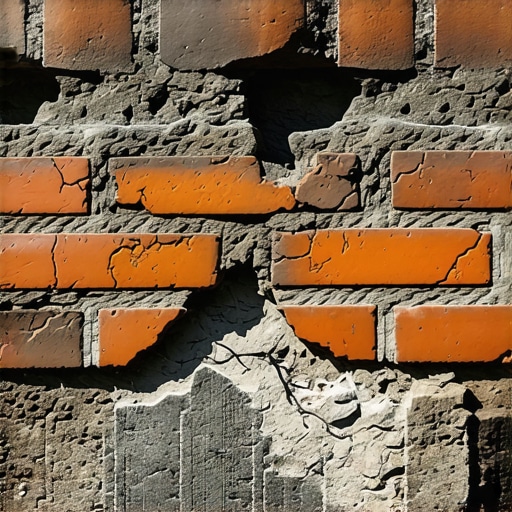
Most modern masons love ‘mud’ that sets up fast and hard. They reach for Type S or Type M Portland cement because it’s easy to butter and flick onto the head joints. But if you’re working on a historic pier, that hard mortar is a death sentence. Old-world bricks were fired at lower temperatures, making them softer and more porous than the ‘clinker’ bricks of today. Masonry is meant to breathe. The mortar joint is the ‘sacrificial lamb’ of the wall. It must be softer than the brick so that when the building shifts—and it will shift—the mortar gives way, not the brick. When you use a dense, impermeable mortar, you create a ‘cold joint’ where moisture becomes trapped. During a freeze-thaw cycle, that water expands by 9%, and because it can’t escape through the hard mortar, it blow-outs the face of the brick, a process known as spalling. This is why professional mortar matching services are not a luxury; they are a structural necessity to ensure the chemical compatibility of the repair.
[IMAGE_PLACEHOLDER]
Hydrostatic Pressure and the Foundation Link
You cannot talk about piers without talking about the foundation and the soil that supports it. Often, a crack in a pier is merely a symptom of a larger issue with the modular retaining walls or the perimeter drainage. If the soil around the foundation becomes saturated, it can lead to ‘heaving’ or ‘subsidence,’ causing the piers to tilt. This is when we see the need for retaining wall batter correction. If a wall is leaning—out of ‘plumb’ or lacking the proper ‘batter’—the entire structural load of the property shifts. Water is the architect of ruin. Without robust masonry waterproofing solutions and the correct brickwork sealants application, moisture will migrate from the soil into the pier via capillary action. This ‘rising damp’ carries salts that crystallize on the surface, requiring brick efflorescence removal, but more importantly, it weakens the internal bond of the clay itself.
“Mortar should always be weaker than the masonry units it binds to ensure that stress-induced cracks occur in the replaceable joints rather than the units themselves.” – ASTM C270 Standard Specification
The Restoration Process: From Hawk to Slicker
Fixing a compromised load-bearing pier is an exercise in patience and precision. You don’t just slap some mud in the crack. First, we must stabilize the load, often using temporary shoring. Then, we grind out the failed joints—never using a circular saw, which can nick the brick, but using a hammer and a narrow chisel. We mix a lime-rich mud that matches the original color and texture. I take my hawk, pile it high with a well-tempered batch, and begin to butter the joints. You have to ensure ‘suction’—if the brick is too dry, it will suck the moisture out of the mortar too fast, leading to a ‘flash set’ and a brittle bond. Once the mortar is thumbprint hard, I use a slicker to strike the joint. This compacts the mortar against the ‘tooth’ of the brick, creating a weather-tight seal that still allows the masonry to breathe. For those looking for a modern aesthetic touch on non-load bearing elements, we might consider a metallic brick colors application, but for structural piers, the focus remains 100% on mineralogical compatibility.
When to Panic: The Triage of Masonry
Not every crack is a disaster, but vertical cracks in a pier are high-priority. If you can fit a nickel into the crack, or if you see ‘honeycombing’ in the mortar joints, the structural integrity is compromised. A ‘soldier course’ of bricks that is leaning outward is another red flag. In these cases, the solution isn’t a bucket of caulk; it’s a forensic intervention. We look at the holistic system—from the drainage at the footer to the capstone on the chimney. By the time I’m done with a site, I want that pier to ring like a bell when you tap it. Anything less is just ‘lick-and-stick’ masonry that won’t last a decade. Do it once, do it right, and respect the stone.