
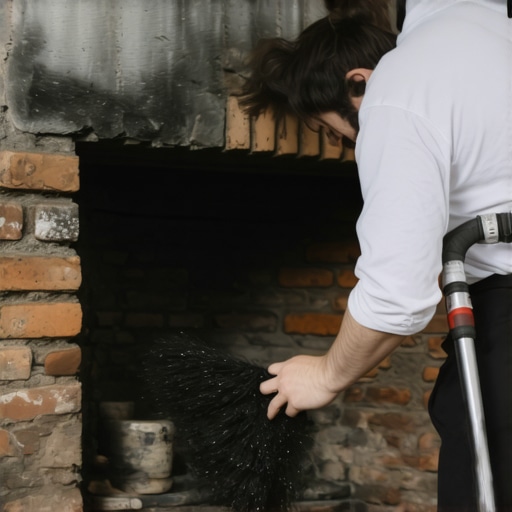
The homeowner called me out because of a ‘black ghost’ haunting their living room—a massive, greasy soot stain bleeding from the firebox up to the crown molding. They thought it was just an aesthetic nuisance. But when I put my scope inside the flue and ran my fingers over the header, I saw the real tragedy: the structural steel lintel was rusted to a crumbling orange dust, and the soot was actually masking deep, thermal-stress cracks in the firebrick. What started as a request for a simple scrub-down turned into a forensic autopsy of a failing chimney system. Most people look at a fireplace and see a cozy weekend feature; I see a complex thermal engine made of clay, lime, and minerals that is constantly trying to tear itself apart through expansion and contraction.
The Micro-Physics of Soot and the Brick’s ‘Tooth’
To understand why you can’t just slap some soap on a brick and call it a day, you have to understand the microscopic landscape of the material. A kiln-fired brick isn’t a solid, impenetrable block; it is a forest of capillaries and pores. When you burn wood, you aren’t just creating heat; you are releasing unburned carbon, resins, and acidic gases. These particles are jagged. On a molecular level, they wedge themselves into the ‘tooth’ of the brick. If you approach this with the wrong chemistry, you don’t clean the brick—you drive the carbon deeper into the substrate, permanently staining the masonry. This is why I cringe when I see a ‘handyman special’ involving a power washer or harsh muriatic acid on interior masonry. You’re not just cleaning; you’re eroding the very face of the unit.
‘The removal of heavy soiling should be accomplished with the least aggressive method possible to avoid damaging the masonry units or the mortar joints.’ – BIA Technical Note 20
The Forensic Cleaning Process: Step-by-Step
Before you ever touch water to the brick, you have to respect the suction. If the brick is dry, it will drink whatever liquid you put on it. If that liquid is full of dissolved soot, you are essentially ‘tattooing’ the fireplace. Step One: Vacuuming the Surface. Use a HEPA-rated vacuum with a brush attachment to remove the loose ‘friable’ carbon. Do not rub; dab. You want to lift the soot out of the pores, not grind it in like you’re buttering a joint. Step Two: Pre-Wetting. We use deionized water to saturate the brick. This fills the capillaries with clean water, so when the cleaning agent is applied, it stays on the surface where the soot lives. Step Three: The Chemical Pull. For historic masonry, I avoid modern surfactants that leave behind salts. A mix of Trisodium Phosphate (TSP) and hot water is the industry standard for a reason, but it must be handled with the respect it deserves. Use a stiff natural-bristle brush—never wire, as wire will leave behind metal fragments that rust and cause ‘spalling’ later.
The Structural Reality: Why Cleaning Reveals the Truth
Once the soot is gone, the real forensic work begins. Many times, the cleaning process reveals that the full repointing services are long overdue. You’ll see the mud (mortar) in the back hearth has turned to sand. In older homes, this is often because of the sulfur in the soot reacting with the lime in the mortar, a process that turns the binder into gypsum, which has no structural integrity. If you see honeycombing in the mortar joints or if the brick quoin repair on the exterior is showing signs of separation, you aren’t just looking at a cleaning job; you’re looking at a structural intervention. This is where tuckpointing curved walls inside a firebox becomes an art form. You need a slicker and a steady hand to strike those joints so they shed any future creosote rather than trapping it.
‘Mortar should always be softer than the masonry units it binds, acting as a sacrificial element to accommodate thermal movement.’ – ASTM C270 Standards
Advanced Maintenance: Beyond the Scrub
A clean fireplace is useless if the chimney cap replacement was ignored and water is pouring down the flue every time it rains. In my decades of chimney sweep and repair, I’ve seen more fireplaces destroyed by water from the top than by fire from the bottom. When water mixes with soot, it creates a highly acidic paste that eats through the flue liner and attacks the concrete pump masonry mixes used in the crown. For those dealing with high-rise structures or larger estates, commercial masonry facade maintenance often includes robotic masonry repair for the hard-to-reach areas of the stack, ensuring that the internal cleaning isn’t undone by external failure. We are even seeing sustainable block cutting techniques being used to replace heat-damaged hearth stones with reclaimed materials that have already survived a century of thermal cycles.
The Final Strike: Preserving the Craft
Don’t fall for the ‘spray-on, walk-away’ cleaners sold at big-box stores. They often contain bleach which reacts with the minerals in the clay to create efflorescence—that white, powdery salt that ruins the look of a soldier course header. If the brick doesn’t ‘ring’ when you give it a light tap with a hawk or a trowel handle, it’s ‘blown’ internally and no amount of cleaning will save it. At that point, you’re looking at masonry repair services to rebuild the firebox. Do it once, and do it right. Use a proper mud mix, ensure your chimney cap is sealed, and treat the brick with the respect its history demands. Anything less is just putting a bandage on a broken leg. “