
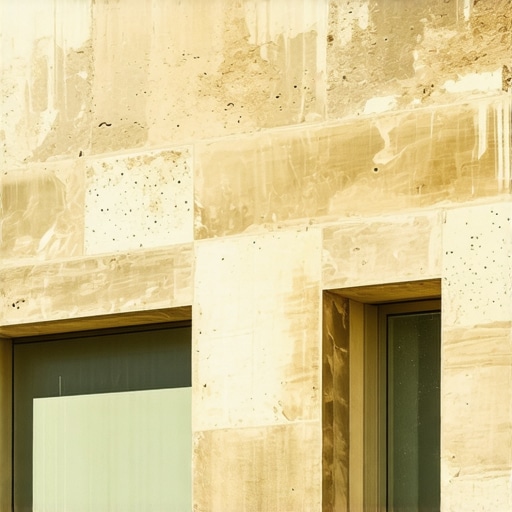
The Forensic Scene: When the Stone Starts to Bleed
The homeowner called me out because she thought her 1890s sandstone entryway was just ‘getting dusty.’ She had hired a local handyman the year before to brighten it up, and he had applied a glossy, film-forming driveway sealer he had leftover from another job. When I knelt down and put my digital scope into a hairline fracture, the reality was grim. Behind that plastic-like sheen, the sandstone was no longer stone; it had the consistency of wet flour. The structural integrity had been liquidated. Because the stone couldn’t breathe, moisture was trapped behind the sealer, and the natural salts were chewing the silica binder to pieces from the inside out. This is the nightmare of modern masonry: applying 21st-century ‘fixes’ to 19th-century physics without understanding the tooth of the material.
The Molecular Battleground of Sandstone
Sandstone is a sedimentary beast. It is a collection of quartz and feldspar grains held together by a mineral cement—usually silica, calcium carbonate, or iron oxide. Unlike concrete, which is a dense, synthetic matrix, sandstone is a series of interconnected capillaries. It is a lung. When we talk about the best porous stone sealers for sandstone facades, we aren’t talking about ‘sealing’ the stone in the sense of a Ziploc bag. We are talking about altering the surface tension of the pores. If you use a film-forming brickwork sealants application on a historic facade, you are signing its death warrant. The physics are simple: water vapor must be able to escape. If it can’t, the hydrostatic pressure during a temperature spike will literally blow the face off the stone, a process we call spalling.
"Water penetration is the single greatest threat to masonry durability, yet the improper application of non-breathable coatings often accelerates the very decay it intended to prevent." – BIA Technical Note 7
The Chemistry of Protection: Silanes and Siloxanes
In my forty years of hauling a hawk and mud, I’ve seen the evolution of chemical treatments. The only acceptable path for sandstone is a penetrative, vapor-permeable repellent. We look for silanes or siloxanes. These molecules are small enough to butter the internal walls of the stone’s pores without clogging them. They create a hydrophobic environment that repels liquid water while allowing water vapor molecules—which are significantly smaller—to pass through. This is the ‘sacrificial’ logic of the old masters. We want the protection to happen deep within the matrix, not on the surface. If you see a ‘wet look’ sealer being brought onto a historic job site, fire the contractor immediately. Historic brick salvage and stone restoration require a matte finish that preserves the natural refractive index of the mineral grains.
The Prerequisite: Re-pointing and Surface Prep
You cannot seal a failing wall. Before a drop of repellent touches the stone, the re-pointing services must be executed with surgical precision. This isn’t just about aesthetic ‘tuckpointing.’ It’s about re-pointing services that use a mortar softer than the stone itself. If you use a high-Portland cement mud on soft sandstone, the stone will break before the mortar does. We use Type O or lime-putty mixes to ensure the joints act as the moisture exit ramp. Once the joints are struck with a slicker and the brick efflorescence removal is complete—using a mild acetic solution or specialized ion-exchange cleaners—only then can we discuss sealing. If you see white powdery salts on the surface, that is the stone’s way of screaming that it has a hydration problem. Sealing over efflorescence is like painting over rust; it’s a vanity move that masks a structural cancer.
The Physics of the Vertical Plane: Retaining Walls and Batter
When we move from the facade to the landscape, the engineering changes but the chemistry remains. I often perform AI masonry assessment on failing garden walls where the retaining wall batter correction is needed. A wall that is ‘leaning’ is often suffering from hydrostatic pressure. If the drainage isn’t right, no sealer in the world will save it. We use retaining wall reinforcement like geogrid or helical anchors, but the stone wall repair always comes back to moisture management. For a retaining wall block replacement, we ensure the new units match the porosity of the old, or the ‘cold joint’ between the new and old sections will become a focal point for freeze-thaw cracking. Concrete flatwork services often fail here too, by pouring slabs that drain toward the stone foundation, forcing the sandstone to absorb an impossible volume of groundwater.
"Masonry units must be compatible in both compressive strength and thermal expansion coefficients to prevent localized stress concentrations." – ASTM C270 Standards
The Micro-Zoom: Why Water Expands
Let’s talk about the 9%. When water freezes, it expands by nine percent of its volume. In a porous stone like sandstone, if those capillaries are full of liquid because a cheap sealer has blocked the exit, that 9% expansion exerts thousands of pounds of pressure per square inch. This isn’t just a crack; it’s a microscopic explosion. This is why concrete flatwork services in northern climates require air-entrainment—tiny bubbles that act as ‘relief valves.’ Sandstone doesn’t have these valves naturally, so the brickwork sealants application must ensure the stone stays as dry as possible. A ‘beading’ effect on the surface is nice, but the real victory is a dry core. If the stone feels damp to the touch an hour after a rain, your sealer has failed, or it was the wrong spec for the stone’s ‘suction’ rate.