
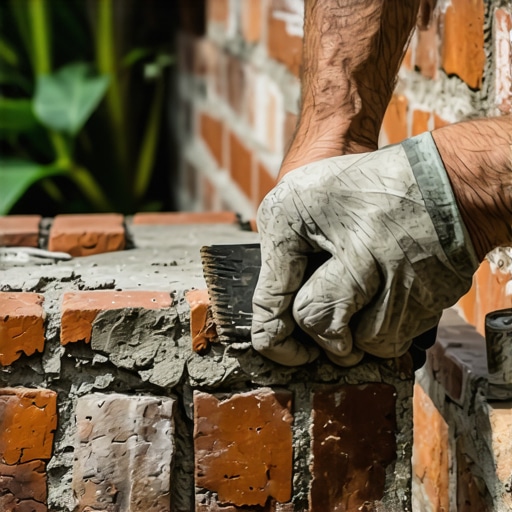
The Forensic Mason: Why Sustainable Tuckpointing Mortars are the Only Cure for Dying Brickwork
I was standing in the damp crawlspace of an 1880s Victorian, my flashlight catching the glint of what the homeowner called ‘wall dust.’ To the untrained eye, it looked like a bit of salt. To me, it was a crime scene. I pulled out my digital borescope and threaded it into a hairline fracture in the mortar. What I saw was a catastrophe: the structural common brick was literally turning into red sand behind a facade of hard, grey Portland cement. This is the ‘Forensic Scene’ I walk into weekly. A previous ‘handyman’ had used a high-strength Type S mortar for a quick patch job, effectively sealing the wall’s fate. By using a material harder than the brick itself, they had turned the mortar from a protector into a weapon. This is where the physics of masonry either saves a building or destroys it. If you want to stop the rot, you have to understand why sustainable masonry materials and proper historic mortar analysis are not just ‘green’ choices—they are structural imperatives.
The Physics of the Sacrificial Joint
In the world of old-world masonry, we follow a golden rule: the mortar must always be softer and more permeable than the masonry unit. This is the ‘sacrificial principle.’ When a wall breathes, moisture moves through it. If the mortar is breathable, the moisture evaporates through the joints. If the joints are choked with modern, non-porous ‘mud,’ that moisture gets trapped behind the face of the brick. When the temperature drops, that water expands by 9%, and it takes the face of your brick with it. This is called spalling.
“Mortar should be weaker than the masonry units so that any cracks occur in the mortar joints where they can be easily repaired.” – BIA Technical Note 1
Switching to sustainable tuckpointing mortars, specifically those based on Natural Hydraulic Lime (NHL) or high-calcium lime putty, restores this balance. Unlike Portland cement, which creates a rigid, brittle bond, lime-based mortars are flexible. They allow for the micro-movements of a century-old foundation without cracking. They don’t just sit there; they work with the building.
Micro-Zoom: The Chemistry of Carbonation vs. Hydration
Modern mortars harden through a process called hydration—a rapid chemical reaction that creates a crystalline structure almost overnight. It’s fast, it’s cheap, and for historic brick, it’s deadly. Sustainable, traditional mortars harden through carbonation. As the lime mortar sets, it slowly re-absorbs carbon dioxide (CO2) from the atmosphere, effectively turning back into limestone over months and years. This slow-motion petrification creates a ‘self-healing’ property. When a micro-crack forms in a lime joint, moisture dissolves a tiny amount of free lime and redeposits it into the crack, sealing it. You won’t get that from a bag of big-box pre-mix. This is why full repointing services must always begin with a historic mortar analysis. We take a sample of the original ‘mud,’ dissolve the binder in acid, and examine the sand’s graduation and the binder’s chemistry. You can’t just ‘butter’ a joint and hope for the best; you have to match the ‘tooth’ of the original material.
The Truth About Fiber-Reinforced Mortars and Concrete Repair
While I’ll fight you in the street over using Portland on an 1890s arch, there is a place for modern tech in spalled concrete steps repair. This is where fiber-reinforced mortars earn their keep. Concrete is a beast in compression but a coward in tension. When we are dealing with high-traffic areas like steps or structural landings, we use mortars infused with micro-synthetic fibers. These fibers act like a secondary skeleton, arresting the micro-cracks that lead to total failure. It’s about choosing the right tool for the forensic reality of the site. If I’m doing an outdoor fireplace rebuild, I’m looking at thermal shock. A standard mortar will ‘flash set’ and crumble under the heat of a few good oak logs. You need a sustainable, heat-stable mix that can expand and contract without losing its grip on the firebrick.
Structural Geometry: Brick Arch Restoration
A brick arch restoration is where masonry becomes high-stakes physics. An arch is a constant conversation between gravity and lateral thrust. Every brick—the ‘intrados’ at the bottom and the ‘extrados’ at the top—is fighting to push outward. The mortar is the diplomat keeping the peace. When an arch starts to fail, it’s usually because the mortar has washed out or someone used a rigid ‘slicker’ to pack in a hard cement that didn’t allow for the arch’s natural ‘heave.’ We have to carefully rake out the joints, often using hand tools to avoid vibrating the keystone loose, and then inject a sustainable, flowable lime mortar that fills the voids without creating ‘cold joints.’ This is re-pointing services at its most technical.
“The use of high-strength Portland cement mortars with older, softer bricks is a primary cause of masonry deterioration.” – National Park Service, Preservation Brief 2
The Retaining Wall Reality
I often get calls for retaining wall block replacement. Usually, it’s a ‘wavy’ wall where the homeowner tried to save a few bucks. The physics here is simple: hydrostatic pressure. If your mortar isn’t breathable and your drainage is clogged, the earth behind that wall will eventually push it into the yard. Sustainable masonry isn’t just about the mix; it’s about the system. We use porous mortars and proper ‘weep holes’ to ensure that the wall isn’t a dam, but a filter. If you’re looking at a masonry damage assessment and see horizontal cracking in a retaining wall, you aren’t looking at a ‘minor issue’; you’re looking at a structural surrender. You do it once with the right materials, or you do it twice and pay me double the second time.
The Long Game
There is a gritty satisfaction in full repointing services done right. It’s the smell of the wet lime, the weight of the hawk in your hand, and the knowledge that the wall you just ‘slicked’ will be standing long after you’re gone. Modern construction is obsessed with ‘seamless’ finishes and ‘game-changing’ speed. Forensic masonry is about the slow, deliberate application of science and sweat. When you switch to sustainable mortars, you aren’t just being ‘eco-friendly.’ You are respecting the chemistry of the stone and the legacy of the craft. Don’t let a ‘handyman’ with a bag of cheap cement turn your home’s history into a pile of red dust. Get a historic mortar analysis, use the right mud, and let the building breathe again.