
The Forensic Scene: When the Corner Tells a Lie
The homeowner thought it was just a hairline crack, a minor blemish on the corner of a 1920s limestone estate. But when I put my scope inside that fissure, I saw the structural steel was rusted to dust, expanding with enough force to pop the face off a three-hundred-pound block. This wasn’t just a cosmetic issue; it was a slow-motion explosion. That corner quoin, meant to be the anchor of the entire masonry mass, was literally unzipping from the building. Most modern guys would slap some epoxy in there and call it a day, but that’s a death sentence for historic stone. To save a facade, you have to understand the physics of the corner and the chemistry of the stone itself.
The Structural Anatomy of a Quoin
Quoins aren’t just for show. In traditional masonry, they are the ‘teeth’ that lock the two planes of a wall together. Whether we are talking about brick quoin repair or solid stone restoration, these units handle the highest concentration of stress. They are the transition points for thermal expansion and the first line of defense against the wind-driven rain that hammers a building’s corners. When you see a quoin ‘sugaring’—turning back into sand at the touch of a finger—you aren’t just looking at weathering; you are looking at a failure of breathability. This is why historic mortar analysis is the first tool I grab, not a chisel. If the previous guy used a high-strength Portland cement for tuckpointing cost estimation savings, he effectively trapped moisture inside the softer limestone. As that water tries to escape, it hits the wall of hard cement and stays in the stone. When the temperature drops, that water expands by 9%, and the face of your historic stone ends up on the sidewalk.
“The use of mortar that is harder or less permeable than the masonry units themselves is a primary cause of accelerated deterioration in historic masonry systems.” – ASTM C1713 – Standard Specification for Manufactured Culvert and Storm Drain Units
The Physics of Stone Decay: Why Re-Carving is Necessary
We need to talk about sub-florescence. Unlike efflorescence, where salts migrate to the surface and leave a white powder, sub-florescence happens when those salts crystallize just below the surface of the stone. The pressure of that crystallization can reach thousands of pounds per square inch, shattering the stone’s internal matrix. This is why we can’t just ‘patch’ a quoin. A patch is a ‘cold joint’ waiting to fail. To truly restore the integrity of the corner, we have to talk about re-carving or the ‘Dutchman’ repair. Re-carving involves removing the ‘cancerous’ stone until we hit the ‘heart’—the sound, un-weathered material that still has its original density. It requires a tactile understanding of the stone’s grain. If you fight the grain, the stone will ‘run’ or ‘pluck,’ leaving you with a jagged mess instead of a clean margin.
The Master’s Process: From Mud to Margin
Before I even touch a mallet, I look at the surrounding masonry joint sand repair and the overall stability of the structure. If the corner is sinking, you don’t need a carver; you need foundation underpinning. But if the bones are good, we start with the ‘relief’ cuts. We use a diamond blade to score the damaged area, being careful not to generate too much heat, which can micro-fracture the stone. Then comes the ‘hawk’ and the ‘slicker.’ We aren’t just ‘buttering’ the stone; we are creating a new profile. If the damage is deep, we use high-performance mortar mixes that are specifically engineered to mimic the modulus of elasticity of the original stone. We’re talking about lime-based mixes that ‘breathe.’ I mix my ‘mud’ to a stiff consistency—if it doesn’t hang off the trowel, it’s too wet. We apply it in layers, allowing the ‘suction’ of the stone to draw out excess moisture, locking the new material into the ‘tooth’ of the old. While we wait for the set, we might look at other vulnerabilities, like chimney damper repair or green roofing masonry integration, because water from the top is the enemy of the bottom.
Tools of the Trade: The Art of the Strike
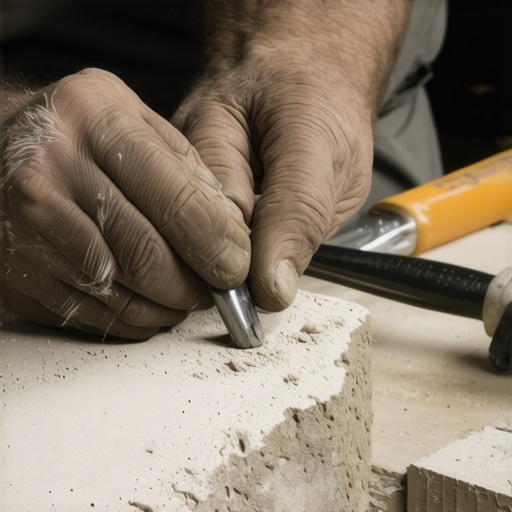
Re-carving is about shadows. A quoin looks like a quoin because of the ‘margin’—that flat, smooth border around the rock-faced center. To recreate this, I use a ‘toothed’ chisel (a boucharde) to create the texture, then follow up with a flat chisel to ‘strike’ the margin. It’s a rhythmic process. You feel the vibration through the handle. If it feels ‘dead,’ you’ve hit a pocket of decay. If it ‘rings,’ the stone is sound. This is where modern modular masonry construction fails to compare; there is no soul in a pre-cast block. We also have to consider brick veneer installation on modern additions to these historic homes. Often, the tie-ins are done incorrectly, creating a ‘dam’ that redirects water right into the historic quoins. A real pro looks at the whole building as a hydraulic system.
“Water penetration is the single greatest threat to masonry durability, particularly at the vulnerable intersections of walls and corners.” – BIA Technical Note 7
The Ethics of the Edge: Preservation vs. Replacement
People ask me about tuckpointing cost estimation all the time, but they rarely ask about the cost of doing it wrong. If you hire a guy who uses a grinder to ‘clean out’ joints on a historic stone corner, he’s going to nick the edges of the quoins. Once that ‘fire-skin’ of the stone is broken, the rate of decay triples. Re-carving is a surgical intervention. It’s about preserving the ‘patina’ while restoring the ‘profile.’ We don’t want the building to look brand new; we want it to look well-cared for. That means matching the aggregate in the mortar, the pigment of the stone, and the specific ‘tool marks’ left by the mason a hundred years ago. It’s a job for a forensic mind and a master’s hand. You do it once, or you do it twice—and the second time usually involves a lot more rubble.